Reading view

There are new articles available, click to refresh the page.

CuriosiD: Which communities are considered “Downriver”?

Have you ever wondered which communities in Metro Detroit are part of the Downriver area, and how it got that name?

Listener Scott Troia of Ann Arbor wonders.

I was curious about where the term ‘Downriver’ originated from: Who, when, why they started using it. Is it a geographic boundary, or is it cultural? Who identifies as being from Downriver?”

WDET’s Pat Batcheller does. He was born and raised in Trenton and has lived in Southgate with his wife Amy since 1999. Pat’s happy to answer Scott’s question.

What does “Downriver” mean?

Elizabeth Park sits along the Detroit River in Trenton, Michigan.

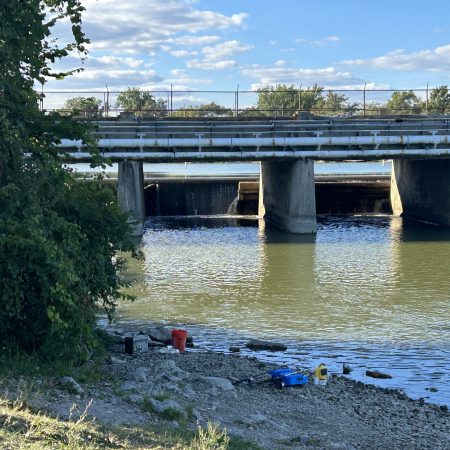
As the name suggests, Downriver refers to those communities on the Detroit River as it flows down into Lake Erie. Humans have lived in the area for thousands of years. The term Downriver is more recent. It appears as two words in a 1917 magazine published by the city of Wyandotte. In 1963, Thomas J. Anderson wrote a book called “The History of Southgate and Downriver”—one word. Today, the term covers a lot more territory than just the riverfront.

Which communities make up Downriver?

That depends on who you ask. Lisa Wayne is the CEO of the Downriver Community Conference. The nonprofit helps people find jobs through the Michigan Works program. It also coordinates grants for its 20 member communities. 

“We serve Allen Park, Brownstown, Dearborn, Dearborn Heights, Ecorse, Flat Rock, Gibraltar, Grosse Ile, Huron Township, Lincoln Park, Melvindale, River Rouge, Riverview, Rockwood, Romulus, Southgate, Taylor, Trenton, Woodhaven and Wyandotte,” Wayne says.

The DCC started with 11 communities and includes Dearborn and Dearborn Heights. Many consider those cities to be outside of the traditional definition of Downriver. Ron Hinrichs grew up in Dearborn but didn’t consider himself a Downriver resident. 

“I remember someone asking me once, ‘where are you from?'” Hinrichs recalls. “And I said, ‘I’m from Dearborn.’ And they said, ‘oh, so you’re—you’re from Downriver.’ And I said, ‘I’m not from Downriver, I’m from Dearborn.'”

Hinrichs leads the Southern Wayne County Regional Chamber, which promotes the Downriver area. He says if you ask ten people where Downriver is, you’ll get ten different answers.

Where does Downriver end?

Downriver does not have defined borders, but most descriptions stop at the Huron River separating Wayne and Monroe counties. That would make Rockwood part of Downriver, but not its next-door neighbor, South Rockwood, a village in Monroe County’s Berlin Township. Stephanie Hawkins is the president of the Berlin Charter Township Historical Society. She says if you ask South Rockwood residents, they’ll say they feel closer to Downriver than Monroe.

“They mentioned that when they want to do something like go shopping, they go north because it is closer than driving all the way down to Monroe,” Hawkins says. “So, I think that’s why you’ll find that the folks who live in the village itself do identify with being Downriver.”

So do people in Taylor, which is not on the Detroit River. Karl Ziomek is Taylor’s communications director and a former journalist at the area’s paper of record, the News-Herald. He recalls newsroom arguments about how far west Downriver reaches.

“And there are a lot of people I think to this day who would believe that Taylor is even stretching it,” Ziomek says. “Certainly, Romulus does. It goes on the other side of Metro Airport, then people start going, ‘well wait a minute, is this really Downriver?”

Pearl Varner laughs at the suggestion that Romulus is part of Downriver because of its distance from the Detroit River. Her family has lived in Romulus for over a century. She runs the city’s historical museum. But Varner says if it brings more visitors to the museum and the downtown area, she’s fine with being considered Downriver.

“You want people to come and see what you’re doing, what your museum is like, what your city is like, what your people are like,” Varner says.

What are people like Downriver?

Ted Butkin is a lifelong Wyandotte resident.

Each community is unique, but they all share common roots. Many are descendants of European immigrants who worked in factories or started their own businesses. Some settled in Wyandotte, where Ted Butkin has lived his whole life.

“We had a German festival, a Polish festival, a Mexican festival and there was one other that were just huge because everyone was represented in this melting pot of Wyandotte,” Butkin says.

Wyandotte is the second oldest incorporated city in Wayne County, after Detroit. Joe Gruber is the city’s economic development director. He says its vibrant downtown attracts people from Downriver and beyond.

Joe Gruber is Wyandotte’s economic and downtown development director.

“All of the small business owners and entrepreneurs in our community are really, really engaged and hard working,” Gruber says. “We try to offer a lot of fun quality-of-life events and opportunities for families to come, especially those events that are free.”

Anthony Beitel moved to Wyandotte a couple of years ago. Before that, he had lived in Detroit and the northern suburbs. Beitel says he didn’t know much about Downriver before relocating with his partner, who is from the area. He says he loves how people support the local economy.

“They have this whole ‘Shop The Dotte’ initiative, which is all about promoting small businesses,” Beitel says. “And it’s just really great to see that sense of community and everybody kind of supporting each other and lifting each other up.” 

Industry drove Downriver for decades, for better or worse

Small businesses have always been a vital part of the Downriver economy, but through much of the 20th century, heavy industry was the main source of jobs and tax revenue. It was also a major source of pollution, such as coal dust. Lisa Donovan lives in Brownstown Township but grew up in Wyandotte. She says sometimes when the wind blew, it turned houses black with ash.

“And they would have piles of coal next to the park in Wyandotte that’s on the waterfront, and you’d come home with ash on you.”

More: New book explains how working class shaped Downriver

Because of that, Donovan says some people—mainly outsiders—saw Downriver as a dirty place to live. That reputation lingered long after downturns in the automotive and steel industries forced many factories to close. Business and civic leaders suggested dumping Downriver in favor of something they thought sounded more attractive—Metro Shores. But, unlike coal dust, that name didn’t stick.

People have pride in Downriver, even those who are new to the area

Michael Echols moved from Detroit to Ecorse a couple of years ago. Ecorse started as one of Wayne County’s original townships in 1827. Today, the cities of Ecorse, Allen Park, Lincoln Park, Melvindale, River Rouge, Southgate, and Wyandotte comprise what used to be Ecorse Township.

Echols says Ecorse is a peaceful place.

“It’s a different variety of people down here, but it’s everybody getting on, and that’s the most beautiful part,” he says.

The river itself defines the region

John Hartig managed the Detroit International Wildlife Refuge for 14 years and has written several books about the Great Lakes.

Just a few hundred feet offshore from Ecorse is Mud Island, part of the Detroit River International Wildlife Refuge. John Hartig once managed the refuge, which includes Grosse Ile and the entire Michigan shore of Lake Erie. He says it took decades to repair the industrial damage to the environment and restore the river’s natural habitat.

“We’ve seen some dramatic improvements in water quality,” he says. “Bald eagles are back, and peregrine falcons, osprey, lake whitefish, lake sturgeon, river otter and beaver are back.”

Downriver has its own culture

Hartig says the river’s revival is changing perceptions of Downriver, its people, and its culture. Linda Francetich is trying to do the same. 15 years ago, she started a website called Discover Downriver to promote the area’s cultural activities, such as festivals and concerts. Francetich says the area might not have the vibe of Royal Oak or Birmingham, but that’s OK.

“Everyone has their own regional culture,” she says. “But I think Downriver has a very unique culture because of how close everybody is and how supportive everybody is.”

Francetich says Downriver has a lot of musical talent, including bands such as 50 Amp Fuse and the Transit Brothers. Chris French plays trumpet for the Transit Brothers and the Downriver Community Band. He also owns a family law firm and organizes yearly concerts to benefit Downriver veterans. French says the region has a lot to offer, including a variety of real estate.

“You want a farm, we have farms,” he says. “We’ve got water everywhere, so you can buy a house on the water.”

Some of the most impressive homes on the water are on Grosse Ile, which sits in the middle of the Detroit River. Tony Krukowski is the vice president of the Grosse Ile Historical Museum. He says the island’s scenery is a big draw.

“People just love to drive around the island, especially around East River Road and West River Road to take in the natural scene,” he says.

Two bridges connect Grosse Ile to the rest of Downriver.   Listener Scott Troia, who asked the question, says he understands the area better now that we’ve connected the dots for him.

“What are the boundaries of it and do people from different communities actually self-identify with being part of Downriver that might be on some of those fringe cities? You very much covered those topics, really.”

Thanks, Scott. It’s why we’re here. 

WDET’s CuriosiD series answers your questions about everything Detroit. Subscribe to CuriosiD on Apple PodcastsSpotifyNPR.org or wherever you get your podcasts.

We want to hear from you!

Have a question about Southeast Michigan’s history or culture? Send it our way at wdet.org/curious or fill out the form below. You ask, we answer.

Support the podcasts you love.

One-of-a-kind podcasts from WDET bring you engaging conversations, news you need to know and stories you love to hear. Keep the conversations coming. Please make a gift today.

The post CuriosiD: Which communities are considered “Downriver”? appeared first on WDET 101.9 FM.
New book explores how working class shaped Downriver

Metro Detroit’s Downriver area is where heavy industry meets nature, creating a complicated dynamic between the economy and the environment.

Steel mills and other factories that once lined the Detroit River employed thousands of people from River Rouge south to Rockwood. Workers enjoyed the benefits of well-paying manufacturing jobs that bolstered the middle class. But they also recognized the environmental threats those factories posed to the land, the water, and the air around them.

Labor unions and other groups fought to protect the Downriver area’s natural resources and the recreational opportunities they provided.

Michigan State University labor historian Lisa M. Fine has studied the working class’s relationship with the communities where they live. She studied those bonds and wrote a book about them. It’s called “Downriver Detroit: The Working Class, the Environment, and the Bonds of Place.”

WDET’s Pat Batcheller, a Downriver native, spoke with Fine about her research. Here’s a transcript of their conversation, lightly edited for clarity.

Listen: New book explores how working class shaped Downriver

Pat Batcheller: Why did you write the book?

Lisa Fine: I cast out to find a place where I could test my theories that working class people cared about not only the natural world around them, but also the community, the region, the place in which they lived. My first scholarly exploration was Pointe Mouillee, the game reserve down there. And it was to my great delight and surprise to find a site Downriver that the people of the region and beyond wanted to preserve once it became available for sale to the state, so that everybody publicly can hunt there for ducks or whatever else they wanted to hunt for.

And to me, that just seemed like a great validation in some ways, or sort of an invitation in many ways, to explore this throughout the entire region. I wanted to uncover the ways in which working class people living in a particular region expressed their identities and their actions through the things that define them by that region.

PB: And what do you think connects people to Downriver?

LF: Since I’m a historian, the first thing that I’ll say is I think it’s history. So for many people, like Native American communities or immigrants, it’s the ways in which the region has become their home, the ways they’ve been able to make a living there, to establish families and communities, and to create a working-class way of life. There’s such a powerful nostalgia that I uncovered.

These things were threatened during the 1960s and 70s because of the kind of employment, because of the kind of life that people could build, because of the place itself. It’s not a place that you would normally associate with natural beauty. But in fact, the people that live there do love the waterfront, and they do love the terrain and the spaces there. People connected to that as well.

PB: You mentioned Pointe Mouillee, which is only a few miles down the river from what used to be heavy industry. You still have Great Lakes Steel in Ecorse. But a couple of steel plants dried up. DTE Energy tore down its coal-fired power plant in Trenton not that long ago. You’ve got this balance that you have to strike between preserving the natural features and at the same time maintaining the tax base, the job base. How difficult was that for people to balance?

LF: It was a constant negotiation. Pointe Mouillee was originally an elite hunting ground owned by industrialists from all over the northeast. But then when it was being sold, there was a groundswell to make this available as a public space, which is incredible. Federal, local and state funds became available to do that.

But there were also other developments later such as the creation of the Detroit River International Wildlife Refuge, which was an incredible effort to preserve spaces up and down the river and even down to Lake Erie. All of those were negotiations that were affected by historical circumstances, availability of resources, public input, and sometimes pushback around it.

One of the labor leaders that I feature in my book, Harry Lester , said, “you have to have jobs. They have to work.” And so, the responsibility to make that balance or to engage in that negotiation should not rest solely on the working people. We’re not going to give up the desire to have a Detroit River that we could use, that we could fish in, that we could swim in one day. This responsibility should be shared by local, state and federal officials.

Lisa M. Fine’s book explores economic and environmental history of Downriver.

PB: You mentioned in your book the role that unions played in those negotiations. Why was that important?

LF: It signaled at least at the beginning of the environmental movement in the United States. Working class people, through their labor unions, were going to be lobbying for and engaging in activities on behalf of the environment. Unions recognized this: what good is bargaining for more spending money and more free time if the places that they want to spend their money and engage in their outdoor activities are unacceptable, trashed or polluted?

PB: What did you learn about the people who call Downriver home?

LF: I learned that they were both similar to places all around the country and also completely unique, which I know sounds contradictory. But for me, that’s the importance of the study.

On the one hand, very few communities of working-class people live in an environment like this. They don’t live beside a boundary water and a river with all the concentration of industry. But on the other hand, there are so many downrivers and downwinds and downstreams all across the United States.

Working class people who live in those communities never sign on to the fouling of their environments and never sign on to be pushed out of their communities. Those kinds of things are not unique. And yet the ways that the people of Downriver responded, with this powerful nostalgia, this commitment to improving their resources and their desire to stay I found very compelling.

Lisa M. Fine is a labor historian at Michigan State University.

PB: How important is the river itself to the region’s identity?

LF: It’s all about the water. I’ve visited many times down there and it does dominate the landscape, certainly among the communities that are right on it. People from the very beginning lived near there because of those waters. Industry came there because of those waters. It’s the magnet that brought both of these constituencies together—industry and people. It’s sort of the font of all activities in Downriver. And it’s not just the Detroit River; it’s all the different tributaries emptying into Lake Erie. It’s a very defining, important, feature of this. It’s the thing that makes Downriver what it is.

PB: Why is the bond to this place so strong?

LF: I think it’s history. I think it’s legacy. I think it’s the kind of life that working class people were able to create there. I think it’s the proximity to the resources, natural resources that they had access to, and that they created access to.

I mean, these were things that weren’t just handed to they, they worked to do this. And once that era of deindustrialization, or as I refer to in the book, the ‘Downriver disaster’ happened, all of these things were challenged so profoundly.

I think the importance of this comes to the forefront and they realize that they’re losing more than just a job. They’re losing a way of life that they had participated in creating.

And there are certainly people who left. I quoted some people who actually did leave because of the pollution and some of the challenges of living in Downriver. Nevertheless, once this is challenged, it is a very difficult obstacle to overcome because of the loss of the tax base when firms and companies left, and something that they had personally felt that they had been participating in creating.

PB: What was the “Downriver disaster?”

LF: It was the departure of jobs, companies, corporations, and plants. These were good union jobs that allowed them to support their families and to live close to a middle-class kind of life where they can engage in the different kinds of outdoors activities, if that’s what they were interested in. It didn’t just threaten their livelihood, but it threatened an entire way of life and communities as a whole. Plants just picked up and left or went out of business. It changed the whole character of the region.

One scholar that I quote believed that it was a collective trauma. They thought, “oh, this is just a downturn. It’ll come back.” And then over time, people began to realize maybe it wasn’t. And we have to think of a different plan for the future. It was a disaster for many of the communities and certainly for the families that live there.

PB: How has Downriver managed to survive these kinds of economic and industrial upheavals?

LF: There certainly was some outmigration. There certainly was a shift to different types of employment. There have been, as I talk about at the end of my book, different ways of thinking about the future of Downriver. Ironically, using the deindustrialization as a way to promote Downriver as a place of physical beauty and a place where people can come to take advantage of that has been one arena. The creation of the Detroit River International Wildlife Refuge has been one way to do that. But there is still some industry, and that’s continuing. There have been some efforts to promote it as a good place for people to live.

Again, there’s been a lot of different strategies here. I’m not sure that there’s one silver bullet or perfect course of action. but people have been staying and trying to make Downriver a ‘go’ even through the difficulties that have happened.

PB: People don’t necessarily consider Monroe as part of Downriver because it’s not on the river, it’s on Lake Erie. Why did you include Monroe in your book?

LF: I thought about that a lot because I knew the different characterizations of Downriver and the different towns and cities that have been included in it. It was purely to tell the story that I wanted to tell.

First of all, steel is an important industry, and some of the earliest steel strikes took place in Monroe in the 1930s, which I do recount. They’re part of that steel industry history.

I also didn’t want to leave out the Fermi atomic power plant story. It’s just north of Monroe, but a lot of the opposition and a lot of the activism around it comes from the Monroe area. So again, that would have been, I think, a little artificial to leave out.

And then finally, one of my favorite organizations that I feature in the chapter on water is the Lake Erie Cleanup Committee. It emerged out of the little beach communities north of Monroe and recognized that the pollution that they experienced at Sterling State Park was a result of what was going on upstream. So, it was impossible to separate that out.

And that brought on all of the efforts to try to clean up the Detroit River, even though it was originally a clean up Lake Erie committee. A whole bunch of individuals came together— sportsmen, environmental groups, conservationists. So to me, it seemed artificial to separate out all those efforts just because they happen to be a little further down and on Lake Erie.

I hope that some of the stories that I told explain why I thought it belonged there.

Support local journalism.

WDET strives to cover what’s happening in your community. As a public media institution, we maintain our ability to explore the music and culture of our region through independent support from readers like you. If you value WDET as your source of news, music and conversation, please make a gift today.

The post New book explores how working class shaped Downriver appeared first on WDET 101.9 FM.

The Metro: Justin Onwenu says state government should protect residents from the ‘insanity’ of national politics

Life is becoming less affordable for Michiganders. And in Lansing, despite the constraints they face, many believe lawmakers are not doing enough to change that for residents. 

With state Senator Erika Geiss term limited out of her seat, two Democrats are now vying to improve life for residents in parts of Detroit and Downriver.

Justin Onwenu is running as a Democrat for District 1’s state Senate. He spoke about what he wants to change with The Metro‘s Robyn Vincent.

Listen to The Metro weekdays from 10 a.m. to noon ET on 101.9 FM and streaming on demand.

Subscribe to The Metro on Apple Podcasts, Spotify, NPR.org or wherever you get your podcasts.

Support the podcasts you love.

One-of-a-kind podcasts from WDET bring you engaging conversations, news you need to know and stories you love to hear. Keep the conversations coming. Please make a gift today.

More stories from The Metro

The post The Metro: Justin Onwenu says state government should protect residents from the ‘insanity’ of national politics appeared first on WDET 101.9 FM.

Why this Detroit Congressman keeps trying to impeach Trump officials

Congressman Shri Thanedar has filed articles of impeachment against U.S. Attorney General Pam Bondi, the latest effort from the Detroit Democrat to hold high-ranking members of the Trump administration accountable. Last week, Thanedar introduced H.Res.1105, which in part accuses Bondi of covering up the investigation into disgraced financier and child sex trafficker Jeffrey Epstein, an […]

The post Why this Detroit Congressman keeps trying to impeach Trump officials appeared first on Detroit Metro Times.

❌