Michigan’s secretary of state runs the offices that renew licenses and register cars. The same office also runs elections in the state.
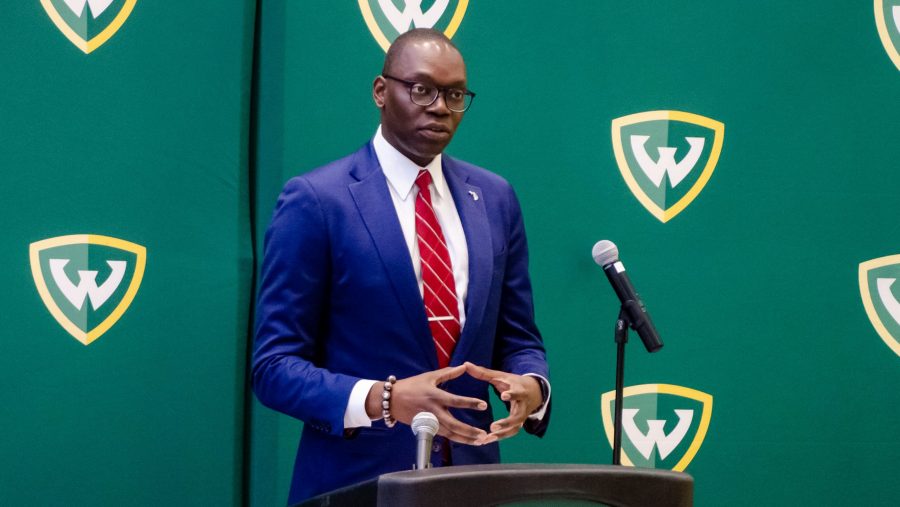
Michigan Lieutenant Governor Garlin Gilchrist is one of two people running for the position.
Gilchrist was a software engineer who then ran and lost a bid for Detroit City Clerk in 2017. Since 2018, he’s been lieutenant governor for the state. Now, he’s running for secretary of state after leaving the governor’s race.
Why? How did Gilchrist’s role of lieutenant governor prepare him to be secretary of state? Gilchrist spoke with The Metro‘s Robyn Vincent about this and more.
Hear the full conversation using the media player above.
Listen to The Metro weekdays from 10 a.m. to noon ET on 101.9 FM and streaming on-demand. Never miss an episode — subscribe to The Metro onApple Podcasts,Spotify,YouTube, orNPR, or wherever you get your podcasts. Have thoughts? Email the show at metro@wdet.org.
Support the podcasts you love.
One-of-a-kind podcasts from WDET bring you engaging conversations, news you need to know and stories you love to hear. Keep the conversations coming. Please make a gift today.
A Detroit man was arrested Thursday for making threats against Mayor Sheffield.
Sterling Anthony Peters was charged after threatening Sheffield twice on Monday, Oct. 5. The first occurred when Peters entered the Coleman A. Young Municipal Center downtown, attempting to access Mayor Sheffield’s office.
When officers attempted to remove him, according to prosecutors, he threatened to “shoot up” the building.
Later, Peters entered the Detroit Police Headquarters, where he was promptly escorted out by officers. While they were doing so, he made another threat, this time to hurt Mayor Sheffield directly.
In court Thursday, Peters’ attorneys suggested he may be dealing with a mental health crisis, as he has recently faced a death in the family.
In a statement released Thursday, Wayne County prosecutor Kym Worthy asserted her zero-tolerance policy on threats of this nature.
“We will absolutely not tolerate threats to elected officials including our judges. These threats are on the rise and are extremely concerning. We will prove the charge in this case in court beyond a reasonable doubt.”
Peters was arraigned Thursday on one count of making a false report or threat of terrorism. He received a $50,000 bond and is currently on house arrest.
Support local journalism.
WDET strives to cover what’s happening in your community. As a public media institution, we maintain our ability to explore the music and culture of our region through independent support from readers like you. If you value WDET as your source of news, music and conversation, please make a gift today.
Costs continue to rise in Michigan for things like gas, groceries and utilities
In March, a DTE rate hike increased bills by 4.6% for a typical customer. Two months later, a Consumers Energy rate hike also increased rates by 6.1%, its second electric increase in a year.
Recent rate hikes and power outages have spurred a lot of anger and frustration.
As some residents in Ann Arbor see it, one solution is to replace DTE with a city-owned utility.
A proposal on the November ballot would modify Ann Arbor’s city charter, clearing the way for a public municipal utility board.
Supporters say a city-owned utility would mean lower bills, more renewable energy, and fewer outages. Michigan already has about 20 city-owned electric utilities, including Chelsea, and Lansing.
How did we get to be here?
Getting Proposal E onto the ballot took a court battle.
In August, the Ann Arbor Responsible Energy Coalition sued the city, arguing the petitions fell short. DTE also paid for this group’s cost study. A Washtenaw County judge threw that case out. The Michigan Court of Appeals agreed last month.
Then, last week, Ann Arbor’s own city council voted 10-1 to oppose Proposal E and directed its city attorney to challenge it in court. Many residents at the council meeting were upset.
Why is Ann Arbor’s city council fighting a ballot question its own voters put there? And who gets to decide whether that vote counts?
Erica Briggs is an Ann Arbor city council member. She voted in favor of the resolution. She spoke with The Metro’s Robyn Vincent.
Hear the full conversation using the media player above.
Listen to The Metro weekdays from 10 a.m. to noon ET on 101.9 FM and stream on-demand. Never miss an episode — subscribe to The Metro onApple Podcasts,Spotify,YouTube,NPR, or wherever you get your podcasts
Support the podcasts you love.
One-of-a-kind podcasts from WDET bring you engaging conversations, news you need to know and stories you love to hear. Keep the conversations coming. Please make a gift today.
The midterms are less than a month away, and there is one race that hasn’t received as much attention as the others. This week on MichMash, WDET’s Cheyna Roth and Gongwer News Service’s Alethia Kasben discuss the race and talk to the candidates running in it.
With such a high-profile midterm election, the race for attorney general has flown under the radar for much of the campaign season. Republican Doug Lloyd, the Eaton County prosecutor, is running against Democrat Eli Savit, the current Washtenaw County prosecutor. Both candidates are facing questions from critics. Lloyd is being questioned about whether he would be beholden to the Trump administration. He says he has never even met the president.
“I made it clear from day one, when I got into this race, that the attorney general’s responsibility is to protect Michigan’s sovereignty. I’ve never met Donald Trump. You know, I’ve never spoken to Donald Trump. I’ve only seen Donald Trump, you know, on TV like him, most of America.”
Savit is being questioned about whether he would push Washtenaw County’s policies on the whole state. He says he wouldn’t.
“I believe that these types of decisions are appropriately made by local prosecutors, you know, and I’m not running to take Washtenaw County’s policies, statewide. Nor could I, even if I wanted to.”
Michigan’s secretary of state oversees license renewals, car registrations and elections — the voter rolls, the rules clerks follow, and the certification of results. Jocelyn Benson is term-limited. Two candidates are running to replace her.
The Metro’s Robyn Vincent spoke with Forlini about how rare noncitizen voting is and what he’d do as secretary of state.
Lieutenant Governor Garlin Gilchrist II, the Democrat in the race, joins The Metro next week.
Editor’s note: Forlini said noncitizens are turning up for jury duty in Macomb County. People there have claimed not to be citizens to get excused — but whether they are in fact noncitizens is not established.
He also said 96% of Republicans and Democrats voted for his bills in the Legislature. The Metro has not verified that.
Hear the full conversation using the media player above.
Listen to The Metro weekdays from 10 a.m. to noon ET on 101.9 FM and stream on-demand. Never miss an episode — subscribe to The Metro onApple Podcasts,Spotify,YouTube,NPR, or wherever you get your podcasts
Support the podcasts you love.
One-of-a-kind podcasts from WDET bring you engaging conversations, news you need to know and stories you love to hear. Keep the conversations coming. Please make a gift today.
To some, Nessel’s become one of Michigan’s strongest defenders. To others, she’s gone too far.
A new Michigan law says whoever replaces Nessel in January cannot sue the federal government without permission from state lawmakers. Republican state House Speaker Matt Hall pushed for the law. Governor Gretchen Whitmer signed it.
Attorney General Dana Nessel spoke with host Robyn Vincent about the battles she’s fought and why.
She said her office has contested every utility rate hike request since she took office — roughly $4.7 billion saved for ratepayers, by its own count — and that the system is broken anyway.
Vincent asked how she squares that fight with a governor of her own party who appoints the commissioners approving those rates, and Nessel she would not have made Whitmer’s appointments to the Michigan Public Service Commission, and that the governor could have reappointed former Commissioner Alessandra Carreon, who Nessel said sometimes deferred to her office’s arguments.
Carreon’s successor, Commissioner Shaquila Myers, was “well known — I’ll just say it — to be in the pocket of DTE,” Nessel said. She added that during Myers’ time as chief of staff to then-House Speaker Joe Tate, bills the utilities opposed “would somehow end up” quashed.
The Metro sought comment from the Public Service Commission and from the governor’s office.
Governor Whitmer’s chief of staff, Zack Pohl, said in a statement: “Shaquila Myers is one of the sharpest policy minds in the state, and she has dedicated her entire career to public service. She is a person of high integrity who is respected on both sides of the aisle.”
The Public Service Commission said in a statement that over more than 20 years in public service, Myers has been chief of staff to the lieutenant governor, a senior adviser to the governor and chief of staff to the speaker of the House. “During her time in the latter role, Michigan enacted a sweeping package of legislation that puts Michigan on a path toward 100% clean energy by 2040,” the statement said. “As she has from the beginning of her time on the MPSC, Commissioner Myers asks to be judged by her work at the Commission, including contributing to Michigan’s best affordability ranking in a decade and to enacting some of the nation’s strongest protections to prevent customers from having to bear any costs associated with data centers. She aims to continue that work during the coming years on the Commission.”
Nessel disputes that last point. In the same interview, she said that under the commission’s approval of power contracts for a Google data center in Van Buren Township, “the ratepayers are absolutely not protected at all.”
After the interview, the commission offered to make Chair Dan Scripps and Commissioner Myers available to appear on WDET. The Metro has invited Myers.
Editor’s Note: This story has been updated with statements from Gov. Gretchen Whitmer’s office and the Michigan Public Service Commission.
Hear the full conversation using the media player above.
Listen to The Metro weekdays from 10 a.m. to noon ET on 101.9 FM and stream on-demand. Never miss an episode — subscribe to The Metro onApple Podcasts,Spotify,YouTube,NPR, or wherever you get your podcasts
Support the podcasts you love.
One-of-a-kind podcasts from WDET bring you engaging conversations, news you need to know and stories you love to hear. Keep the conversations coming. Please make a gift today.
For about a year, Mayor Mary Sheffield has seemed to be riding high. To get elected, she mounted an impressive campaign, taking 77 % of the vote. Once in office, she hit the ground running.
The mayor has created new anti-poverty and community safety departments. Many have commented on her leadership skills, balancing confidence and intellect with openness, and a willingness to listen.
That was true during the summer, when a number of kids were participating in “teen takeovers.” The police department imposed a curfew, but Sheffield also took the time to listen to teens, to ask them what it was that they needed and wanted from their city.
Now, the mayor’s office is under scrutiny.
Sheffield’s ex-boyfriend, Marvin Walker, says when she was council president, she took $200,000 in kickbacks from city real estate deals. She denies that.
Walker also had private photographs of the two of them. A Detroit activist posted them on Facebook. Sheffield calls it harassment.
Detroit Police Chief Todd Bettison called the two men and asked them to take the photos down. Weeks later, police seized one man’s phone. The city’s Inspector General is now investigating the chief of police.
Those are a lot of details. So what do we actually know?
Detroit Free Press investigative reporter Violet Ikonomova has been looking into this. She spoke with The Metro’s Robyn Vincent.
The Metro invited Detroit Mayor Mary Sheffield onto the show. Her office has not responded.
Hear the full conversation using the media player above.
Listen to The Metro weekdays from 10 a.m. to noon ET on 101.9 FM and streaming on-demand. Never miss an episode — subscribe to The Metro onApple Podcasts,Spotify,YouTube, orNPR, or wherever you get your podcasts. Have thoughts? Email the show at metro@wdet.org.
Support the podcasts you love.
One-of-a-kind podcasts from WDET bring you engaging conversations, news you need to know and stories you love to hear. Keep the conversations coming. Please make a gift today.
In Michigan, it’s never a bad idea to boost your relationship with auto workers — or ties to the auto industry.
Republican Mike Rogers spent 14 years in Congress, but before that he was an FBI agent and worked on cars.
“I started out in a car factory building Chrysler LeBaron convertibles. It’s a really good car. I love that car,” Rogers told reporters in Madison Heights this week.
Republican U.S. Senate Candidate Mike Rogers campaigns in Michigan in September 2026
Rogers worked in a non-union shop in the early 1980s making modifications to already-assembled cars.
His opponent, Abdul El-Sayed, is more white collar. He holds medical and public health degrees. However, he has blue collar backing — specifically, the United Auto Workers union.
In an interview with Michigan Public Radio, UAW President Shawn Fain explained why El-Sayed is the choice for the union’s nearly 1 million current and retired members.
“We’ve got to elect people that give a damn about workers, and not billionaires and corporate-class people,” Fain said. “I mean, and unfortunately, our political system has been hijacked by the richest people in the world.”
Michigan’s U.S. Senate race could help decide the balance of power in Washington D.C. next year. The ongoing trade war between the U.S. and Canada is just simmering under the surface.
Tariffs aren’t always the bad guy
Fain doesn’t outwardly dislike certain taxes on imports.
“We support strategic targeted tariffs. Blanket tariffs on everything under the sun, or tariffs just to force a country to do something for political reasons? That makes no sense whatsoever,” Fain said.
“And the 50% on Canada, we don’t agree with that. Like Canada is not the problem.”
The Trump administration has placed 50% tariffs on $27.6 billion in Canadian goods and materials. The Canadian government has responded with equal levies.
A strained relationship
Marchers at this month’s Labor Day Parade in Detroit weren’t happy about the tariffs or how we’re treating our closest trade partner. Retired tool and dye man Stan Geis was one of many who carried a sign emblazoned with images of an American flag and the Canadian maple leaf.
The message: “Solidarity. We stand with our neighbor.”
“I liked when we had the trade across the border … with men working in our country from Canada (going) back and forth. It was good. Now it just stinks.”
Sign at the Labor Day Parade.
That’s not to say the relationship between the UAW and the workers of UNIFOR — the Canadian auto workers union — hasn’t hit some potholes.
John D’Agnolo is the president of UNIFOR Local 200 across the border in Windsor. Southern Ontario is home to factories of several major automakers.
He says American autoworkers sometimes have the wrong idea.
“They think that we’re taking from them when we’re not.”
D’Agnolo has just wrapped up a grueling two weeks in contract negotiations with automaker Stellantis.
They’re not going well. Stellantis aims to sell an idled Jeep plant in Brampton, Ontario, to an armored car company.
D’Agnolo said the inconsistent tariffs are making the bargaining process more difficult.
“The challenge with these tariffs and not knowing what you’re going to get from day to day,” D’Agnolo said. “Companies are not going to invest in new programs.”
Uncertainty in Canada
Windsorites get all the Michigan political ads from Detroit-area TV stations. D’Agnolo said the current political climate is only fueling anxiety.
“You have to turn off the TV because you don’t want to hear it because it becomes your life. It becomes now you got mental issues because you’re worried,” D’Agnolo said.
“So yeah, it’s horrible right now.”
Opposite sides
In the U.S. Senate race, the two main party candidates are on opposite sides of the trade war.
El-Sayed doesn’t like that President Trump picked a fight with Canada.
“There’s a way that tariffs could be used to actually protect jobs. This ain’t it. Like all things Donald Trump, it is chaotic, ham-fisted, self-serving,” El-Sayed said.
El-Sayed points out that his Republican opponent was an advocate for free trade until this latest round of tariffs.
For his part, Rogers told C-SPAN this week he plans to collaborate with Trump in a way El-Sayed will not.
“I will go back to work with the president on tariffs that are working and work with the president on tariffs that are not working,” Rogers said.
“You know, my opponent, all he wants to do is fight with Trump.”
Cost of tariffs
A conservative free market organization, the National Taxpayers Union Foundation — says President Trump’s tariffs are costing Michigan households an extra $5,600 per year.
That’s the third-highest in the nation behind California and Texas.
Steve Grigorian heads the influential Detroit Economic Club. He thinks that could play a role in the election.
“We’re business people, but we go to the grocery store, we go to fill up our gas tank. So it’s definitely top of mind. I think it will definitely be top of mind as people go to the polls”
Ballots for the November election were sent out this week. Election Day is less than six weeks away.
One of the most watched races across the country is in Michigan’s 7th Congressional District. That area includes Lansing, East Lansing, and the farm counties and exurbs around them, out to Livingston County and the edge of Oakland County.
Republican Congressman Tom Barrett won the seat two years ago by less than four points, and both parties think it could decide who has a majority in the House of Representatives. Barrett’s opponent is progressive Democrat Will Lawrence. The Metro spoke with him last week.
Barrett spent 22 years in the Army. He was deployed to Iraq and Guantánamo Bay, and served nearly a decade in the state legislature before going to Washington.
Over the weekend, President Trump rejected an Iranian offer to reopen the Strait of Hormuz. The war has continued, and so has the increasing cost of gas prices.
Congressman Barrett joined The Metro‘s Robyn Vincent to discuss where his positions overlap — and don’t — with President Trump’s, and what his plans are if he’s able to keep his seat.
In the conversation, Congressman Tom Barrett said that over 10 million undocumented immigrants flooded across our border when then-President Joe Biden was in office.
Research from the conservative Cato Institute estimates that the net increase in the undocumented immigrant population during the Biden administration was closer to about 5.5 million people. That’s because millions of people were expelled, deported or returned to their home country or Mexico before President Donald Trump took office.
Hear the full conversation using the media player above.
Listen to The Metro weekdays from 10 a.m. to noon ET on 101.9 FM and streaming on-demand. Never miss an episode — subscribe to The Metro onApple Podcasts,Spotify,YouTube, orNPR, or wherever you get your podcasts. Have thoughts? Email the show at metro@wdet.org.
Support the podcasts you love.
One-of-a-kind podcasts from WDET bring you engaging conversations, news you need to know and stories you love to hear. Keep the conversations coming. Please make a gift today.
Chaos. That’s the trend line in the auto sector of our economy. A war in Iran has raised gas prices. A Trump administration antagonistic to electric vehicles has reshaped the auto industry, causing Stellantis, General Motors and Ford to lose a combined $52 billion as they’ve shifted away from their electric investments.
And through it all, the Trump administration has enacted tariffs. Recently, they’ve gotten steeper.
In August, America enacted new tariffs on Canadian aluminum and steel. Canada responded with tariffs on many US goods, including those aforementioned products.
What do these trends mean for auto companies and auto workers? How are customers affected? And, how are both parties trying to adapt to rapidly changing policies?
Hear the full conversation using the media player above.
Listen to The Metro weekdays from 10 a.m. to noon ET on 101.9 FM and streaming on-demand. Never miss an episode — subscribe to The Metro onApple Podcasts,Spotify,YouTube, orNPR, or wherever you get your podcasts. Have thoughts? Email the show at metro@wdet.org.
Support the podcasts you love.
One-of-a-kind podcasts from WDET bring you engaging conversations, news you need to know and stories you love to hear. Keep the conversations coming. Please make a gift today.
Many have an opinion about Detroit’s Renaissance Center.
Some view it as ugly, detached from the city, and with General Motors having moved out, they believe it should be redeveloped.
And then there are people who like the RenCen. They see its tallest towers as an emblem of the city. They’re often the same people who argue that pouring public money into its redevelopment will detract from other priorities — things like schools, public transit, and housing that teachers and nurses can afford.
This question — whether a large public-private project is worth it for the public — has come into sharper focus. That’s because GM and Bedrock are now asking for just under $550 million to subsidize the redevelopment of the RenCen. That’s up from about $350 million when they first announced the plan.
Jared Fleisher is the CEO of Bedrock. He spoke about the plan with The Metro’s Robyn Vincent. Later, Anne Goulet joined the conversation. She is the principal of two firms, ARGitct and Anne R Goulet Architecture and Design.
Hear the full conversation using the media player above.
Listen to The Metro weekdays from 10 a.m. to noon ET on 101.9 FM and streaming on-demand. Never miss an episode — subscribe to The Metro onApple Podcasts,Spotify,YouTube, orNPR, or wherever you get your podcasts. Have thoughts? Email the show at metro@wdet.org.
Support the podcasts you love.
One-of-a-kind podcasts from WDET bring you engaging conversations, news you need to know and stories you love to hear. Keep the conversations coming. Please make a gift today.
Control of the Michigan Legislature is on the line in this year’s midterm elections. As part of WDET’s weekly series, Gongwer News Service’s Zach Gorchow and Alethia Kasben discuss 10 races they believe could flip from one party to another. They are joined by Gongwer Assistant Editor Elena Durnbaugh, who covers the state House.
One of the topics heading into this election is whether the national political environment will affect local results. Durnbaugh says that if it does, local politicians will need to respond accordingly.
“…the national environment, where we have a situation where we have a Republican president who is deeply unpopular. It’s a midterm. People are looking for change that means that if you’re a Republican in a seat, you’re going to have to work harder to keep it.”
Durnbaugh said politicians’ voting records and what they have done while in control of the Legislature could also push voters one way or another.
One-of-a-kind podcasts from WDET bring you engaging conversations, news you need to know and stories you love to hear. Keep the conversations coming. Please make a gift today.
With only a couple of months left until the midterms, Michigan’s gubernatorial candidates are trying to build support in their bids to become the state’s next governor. This week on WDET’s MichMash, Gongwer News Service’s Zach Gorchow and Alethia Kasben discuss how this race for governor differs from previous ones.
They are joined by Andrea Bitely, founder of the public relations firm Bitely Communications.
The race drawing the most attention in Michigan so far is the U.S. Senate race between Dr. Abdul El-Sayed and Mike Rogers. As for the gubernatorial race between Secretary of State Jocelyn Benson and U.S. Rep. John James, Bitely says it isn’t garnering the same level of attention.
“The gubernatorial race is potentially the most boring gubernatorial race in the history of gubernatorial races.”
Bitely continued by saying that after Mayor Mike Duggan dropped out, the race lost some of its interest for her.
“I think it got a lot more boring on May 21st [2026]. But maybe that’s just the the Duggan campaign staffer in me coming out.”
May 21 was the day Duggan dropped out of the race for governor.
Bitely concluded that to draw more attention to the gubernatorial race and their respective campaigns, the candidates need more rallies and events, along with a resounding message that sticks with voters.
One-of-a-kind podcasts from WDET bring you engaging conversations, news you need to know and stories you love to hear. Keep the conversations coming. Please make a gift today. Give now »
Meanwhile, reported hate crimes against Muslims jumped seventeenfold in one year. They have never returned to where they were.
Almost none of that machinery was ever dismantled. So, we’re wondering how has American politics changed — and how hasn’t it — since September of 2001.
Ali Harb is a freelance journalist based in Washington D.C. He covers American politics, U.S. foreign policy, and politics in the Middle East. He spoke with The Metro‘s Robyn Vincent.
Hear the full conversation using the media player above.
Listen to The Metro weekdays from 10 a.m. to noon ET on 101.9 FM and stream on-demand. Never miss an episode – subscribe to The Metro onApple Podcasts,Spotify,YouTube,NPR, or wherever you get your podcasts.
Support the podcasts you love.
One-of-a-kind podcasts from WDET bring you engaging conversations, news you need to know and stories you love to hear. Keep the conversations coming. Please make a gift today.
According to a Politico poll, 72% of Americans say there’s too much money in politics. Respondents said special interest spending leads to corruption that should be restricted.
In Michigan, a local campaign believes residents can have a stronger, more representative democracy if political spending by some big-time actors is limited.
The Michiganders for Money Out of Politics measure, which is now on the November ballot, would change some aspects of how money gets into the hands of politicians and political candidates.
Voters decide Nov. 3, though opponents have asked the Michigan Supreme Court to block it.
Sean McBrearty is the executive committee co-chair for the Michiganders for Money out of Politics campaign. He spoke with producer and host Robyn Vincent about what happens if the ballot measure passes.
Hear the full conversation using the media player above.
Listen to The Metro weekdays from 10 a.m. to noon ET on 101.9 FM and stream on-demand.
One-of-a-kind podcasts from WDET bring you engaging conversations, news you need to know and stories you love to hear. Keep the conversations coming. Please make a gift today.
Detroit voters created a board of civilian commissioners in 1974 with the power to investigate their own police department. Eleven members. Its own staff of investigators.
Victoria Camille represents District Seven on the oversight board. She’s circulating a petition to get that access back. And Thursday afternoon, she was prepared to vote on whether Detroiters can still speak to her board from home.
Commissioner Camille spoke with The Metro‘s Robyn Vincent about what the police oversight board can actually do to hold cops accountable and whether some of its power has weakened.
Editor’s Note: After this segment aired, the motion to limit public comment options to solely in-person attendees was rescinded.
Hear the full conversation using the media player above.
Listen to The Metro weekdays from 10 a.m. to noon ET on 101.9 FM and stream on-demand.
One-of-a-kind podcasts from WDET bring you engaging conversations, news you need to know and stories you love to hear. Keep the conversations coming. Please make a gift today.
Since the pandemic, Michigan schools have faced a persistent problem: Students are not showing up enough to class.
In Detroit public schools, the chronic absenteeism rate has been higher than the rest of the state’s. Recently, that number has been decreasing.
In just one school year, chronic absenteeism dropped 10 percentage points. Even in comparison with other high-poverty school districts, a recent report shows Detroit public schools have been the most effective in the state at boosting attendance rates.
Why? And, should other school districts take note of what’s happening in Detroit’s schools?
Jeremy Singer is an assistant professor of education policy and leadership at University of Michigan-Flint, and does research with Wayne State. He helped write that report, and spoke about it with The Metro‘s Robyn Vincent.
Hear the full conversation using the media player above.
Listen to The Metro weekdays from 10 a.m. to noon ET on 101.9 FM and stream on-demand.
One-of-a-kind podcasts from WDET bring you engaging conversations, news you need to know and stories you love to hear. Keep the conversations coming. Please make a gift today.
That’s in part because of the state’s open U.S. Senate seat. If Democrats lose, their path to a Senate majority all but closes.
The race can tell us a lot about the direction of the Democratic Party — what is seen as acceptable to voters, and what appears too extreme.
That’s because trends here represent things happening elsewhere, in places where manufacturing is declining but still deemed important, where wages are stagnating, and where younger people are leaving in hopes of finding greener pastures in other states.
So, how should we be looking at the Senate race between Dr. Abdul El-Sayed and Mike Rogers? What does it tell us about the politics of the median Michigan voter? And what does it say about the kinds of politics that are possible.
Adrian Hemond is the CEO of the bipartisan advocacy firm, Grassroots Midwest. He’s also a longtime Democrat. He spoke with The Metro‘s Sam Corey.
Editor’s Note: In this conversation, Adrian Hemond said Dr. Abdul El-Sayed has associated with people who have committed acts of antisemitism. He did not name anyone on air, and we did not press him to at the time. We should have. WDET asked Hemond afterward for specifics and reviewed what he provided. None of it involved conduct by Dr. El-Sayed, and we found no evidence supporting the claim as stated. We should not have let it air unchallenged.
An earlier version of this note included material that did not meet our editorial standards.
Listen to The Metro weekdays from 10 a.m. to noon ET on 101.9 FM and streaming on-demand.
One-of-a-kind podcasts from WDET bring you engaging conversations, news you need to know and stories you love to hear. Keep the conversations coming. Please make a gift today.
Ballot proposal drama, the significance of a report on the Flint water crisis and mixed feelings about funding for a copper mine. There was a lot to cover this week.
On MichMash, WDET’s Cheyna Roth and Gongwer News Service’s Alethia Kasben break down the week’s major headlines with The Detroit News’ Beth LeBlanc.
One of the main headlines was Gov. Gretchen Whitmer urging lawmakers to send new versions of nine vetoed bills to her this fall. LeBlanc says she understands the move but doesn’t think it will succeed.
“Those nine bills passed through a Democratic trifecta. Right now, the makeup of the House and Senate is very different. Matt Hall held up these bills for a year, and many in his caucus don’t agree with these bills. I don’t really know if they have any chance of getting to the governor at this point,” LeBlanc said.
The governor received a lot of pushback when she vetoed the bills nearly six weeks ago.
One-of-a-kind podcasts from WDET bring you engaging conversations, news you need to know and stories you love to hear. Keep the conversations coming. Please make a gift today.

 Login
Login