
Reading view

There are new articles available, click to refresh the page.

Meet a Baldwin resident who visits ICE detention every week

For the nearly 1,500 immigration detainees at North Lake Processing Center, the large ICE detention facility in Baldwin in northern Michigan, visitation hours are limited.

Each detainee gets two hours a week. And many are being held hundreds of miles from friends and family.

Over the past few months, Julie Cordier has been visiting them.

She keeps a binder filled with notes on the people she’s visited and when. She estimates she’s met between 15 and 20 detainees, none of whom she knew before, who were brought to her corner of Michigan after being detained all across the U.S.

She says the cabin she shares with her husband at the end of along, winding dirt road is “kind of our happy place, out in the middle of the woods on a two track, nobody around.”

Except, it happens to be less than 10 miles from the private prison facility, owned by GEO Group, that’s been operating as a immigration detention center since last summer. 

The first time she visited was with her pastor at the Covenant Community United Methodist Church in Baldwin. 

They got the idea from a retired pastor in Grand Rapids, who has been driving people out to North Lake to visit detainees ever since a member of his church was detained. 

“We knew that there were all these strict rules,” she said. “Your shirt isn’t supposed to have any pockets. You can’t wear an underwire bra because of the metal. They are literally for people who come a long way to see their family members, and if you’re wearing an underwire bra, you’re not going in.

“They’ll give you a pair of scissors. They send you out to the little waiting area, and women wiggle out of their bra and cut out the underwire.”

To get in, she just needs someone’s name and what’s called their “Alien Number” — which is how they’re identified by the government. She calls it an “A” number. She doesn’t like the word “alien.”

The detainee she first met puts her in touch with others. 

“He’ll say, this person, here’s a name, a number, he really needs a visit. He’s really struggling. He’s losing hope and could really use a visit.”

Now, Cordier goes most weeks that she can, sometimes multiple times a week. She has been to North Lake so many times that she catches up with the staff at the facility about their weekends, their families, and how they’re doing. 

The other day, when she called to ask about visitation hours, the person on the other end of the line at North Lake recognized her voice.

“The gal who answered the phone,” she said, “was like, is this, Julie? I’m like, it is.”

She has helped family members of detainees get their cars back after they were impounded, given advice to people who’ve lost their apartments, and deposited money into commissary accounts on behalf of detainee’s family members who couldn’t do it in person. 

If people in detention don’t have family or friends who can come, the only connection they have to the outside world is through visitors like herself. 

“You actually feel like, oh my gosh, this is probably one of the very most important things I’ve ever done in my life,” Cordier said.

Baldwin is a very conservative part of Michigan. 65% of Lake County voted for President Donald Trump. 

When the facility re-opened back in June, lots of people here were excited about the jobs and traffic coming to this area, where there are very few opportunities for well-paying work. 

Cordier is part of a network of people across West and northwest Michigan paying visits to North Lake. It’s called Hope for Neighbors

But not all of her neighbors want to come with her to support detainees. 

“Honestly, not everybody in our church is wanting to get involved with it,” Cordier said. “I think a lot of people have preconceived ideas about the migrant population… and if you don’t take the time to actually get to know the immigrant population, I guess you just believe what you’re told, right?”

She pointed to data from ICE, about 1,200 out of the nearly 1,500 people detained at North Lake have no criminal record. 

When people at her church ask her why she continues to go, Julie says it’s simple to explain.

“It’s very easy to just hearken back to the things that Jesus said and say, ‘Hey, I’m welcoming the refugee. I’m loving my neighbor.'”

This story was originally published by Interlochen Public Radio.

The post Meet a Baldwin resident who visits ICE detention every week appeared first on WDET 101.9 FM.

Entry Points hopes to give juvenile lifer artists a place to flourish after release

A Hamtramck-based artist residency program has received a $175,000 innovation award for three years.

Entry Points is a program that offers housing and studio space for returning citizens who were formerly incarcerated juvenile lifers. The program began through the work of Hamtramck Free School, an alternative educational organization that facilitates creative writing and art workshops in Michigan prisons, working with juveniles who were sentenced to life without parole. 

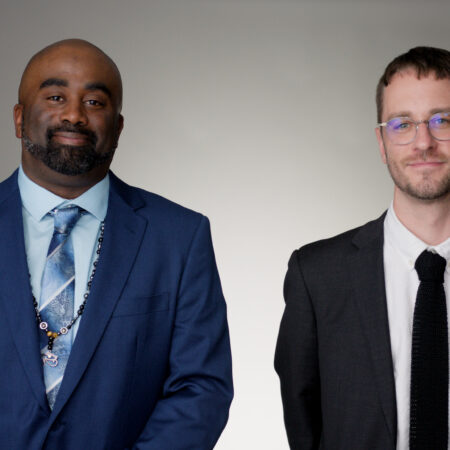
Entry Points Artistic Director Jonathan Rajewski and Director of Transitions, Kyle Daniel-Bey, are working together to help returning citizens reintegrate into public life, including presenting their work publicly.

Rajewski says art is a way for people to express themselves. 

“We work within the prison system are artists and, you know, art has and continues to be an important conduit of self-expression. It’s a rejection of censorship. It’s an articulation of resistance. It’s an acknowledgement of, you know, the social structures that dictate our livelihoods,” he explains. 

Second chances

Daniel-Bey was a juvenile lifer after being incarcerated at 17. He was released from prison due to the Miller v. Alabama 2012 ruling by the U.S. Supreme court.

The ruling says, “No juvenile defendant may face a mandatory sentence of life imprisonment without the possibility of parole, no matter how serious the crime,” according to Justia. 

Daniel-Bey says he got a second chance.

“When the Miller ruling came out in 2012, it was finally a door opening because I was never supposed to come home. And art was a way to sustain myself in prison, not only financially, but spiritually and emotionally,” Daniel-Bey shares.

Daniel-Bey says he met Jonathan in 2013 at the Macomb Correctional Facility through a creative writing workshop. He says they became friends.

I came home in 2018. Since then, we’ve continued our creative exploits through what was created,” he says. 

Supporting returning artists

Entry Points gives people an entry point back into society and a chance to make art. The first resident moved in October 2022, when a former juvenile lifer needed a place to live once he was released.

Rajewski says the artists can use the space for studio visits, visits from curators, and exhibition opportunities. 

“Our first resident was a writer and almost strictly in the literary realm. And so those relationships tend to be focused more in the literary realm,” he shares.

Daniel-Bey says former juvenile lifers often come home often without resources, family, or support. 

As an adult that goes to prison and spends 20 years and comes back out, they at least have an experiential understanding of having to have paid a bill or navigating as an adult, get a job and all those types of things. We had none of that. And so what we do is we are helping to cushion that landing,” he explains. 

Paying it forward

The grant allows at least three artists to use the space over the period of three years, allowing additional staff to be hired. Meanwhile, the program is run by volunteers.

The award is given by the JM Kaplan Fund to 10 awardees for their work in tackling social justice, environmental conservation, and heritage preservation.

Rajewski says he’s grateful for this opportunity to give back.

“This amplifies the work that we’re doing… in the free school, we are largely made up of volunteers. There are no paid employees. There really aren’t any specific kinds of leadership. It’s a sort of shared kind of democratically organized discursive project,” he exclaims. 

Daniel-Bey says that besides supporting the resident artists, the funding will support other artists.

“We also do microgrants to other artists. We have other juvenile lifers that have home support and family support, but they may not be have the material support to get their art supplies,” he explains.

Healing power

Daniel-Bey says art is a universal language that can heal people.

“Their art is trying to speak to the soul and the spirit of people and bring them into community, bring them into unity and into a more humanistic understanding of what drives not only the children that do these things, but the society that produced them,” he says.

Rajewski says the funding supports the work they’ve been doing for years.

When I met Kyle, he was never coming home, and now here we are working outside on this project together. And it is just an endlessly powerful experience to support this work together,” he says.

Support local journalism.

WDET strives to cover what’s happening in your community. As a public media institution, we maintain our ability to explore the music and culture of our region through independent support from readers like you. If you value WDET as your source of news, music and conversation, please make a gift today.

The post Entry Points hopes to give juvenile lifer artists a place to flourish after release appeared first on WDET 101.9 FM.

❌