
Reading view

There are new articles available, click to refresh the page.

Detroit Evening Report: Justice Department demands Wayne County’s 2024 ballots, claims ‘history of fraud’

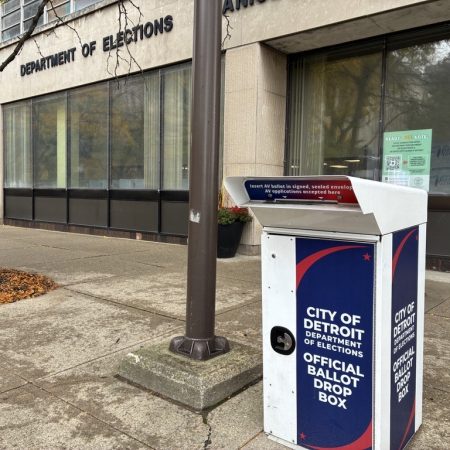
The U.S. Justice Department wants Wayne County to hand over ballots from the 2024 election. Justice officials claim the county surrounding Detroit has a “history of fraud convictions and other allegations.” 

Michigan officials say the few examples of fraud cited by the Justice Department out of millions of votes cast were not connected to the 2024 election. Michigan Secretary of State Jocelyn Benson—who is running for governor as a Democrat—says she believes President Trump is trying to manufacture fear among voters. 

Michigan’s Republican-controlled state senate also found no evidence of widespread or systemic fraud in the 2020 election.

-Reporting by Quinn Klinefelter

Additional headlines for Tuesday, April 21, 2026

Detroit representatives co-sponsor water access, affordability bills

Detroit-area representatives are among those co-sponsoring water access and affordability bills in the U.S. House. If passed, he bills would create an Environmental Protection Agency program that provides access to clean water for low-income households. 

Congresswoman Debbie Dingell is one of the sponsors of the legislation. She says clean, accessible, affordable drinking water is a basic human right. The bills would also prohibit water shutoffs and give equal protection for renters and homeowners. 

These bills are similar to ones Dingell and Congresswoman Rashida Tlaib got passed in 2021, though funding was allowed to run out in the Republican-controlled House. 

-Reporting by Russ McNamara

Dearborn invests in new developments

Dearborn Mayor Abdullah Hammoud says the city and its private sector partners are investing $180 million in a wide variety of developments, including new housing. Hammoud says the city has already reviewed and approved some concept plans and is speeding up the permitting process.

Volunteers needed for Cinco De Mayo Fiesta

Raíces Detroit is looking for volunteers for its Cinco de Mayo Fiesta and Parade. Volunteers will serve in a variety of roles, including event set-up and breakdown, assistance with parade staging, vendor support and more.

The Fiesta will be Saturday, May 2 and Sunday, May 3. The parade will be held on Sunday.

To volunteer, contact Raíces Detroit at 313-404-0850. 

Interfaith Odysseys explores Islam

The Interfaith Leadership Council of Metropolitan Detroit invites the community to explore Islam as a part of its Interfaith Odysseys program in May. Attendees will visit the Islamic Center of America – the largest mosque in the United States. The event includes a tour of the mosque, an introduction to Islam and a warm meal.

Guests will also view the “Art, Faith and Sacred Space” exhibit of work by Lebanese-born artist Haroutioun Isack Bastajian. Interfaith Odysseys are designed for all members of the family.

Joyce Foundation seeks to fund artists

The Joyce Foundation is offering artists across the Great Lakes a chance at a hundred thousand dollars in unrestricted funds for community-focused projects.

Artists in Michigan can nominate themselves through May 4. The Joyce Awards artists in the visual, performing, film, literary and media arts exploring issues of racial equity and engaging communities through collaboration. 

For more information and to apply, visit www.joycefdn.org/grants.  

Listen to the latest episode of the “Detroit Evening Report” on Apple Podcasts, Spotify, NPR.org or wherever you get your podcasts.

Trusted, accurate, up-to-date.

WDET strives to make our journalism accessible to everyone. As a public media institution, we maintain our journalistic integrity through independent support from readers like you. If you value WDET as your source of news, music and conversation, please make a gift today.

Donate today »

The post Detroit Evening Report: Justice Department demands Wayne County’s 2024 ballots, claims ‘history of fraud’ appeared first on WDET 101.9 FM.
When a water main break flooded Southwest Detroit, community put it back together

During a City Council meeting earlier this month, Councilwoman Gabriela Santiago-Romero critiqued the city’s response to last year’s devastating water main break in the Springwells neighborhood in Southwest Detroit.

 “We all know, and we should know as a city, that we did not do them right,” Santiago-Romero said. “We need to all be actively speaking on this so that we can bring the narrative right, so that we continue, so that we’re able to work on this together.” 

One year ago, a 54-inch water main burst in the neighborhood. During freezing temperatures, water filled the streets early in the morning of Feb. 17, affecting hundreds of residents across several blocks. Homes were damaged. Personal belongings and cars were destroyed, and many of the impacted residents were displaced.

Obstacles to a quick response

The city quickly ran into difficulties in the days following the infrastructure failure.

One of the first issues was that many residents wouldn’t answer their doors. Southwest Detroit is the home of a large immigrant population. After the election of Donald Trump, community members had been preparing neighbors for the increased presence of Immigration and Customs Enforcement (ICE). This included advising people not to answer their doors.

Language also became an obstacle. When city officials who facilitated the evacuation and inspections of flooded homes needed translators, they relied on bilingual community members to volunteer to help.

That’s how Sonia Rose, a local business owner and organizer for Detroit Southwest Pride, first got involved.

More people answered their doors once trusted neighbors began to accompany city employees. But Rose said most people answered after volunteers alone started distributing meals.

“People started opening up the door cause now they’re a few days hungry,” Rose said. “So, ‘do you need anything?’ ‘Can we get you more stuff? And they’re like, you know, ‘we don’t have blankets’ … So we started to understand what people were needing very, very quickly. Like, before the city was even thinking about stuff.” 

Community fills the gaps

Almost immediately after the flooding, a network of individual volunteers, nonprofits, and businesses quickly started to organize and address blind spots in the city’s response. Volunteers on the ground were assigned specific blocks to monitor and help. There was even a community-driven database of needs created by the nonprofit Urban Neighborhood Initiatives.

Rose said without the coordinated response of the community, the situation could’ve been more dire.

“I do tribute our volunteer team, and our knowledge and what we know. We didn’t have any deaths. We didn’t have any. And there should have been.”

When the city moved people into hotels, tasks for volunteers grew. Food needed to be delivered outside of the neighborhood when people said they weren’t getting three meals at the hotel or only received junk food like hot dogs, pizza, and bologna sandwiches.

Concerns about ICE followed residents

Veronica Rodriguez was one of the volunteers making regular trips to the hotels, mostly in Southfield. She said that, while ICE was present in the Springwells neighborhood, there were many more officers around the hotels where displaced residents were being housed.

Volunteers would try to monitor ICE activity whenever they provided rides to school or work from the hotels, but many people were still afraid to leave.

“Most of them weren’t able to get their cars out of here, it was just a mess,” Rodriguez said. “The ones that could get rides from that area were scared cause it was quite away to travel for work. So many lost their jobs or they didn’t work for at least thirty days.”

Rodriguez turned down a job offer so she could assist with the response to the water main break. She described volunteering as a 24/7 task, with many who helped in the first sixty days sometimes being out as late as 10pm. Even when she got a job months later, she was still taking calls for residents seeking reimbursement from the city for damages.

“It changed their lives but it also changed mine to where you don’t trust your government,” Rodriguez said. “As much as the City of Detroit and the Water Department want to take credit for the water, the food, the donations, the meals, and all that, 85% of all that was community.”

Laura Chavez is the founder of Raices Detroit, an organization she started largely out of the response to the infrastructure failure. As another community member who was deeply involved in the volunteer efforts, Chavez offered what she believes is the most important lesson from the city’s response to the water main break:

“If community is not a part of the discussion when you’re creating an emergency response program or initiative, then you’re going to miss certain things,” said Chavez.

One year later, freezing temperatures led to more than 50 new water main breaks across the city.

Trusted, accurate, up-to-date.

WDET strives to make our journalism accessible to everyone. As a public media institution, we maintain our journalistic integrity through independent support from readers like you. If you value WDET as your source of news, music and conversation, please make a gift today.

Donate today »

The post When a water main break flooded Southwest Detroit, community put it back together appeared first on WDET 101.9 FM.

❌