Reading view

There are new articles available, click to refresh the page.

Detroit Evening Report: MDHHS launches health screening for firefighters

The state health department is rolling out an effort to screen firefighters for health issues stemming from their line of work. The Michigan Department of Health and Human Services is providing grant funding for mobile, onsite, or local clinic based screening.

MDHHS officials say firefighters have elevated health risks because of work conditions. The funding will support disease prevention.

The state has allocated $3.5 million for three years. MDHHS expects to grant two awards to local clinics. Applicants can log into a pre-application on March 13.  

Additional headlines for Monday, March 9, 2026

Audit finds inconsistencies in Michigan school staffing reports

A new report says Michigan hasn’t been keeping track of teacher aids, and other school service workers. The state health department oversees the school services program.

Checking credentials can affect how districts receive federal reimbursement for those support services.

The report from the state auditor general found that reviews were backlogged and sometimes took months to complete. There were also a handful of observed cases from the 2019-2020 school year where the state didn’t let districts know when they found staff without the right credentials.

The Office of the Auditor General blames vagueness in the state health department’s review plan and outdated agreements for some of the issues. In response, the department says it will update its policies to include more oversight and a clearer review timeline.  

-Reporting by Colin Jackson 

Southwest events

The Urban Neighborhood Initiatives (UNI) is hosting a “Suerte con Amigos” event. People are invited to play Bingo and other games. There’s also a Kahoot game based on Southwest History.

The game night takes place March 12 at 5:30 p.m. at Vamanos!, located at 4444 Vernor Highway.

Tickets are $10. Prizes include gifts cards and more. 

UNI is also hosting a Southwest Soundz event: “My First Queen,” a night to celebrate mothers and their sons. Free food, games and entertainment on March 27 from 6-10 p.m.  

Detroit celebrates Women’s Month

The City of Detroit is celebrating Women’s Month and honoring women who have led the city.

The Women of Wisdom Annual Awards Ceremony will be held Friday, March 20 from 12-3 p.m. at the Erma A. Henderson Auditorium located at 2 Woodward Ave. Detroit, MI.  Register to save your spot for the Women of Wisdom Award Ceremony.  

Gas prices rising 

Gasoline prices have risen almost 60 cents a gallon since last Monday. AAA says Michigan drivers are paying an average of $3.58 for a gallon of regular unleaded this morning. That’s the highest average price since August 2024. 

It’s $3.52 a gallon in metro Detroit—49 cents higher than it was a week ago. Diesel fuel has soared from $3.89 a gallon last week to $4.67 now. 

-Reporting by Pat Batcheller

Listen to the latest episode of the “Detroit Evening Report” on Apple Podcasts, Spotify, NPR.org or wherever you get your podcasts.

Support local journalism.

WDET strives to cover what’s happening in your community. As a public media institution, we maintain our ability to explore the music and culture of our region through independent support from readers like you. If you value WDET as your source of news, music and conversation, please make a gift today.

The post Detroit Evening Report: MDHHS launches health screening for firefighters appeared first on WDET 101.9 FM.

The Metro: If ‘Detroit Never Left,’ who wrote the comeback story?

If you have lived in Detroit for a while, you’ve heard the city’s revival narrative. The magazines, the national news, the awards —they proclaim Detroit is back. Many Detroiters have bristled at this. Back from where? They never left.

That phrase — “Detroit never left” — is the counter. It is emblazoned on T-shirts, stickers, and murals. Detroiters utter these words to take back the narrative. But from whom?

In her new book, “Detroit Never Left: Black Space, White Borders, Latino Crossings,” Nicole Trujillo-Pagán makes the case that powerful outsiders have long defined Detroit’s problems at the expense of residents. 

She argues foundations, banks, the state, and national media used words like “blight” and “vacancy” to define the city’s problems in ways that benefited themselves while excluding Detroiters.

She joined Robyn Vincent on The Metro to discuss how Detroit’s comeback has looked different depending on where you stand.

Listen to The Metro weekdays from 10 a.m. to noon ET on 101.9 FM and streaming on demand.

Subscribe to The Metro on Apple Podcasts, Spotify, NPR.org or wherever you get your podcasts.

Support local journalism.

WDET strives to cover what’s happening in your community. As a public media institution, we maintain our ability to explore the music and culture of our region through independent support from readers like you. If you value WDET as your source of news, music and conversation, please make a gift today.

More stories from The Metro

The post The Metro: If ‘Detroit Never Left,’ who wrote the comeback story? appeared first on WDET 101.9 FM.

When a water main break flooded Southwest Detroit, community put it back together

During a City Council meeting earlier this month, Councilwoman Gabriela Santiago-Romero critiqued the city’s response to last year’s devastating water main break in the Springwells neighborhood in Southwest Detroit.

 “We all know, and we should know as a city, that we did not do them right,” Santiago-Romero said. “We need to all be actively speaking on this so that we can bring the narrative right, so that we continue, so that we’re able to work on this together.” 

One year ago, a 54-inch water main burst in the neighborhood. During freezing temperatures, water filled the streets early in the morning of Feb. 17, affecting hundreds of residents across several blocks. Homes were damaged. Personal belongings and cars were destroyed, and many of the impacted residents were displaced.

Obstacles to a quick response

The city quickly ran into difficulties in the days following the infrastructure failure.

One of the first issues was that many residents wouldn’t answer their doors. Southwest Detroit is the home of a large immigrant population. After the election of Donald Trump, community members had been preparing neighbors for the increased presence of Immigration and Customs Enforcement (ICE). This included advising people not to answer their doors.

Language also became an obstacle. When city officials who facilitated the evacuation and inspections of flooded homes needed translators, they relied on bilingual community members to volunteer to help.

That’s how Sonia Rose, a local business owner and organizer for Detroit Southwest Pride, first got involved.

More people answered their doors once trusted neighbors began to accompany city employees. But Rose said most people answered after volunteers alone started distributing meals.

“People started opening up the door cause now they’re a few days hungry,” Rose said. “So, ‘do you need anything?’ ‘Can we get you more stuff? And they’re like, you know, ‘we don’t have blankets’ … So we started to understand what people were needing very, very quickly. Like, before the city was even thinking about stuff.” 

Community fills the gaps

Almost immediately after the flooding, a network of individual volunteers, nonprofits, and businesses quickly started to organize and address blind spots in the city’s response. Volunteers on the ground were assigned specific blocks to monitor and help. There was even a community-driven database of needs created by the nonprofit Urban Neighborhood Initiatives.

Rose said without the coordinated response of the community, the situation could’ve been more dire.

“I do tribute our volunteer team, and our knowledge and what we know. We didn’t have any deaths. We didn’t have any. And there should have been.”

When the city moved people into hotels, tasks for volunteers grew. Food needed to be delivered outside of the neighborhood when people said they weren’t getting three meals at the hotel or only received junk food like hot dogs, pizza, and bologna sandwiches.

Concerns about ICE followed residents

Veronica Rodriguez was one of the volunteers making regular trips to the hotels, mostly in Southfield. She said that, while ICE was present in the Springwells neighborhood, there were many more officers around the hotels where displaced residents were being housed.

Volunteers would try to monitor ICE activity whenever they provided rides to school or work from the hotels, but many people were still afraid to leave.

“Most of them weren’t able to get their cars out of here, it was just a mess,” Rodriguez said. “The ones that could get rides from that area were scared cause it was quite away to travel for work. So many lost their jobs or they didn’t work for at least thirty days.”

Rodriguez turned down a job offer so she could assist with the response to the water main break. She described volunteering as a 24/7 task, with many who helped in the first sixty days sometimes being out as late as 10pm. Even when she got a job months later, she was still taking calls for residents seeking reimbursement from the city for damages.

“It changed their lives but it also changed mine to where you don’t trust your government,” Rodriguez said. “As much as the City of Detroit and the Water Department want to take credit for the water, the food, the donations, the meals, and all that, 85% of all that was community.”

Laura Chavez is the founder of Raices Detroit, an organization she started largely out of the response to the infrastructure failure. As another community member who was deeply involved in the volunteer efforts, Chavez offered what she believes is the most important lesson from the city’s response to the water main break:

“If community is not a part of the discussion when you’re creating an emergency response program or initiative, then you’re going to miss certain things,” said Chavez.

One year later, freezing temperatures led to more than 50 new water main breaks across the city.

Trusted, accurate, up-to-date.

WDET strives to make our journalism accessible to everyone. As a public media institution, we maintain our journalistic integrity through independent support from readers like you. If you value WDET as your source of news, music and conversation, please make a gift today.

Donate today »

The post When a water main break flooded Southwest Detroit, community put it back together appeared first on WDET 101.9 FM.

Detroit Evening Report: Civil rights leader Jesse Jackson dies at 84

The Reverend Jesse Jackson has died.  He was 84 years old.  Jackson joined the civil rights movement in the early 1960s and begam working closely with Dr. Martin Luther King Junior.  Jackson was near king on the balcony of the Lorraine Motel in Memphis when King was shot to death in April 1968. 

Jackson became a leader of the Civil Rights Movement in the years after King’s death.  He went onto create Operation PUSH in Chicago as part of his effort to continue advocating for change.  One of his signature slogans was “Keep Hope Alive”.  Jackson ran for president in 1984 and 1988, but failed to win the Democratic Party nomination. 

Jackson maintained close ties with civil rights leaders in Detroit, often visiting for NAACP or Operation PUSH events in the city.  The Rainbow/PUSH non-profit coalition was created in the mid-1990s.  Jackson also gave the eulogy for Rosa Parks at her funeral in Detroit in 2005. 

President Clinton awarded Jackson the Presidential Medal of Freedom in 2000.

Additional headlines from Tuesday, Feb. 17, 2026 

SW Detroit residents remember flood 

This is the first anniversary of a major flood in Southwest Detroit.  A 54-inch water main broke last year, causing problems for hundreds of residents in the area.  

Several feet of icy water poured into streets and basements.  The city had to evacuate more than 150 homes in the Springwells neighborhood.  Residents in the area say some were evacuated by boat.  Some lost their cars due to the amount of freezing water in the streets. 

Michigan ranked #1 for men’s college basketball

And Michigan is ranked number on in The Associated Press men’s college basketball poll.  It’s the first time that’s happened in 13 years.  

The AP says the Wolverines claimed 60 of 61 first-place votes in yesterday’s new poll.  Michigan is set to play number three Duke Saturday evening. 

Listen to the latest episode of the “Detroit Evening Report” on Apple Podcasts, Spotify, NPR.org or wherever you get your podcasts.

Trusted, accurate, up-to-date.

WDET strives to make our journalism accessible to everyone. As a public media institution, we maintain our journalistic integrity through independent support from readers like you. If you value WDET as your source of news, music and conversation, please make a gift today.

Donate today »

The post Detroit Evening Report: Civil rights leader Jesse Jackson dies at 84 appeared first on WDET 101.9 FM.

The Metro: Fear is the new recession. How immigration enforcement is affecting small businesses

Across the country, small businesses in immigrant communities are reporting the same pattern: customers are disappearing, workers aren’t showing up, and revenue is in decline.

Federal immigration enforcement has reshaped daily life in these neighborhoods, and some business owners say it’s hitting them harder than COVID, in part because there’s no PPP loan or government lifeline this time around.

In Los Angeles County, the vast majority of surveyed businesses reported negative impacts, with nearly 50% losing more than half their revenue. In Chicago’s Little Village, business sales have dropped an estimated 50 to 70%. And the Brookings Institution estimates that 2025 may have been the first year in over half a century that net migration to the U.S. went negative.

That same predicament is playing out in metro Detroit. In Southwest Detroit, Dearborn, and Hamtramck, the small businesses that anchor entire neighborhoods are under growing pressure. Business owners along Vernor Highway describe empty storefronts, canceled appointments, and streets that used to bustle with foot traffic now eerily quiet. Community networks — WhatsApp alert groups, volunteer patrols, whistle distribution — have emerged to help residents maintain their daily routines.

Mark Lee is the president and CEO of The Lee Group, a consulting firm that works with small businesses on strategy, marketing, and growth across Southeast Michigan. He joined Robyn Vincent on The Metro to talk about what he’s hearing from owners on the ground.

Listen to the full conversation using the media player above.

Listen to The Metro weekdays from 10 a.m. to noon ET on 101.9 FM and streaming on demand.

Subscribe to The Metro on Apple Podcasts, Spotify, NPR.org or wherever you get your podcasts.

Support local journalism.

WDET strives to cover what’s happening in your community. As a public media institution, we maintain our ability to explore the music and culture of our region through independent support from readers like you. If you value WDET as your source of news, music and conversation, please make a gift today.

More stories from The Metro

The post The Metro: Fear is the new recession. How immigration enforcement is affecting small businesses appeared first on WDET 101.9 FM.

The Metro: Detroit residents honor detained loved ones

Immigration enforcement over the last year has become a lot more visible. Late last year, four Detroit students and their families were detained by ICE. The incident sparked outrage among community members who voiced their concerns.

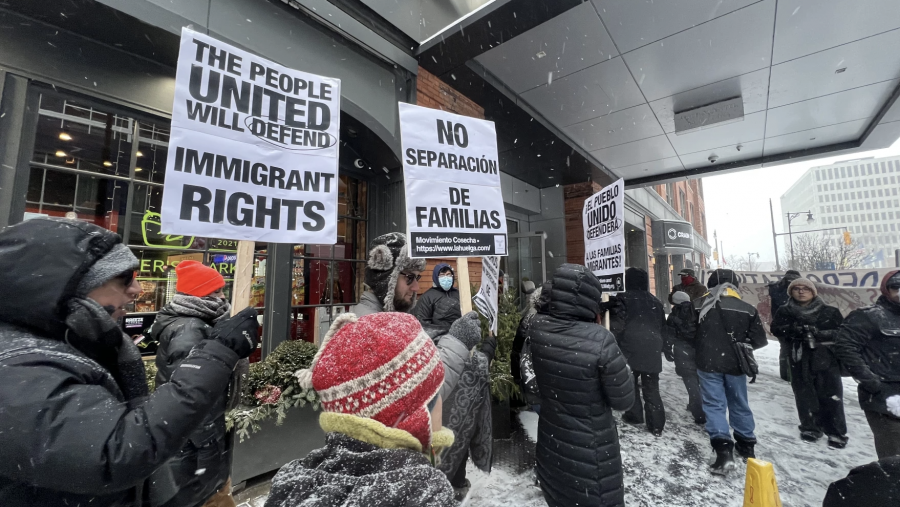
Teachers, students, and parents requested the Detroit Public Schools Community District institute stronger protections for immigrant students, and over the weekend, protestors urged the city council to make Detroit a sanctuary city.

A new project spearheaded by two Detroiters aims to give people whose loved ones were detained or separated by immigration enforcement a place to heal.

The Altars for Collective Grief Project is an effort by Theresa Beckley-Amaya and Julianna Sanroman to construct altars around Southwest Detroit. They will be made of photos of loved ones who have been detained. Beckley-Amaya and Sanroman joined the show to discuss the project and why they organized around grief.

Submit your photos to the project here.

Listen to The Metro weekdays from 10 a.m. to noon ET on 101.9 FM and streaming on demand.

Subscribe to The Metro on Apple Podcasts, Spotify, NPR.org or wherever you get your podcasts.

Support local journalism.

WDET strives to cover what’s happening in your community. As a public media institution, we maintain our ability to explore the music and culture of our region through independent support from readers like you. If you value WDET as your source of news, music and conversation, please make a gift today.

More stories from The Metro

The post The Metro: Detroit residents honor detained loved ones appeared first on WDET 101.9 FM.

The Metro: Santiago-Romero presses Detroit to define limits on ICE activity

During President Trump’s second term, immigration enforcement has become more dangerous and more visible. 

Detention has expanded rapidly. Last year was the deadliest year in more than two decades. Federal records show people have continued to die in custody in the opening days of this year.

There have also been multiple fatal shootings at the hands of on-duty and off-duty ICE agents in recent months. 

In Minneapolis, an ICE agent shot and killed Renee Nicole Good. That killing prompted lawsuits from Minnesota and its largest cities. There were also resignations inside the Justice Department after leadership declined to open a customary civil rights investigation.

Other people have also been killed by ICE agents, including Silverio Villegos González near Chicago and Keith Porter Jr. in California. Those deaths, though, did not trigger the same national response.

In Detroit, City Council Member Gabriela Santiago-Romero is pushing the city to act. She represents Southwest Detroit and chairs the City Council’s Public Health and Safety Committee. She’s asking whether Detroit can legally restrict ICE activity on city property and in sensitive areas, such as schools and hospitals. 

Santiago-Romero joined Robyn Vincent on The Metro to discuss how cities can respond when federal immigration enforcement becomes more aggressive, and how local governments weigh responsibility, risk, and trust.


Listen to The Metro weekdays from 10 a.m. to noon ET on 101.9 FM and streaming on demand.

Subscribe to The Metro on Apple Podcasts, Spotify, NPR.org or wherever you get your podcasts.

Trusted, accurate, up-to-date.

WDET strives to make our journalism accessible to everyone. As a public media institution, we maintain our journalistic integrity through independent support from readers like you. If you value WDET as your source of news, music and conversation, please make a gift today.

Donate today »

More stories from The Metro

The post The Metro: Santiago-Romero presses Detroit to define limits on ICE activity appeared first on WDET 101.9 FM.

❌