 Login
LoginWashtenaw County sheriff says cooperating with ICE puts community members at risk
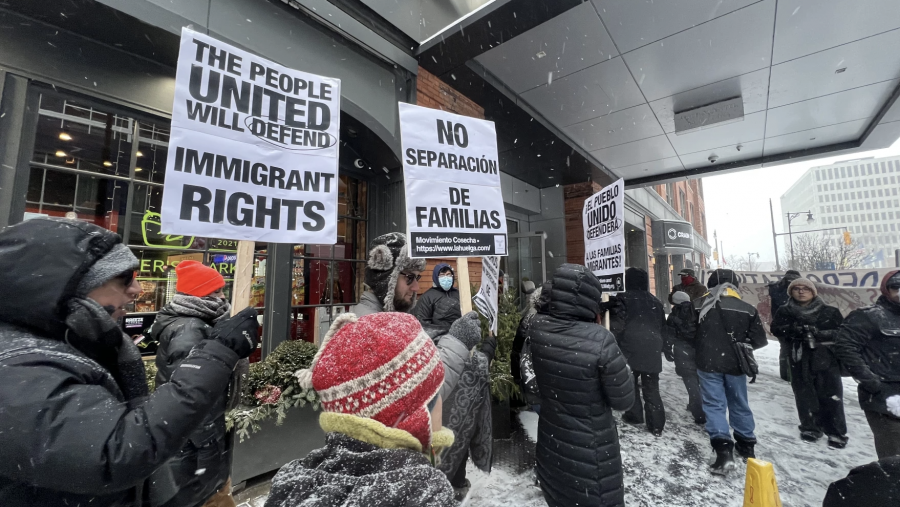
The impact of the recent series of fatal encounters between some Minnesota residents and agents from Immigration and Customs Enforcement is being felt in metro Detroit.
Several law enforcement officials in the region say they do not want to cooperate with deportation operations conducted by ICE.
That includes Washtenaw County Sheriff Alyshia Dyer.
She says Washtenaw sheriff deputies and ICE agents often have very different agendas.
Listen: Washtenaw County Sheriff says cooperating with ICE puts community members at risk
The following interview has been edited for clarity.
Alyshia Dyer: It really puts [police] in conflict with the communities they serve. It’s our responsibility, regardless of immigration status, to keep everyone safe. We need our local communities to trust us. As local police, we rely on the public trust that we build in the communities we serve. The way that immigration enforcement operates is completely different.
And it’s not our duty or responsibility to enforce federal immigration law. We don’t ask about immigration status. We don’t get involved in immigration matters. And especially in this climate, where people are so afraid to even leave their homes, we don’t want to be involved in that.
Quinn Klinefelter, WDET News: As a lay person, it has always seemed to me that federal issues would take precedence over local policing matters. Is it legal for your deputies to basically avoid helping a federal agency like ICE?
AD: Absolutely. The Michigan constitution, as well as our state and local laws, make it very clear that we have a duty to protect and serve all residents of the county. We take an oath as well to do that. And it doesn’t say only if they have valid immigration status. Constitutional rights apply to everyone. And we are not trained nor given resources, nor is it our priority, to look into immigration matters.
The 287 (g) program [which allows local police to act as immigration enforcement agents] is a voluntary program. It is a choice to enter into that program or not. There is no mandate that we have to do it. So we are exercising our discretion and not entering into that agreement. We are going to stay focused on local public safety issues. And, honestly, our resources are already stretched thin.
QK: I would imagine there’s additional costs, financial and otherwise, that a department has to bear when it is working with ICE.
AD: There have been a number of rulings that basically say holding somebody in jail after a judge has ordered them released so that ICE can come pick them up, is a serious issue. It raises liability concerns for the county. Agencies have been sued for doing that. And it’s not our responsibility.
My responsibility as sheriff is to make sure we enforce local and state law, keep the county safe and run the county jail. If a judge orders somebody to be released, they are to be released. And it is not a mandate nor, in my opinion, good practice to keep them in jail pending transfer to immigration officials. If we were to hold somebody in jail solely based on an immigration detainer, which is not a judicial warrant, and we keep them past the release date, then we risk liability for the entire county.
QK: At this point many people have seen the viral videos of ICE tactics in action. They seem to create fear, even among those who have not broken the law. Victims are afraid to call 911, witnesses don’t want to talk, crimes are not reported. Beyond not cooperating with ICE, what can be done by departments like yours to try to restore that trust with the public?
AD: What we have done is made it very clear to the community where our values lie and that we will not be working with ICE. We have maintained a clear separation. We also do not ask about immigration status. So when anyone needs help, they can call 911. But because the national administration remains obsessed with mass deportation, it’s hard for local police. People are fearful. And I have no doubt in my mind that people are not calling the police when they need help because they’re worried. Regardless of what we say, there’s still that fear.
People have confused us with ICE. Them wearing masks and hiding their identities and the tactics they use are not best practices. That’s not what we do at the local level. We try really hard to support all residents. We work closely with immigrant rights groups. I’ve done a number of education town halls, making sure people understand their rights.
Honestly, it puts local law enforcement in an impossible situation. They need the trust of the public to effectively do their job. And when federal immigration agents come in and take someone and detain them, they’re not dealing with the aftermath, right? I’ve had residents in Washtenaw County, people with legal status or who are citizens even, that have said, “Should I carry a birth certificate with me? Is it safe to send my kid to school?”
It is really hard to be sheriff and be responsible for the public safety of a county and know that, unfortunately, there are people in the county that are going to be targeted by immigration enforcement, sometimes solely for just existing. This idea that they’re only going after people with violent felonies or serious criminal records is not true. I have seen the opposite. I’ve also seen cases where they have mistaken someone because they were Latino and they assumed that they were someone undocumented.
Over the years law enforcement has pushed back on that. It’s racial profiling. Seeing these situations play out, not just in Washtenaw County but across the country, is really troubling. I think that local law enforcement and sheriffs have a responsibility to be a voice of reason and assure the public that we are not going to operate how ICE is operating.
QK: You’d raised concerns recently on your personal Facebook page about ICE targeting parents at school bus stops and reportedly detaining a mother in front of her child. Spokespeople for ICE dispute that account, calling it one of the “lies” that put their agents at risk. You later said the report you posted was inaccurate. But you say that doesn’t diminish your worries about how ICE typically operates now compared to a few years ago.
AD: There was a point in time where there was a separation between just focusing on enforcement removal operations and the work that Homeland Security was doing. And there were important things they were doing involving human trafficking and ensuring survivors of violent crime could get citizenship status. Now all of the resources are focused on deporting as many people as possible. I know people that have since retired from some of these agencies, that have said there’s a pressure for quotas. They are told, “You need to deport this many people a month.” That is abhorrent. That’s also a problem.
Trusted, accurate, up-to-date.
WDET strives to make our journalism accessible to everyone. As a public media institution, we maintain our journalistic integrity through independent support from readers like you. If you value WDET as your source of news, music and conversation, please make a gift today.Donate today »
The post Washtenaw County sheriff says cooperating with ICE puts community members at risk appeared first on WDET 101.9 FM.