Reading view

There are new articles available, click to refresh the page.

Former lottery commissioner makes Michigan Secretary of State bid

It’s a crowded field in the race for the Democratic nomination for Michigan Secretary of State.

Ingham County Clerk Barb Byrum and Deputy Secretary of State Aghogho Edevbie are already in the mix.

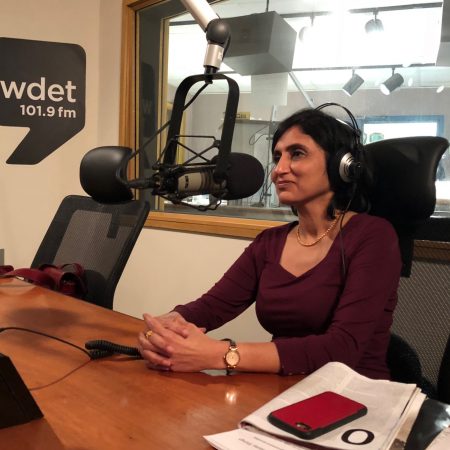
And now another entrant, Suzanna Shkreli. She’s a former Deputy Legal Counsel for Governor Whitmer and recently resigned as Michigan Lottery Commissioner.

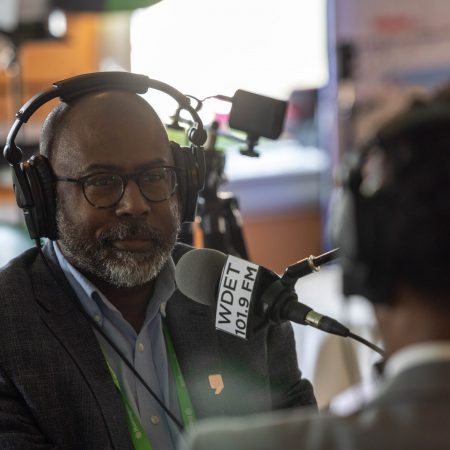
She recently spoke with WDET’s Russ McNamara about why she decided to run.

Listen: Ex-lottery commissioner makes MI Secretary of State bid

The following interview has been edited for length and clarity.

Russ McNamara, WDET: So why are you running?

Suzanna Shkreli: There is so much on the line. I believe that our democracy is at stake. My parents came to this country as children to escape an authoritative government. They fled the former Yugoslavia, and really it’s unthinkable that those same dangers that they fled from have taken root right here at home.

From my work securing convictions against child predators and murderers, as an assistant prosecutor in Macomb [County] to serving in Governor Whitmer’s cabinet as Michigan’s child advocate, I know I have the track record and toughness to make sure this office stays in Democratic hands and to take on those extremists who would try to mess with our elections and silence our voices.

I also know that this job has the opportunity to make working people’s lives, a little bit better and more convenient. I grew up working in my parents restaurant as a child. I learned great customer service early on in my life, and I’ve taken those lessons to every single position I’ve had, and I want to use this job to make Michiganders’ life a little bit easier, from implementing a digital driver’s licenses to working towards faster election results to special walk-in hours for seniors. This job can protect Michiganders fundamental right to vote, but also make the lives of Michiganders more convenient, too.

RM: Given your extensive legal background, why not run for Michigan Attorney General?

Shkreli: So to speak quite frankly with you, this position requires somebody who has taken on tough fights to protect those who don’t have voices. Or those, in this instance, whose voices are trying to be silenced and that’s what we’ve seen with the rising extremism across our state and our country. We need to make sure that we have somebody who can defend the Constitution and defend people’s rights, which is what I’ve done in the past.

I want to use this job to make Michiganders’ lives easier.

RM: Do you have any experience with election administration?

Shkreli: When I served in Governor Whitmer’s office, I was a deputy legal counsel, and I worked on a variety of issues while I was there. I volunteered elections in the past. I’ve worked polls in the past, but also I worked hand-in-hand with the Secretary of State’s office in December of 2020 to deliver the meeting of the electors.

That day the Michigan State Police had flooded the Capitol because of the threats that we received, we did not know what to expect that day. And you had the the electors, [and then] the fake electors try to come into the capitol to deliver those electoral votes. And because of our preparation with Michigan State Police, and because of our preparation with the Secretary of State’s office, we were able to complete the governor’s constitutional requirement and deliver those electoral votes. And that memory is seared in my brain because of the rising level of extremism that we’re seeing against government workers, poll workers and election workers.

RM: Where is this extremism coming from?

Shkreli: I think that there’s rising extremism happening. And Americans and Michiganders all need to step up and call a spade a spade when we’re seeing that. Secretary Benson has done such a wonderful job and who knows where we would have been in 2020, if she wasn’t in that position. So I’m ready to continue that work forward.

I’ve been talking to political leaders throughout the state, and I hope to seek the endorsement of them, but the truth is that this nomination will be on the grassroots level, and that’s what I’m focused on.

I’m running for this office because I know that I’m the best candidate to win the convention as well as win the general. Just in 24 hours, we earned $200,000 which is the most that any Secretary of State candidate has raised in 24 hours. Which is more than some candidates in this race have raised for the last 10-11 months since they’ve been running. So it’s a sign of enthusiasm.

RM: Where are those donations coming from? Are we talking large money donations or a lot of individual ones?

Shkreli: We have donations for Michiganders across the state. We’re really excited about the enthusiasm. We expect this just to be the beginning.

Trusted, accurate, up-to-date.

WDET strives to make our journalism accessible to everyone. As a public media institution, we maintain our journalistic integrity through independent support from readers like you. If you value WDET as your source of news, music and conversation, please make a gift today.

Donate today »

The post Former lottery commissioner makes Michigan Secretary of State bid appeared first on WDET 101.9 FM.
The Metro: At the ballot box, competing visions for the country’s future

It’s Election Day in America, and once again, the question is what kind of country do we want to be?

In state after state, new voting laws have made it harder to cast a ballot. Meanwhile, election workers across the country face threats and trust in the process is eroding.

But there is also new energy and a strong current of change moving through the country. In New York City, Zohran Mamdani, a Democratic Socialist, leads the mayor’s race. In Michigan, Abdul El-Sayed and Mallory McMorrow are pushing bold, grassroots campaigns. Progressives like Omar Fateh and Katie Wilson are gaining traction in Minneapolis and Seattle, respectively.

Their popularity says something: voters want affordable housing, clean water, buses that run, health care that works, food that is fresh and cheap. And that demand, more than any single race, may be democracy’s last line of defense.

So today, as Americans vote, The Metro’s Robyn Vincent turns to E.J. Dionne, a New York Times columnist and Brookings scholar, to help read this moment and unpack what it tells us about the future of American democracy.


Listen to The Metro weekdays from 10 a.m. to noon ET on 101.9 FM and streaming on demand.

Subscribe to The Metro on Apple Podcasts, Spotify, NPR.org or wherever you get your podcasts.

Trusted, accurate, up-to-date.

WDET strives to make our journalism accessible to everyone. As a public media institution, we maintain our journalistic integrity through independent support from readers like you. If you value WDET as your source of news, music and conversation, please make a gift today.

Donate today »

More stories from The Metro

The post The Metro: At the ballot box, competing visions for the country’s future appeared first on WDET 101.9 FM.

The Metro:‘Something compelling about the democratic ideal’ — the case for more representative democracy

When it comes to our federal system, we often don’t have a representative, majoritarian democracy. That means the idea of “one person, one vote” often does not hold. 

Gerrymandering favors one party to be elected in the House of Representatives. The electoral college overrides the popular vote. Money is considered speech, which means that people with more of it have more influence in our politics. 

What would it look like to have a democracy that represents people more than it does geography, and to have a politics that doesn’t favor the rich over those with fewer means?

Osita Nwanevu is a writer at The New Republic and The Guardian and the author of the book, “The Right of the People.” And in it, he argues that if we had a majoritarian democracy, we would collectively be better off. 

Producer Sam Corey spoke to Osita about that prospect, and whether some ballot proposals initiated in Michigan would create a more representative democracy in the state.


Listen to The Metro weekdays from 10 a.m. to noon ET on 101.9 FM and streaming on-demand.


Subscribe to The Metro on Apple Podcasts, Spotify, YouTube, or NPR or wherever you get your podcasts.


Trusted, accurate, up-to-date.

WDET strives to make our journalism accessible to everyone. As a public media institution, we maintain our journalistic integrity through independent support from readers like you. If you value WDET as your source of news, music and conversation, please make a gift today.

Donate today »

More stories from The Metro

The post The Metro:‘Something compelling about the democratic ideal’ — the case for more representative democracy appeared first on WDET 101.9 FM.

The Metro: How to strengthen a fragile democracy

Political violence has been in the news so much, it can sometimes feel exhausting. Last week, the conservative activist, Charlie Kirk, was killed.

But there’s good reason the incident has gotten so much coverage. It’s an indicator of something much bigger and more devastating than the act alone — it’s a signal that our democracy is in a fragile state. 

That’s in part because political violence has been on the rise.

President Donald Trump was shot while on the campaign trail in 2024. An arsonist set fire to the Pennsylvania governor’s mansion in April. In June, a former Minnesota state lawmaker and her husband were assassinated. An insurrection took place at the capitol well before all that. 

And that’s all outside of Michigan. 

Here, a capital riot took place in 2020. A kidnapping was attempted on our governor, Gretchen Whitmer, that same year, in part with hopes of starting a civil war. Just last week, vandalism hit a mosque in Warren. 

But what’s troubling experts about this violence is not just these events. It’s also the reactions to them. 

Comments about Charlie Kirk’s death on social media were often ferocious. Conservatives were calling for war against liberals. Liberals were happy with Kirk’s death. 

To be sure, these are the loudest voices. That’s the way social media algorithms work. The most extreme voices get the most attention because they translate to more advertising revenue. 

But people are still choosing to express views of hate and vitriol. 

How did we get here? And how do we get to a place where our democracy is stronger — where disagreement, and the bodies that contain those various perspectives, can live side by side?

Shikha Dalmia studies authoritarianism in an effort to stop it, and make us a freer society. She’s the president of the Institute for the Study of Modern Authoritarianism, and the Founder and Editor of the Substack, The UnPopulist. She spoke with Robyn Vincent.

Listen to The Metro weekdays from 10 a.m. to noon ET on 101.9 FM and streaming on-demand.


Subscribe to The Metro on Apple Podcasts, Spotify, YouTube, or NPR or wherever you get your podcasts.

Trusted, accurate, up-to-date.

WDET strives to make our journalism accessible to everyone. As a public media institution, we maintain our journalistic integrity through independent support from readers like you. If you value WDET as your source of news, music and conversation, please make a gift today.

Donate today »

More stories from The Metro

The post The Metro: How to strengthen a fragile democracy appeared first on WDET 101.9 FM.
Op-ed: Stand with the public media journalists holding power accountable

With the stroke of a pen, President Trump approved a $1.1 billion cut in July that ends federal support for public media, jeopardizing independent journalism across America. Now, rural and tribal stations face severe cuts or closure, and stations like Detroit Public Radio, which depends on hundreds of thousands of dollars annually in federal funding, might never be the same.

This should concern every American who cares about democracy. The U.S. stands among a select few nations with a truly free press, protected by the First Amendment. But democracy doesn’t sustain itself; it demands active support.

Here at WDET, I am proud to say our journalists are part of that scaffolding. We speak truth to power, hold government officials accountable, and bring you essential reporting that digs into what local leaders are doing and how it affects you.

How WDET works for its community

On The Metro, the daily news and culture show I co-host with Tia Graham, we put local leaders in the hot seat and amplify unheard community voices daily.

Without this type of independent journalism, democracy weakens.

I am also proud to say that, unlike so much of the media competing for your attention, public broadcasters like WDET do not chase clicks or corporate sponsors — our mission is rooted in the public interest. That independence makes us a watchdog against corruption, a provider of emergency alerts, and a trusted news source.

But because we inform people honestly, it upsets powerful people — those who benefit from public ignorance or propaganda.

Without a free press, power goes unchecked, transparency disappears, and trust erodes. In the absence of local independent media, who is holding city council accountable? Who is investigating your local school board or monitoring law enforcement transparency? Studies show when local news disappears, voter turnout drops, polarization rises, and people feel less connected to their community.

A rising trend

While the erosion of local journalism may feel gradual, the danger to press freedom is neither new nor confined to city limits. Around the world, journalists face harassment, imprisonment, and even death for pursuing the truth. We don’t need to look further than the Committee to Protect Journalists to see myriad documented examples of that, abroad and here in the U.S.

But let’s fix our gaze abroad for a moment, because this playbook — weakening independent media — is a timeless tactic deployed by authoritarian rulers across the globe.

In Italy, Prime Minister Giorgia Meloni has packed its public broadcaster with loyalists. This has silenced critical voices and rewritten national narratives.

In Poland, the ruling party seized control of public media, firing hundreds of journalists. It has turned it into a government mouthpiece.

Without a free press, power goes unchecked, transparency disappears, and trust erodes

In Greece, the government abruptly shut down ERT—public radio and TV—with no warning, claiming cost savings, then it hijacked its equipment. It was seen as an attempt to silence independent media.

In Argentina, the far-right President Javier Milei dissolved Télam, the national news agency founded in 1945, accusing it of being “propaganda.” Observers say this is part of his battle with the press and comes amid deep cuts to the public sector.

In the Philippines, Congress refused to renew the license of its leading broadcaster. This move was widely viewed as retaliation for the network’s critical news coverage of President Rodrigo Duterte’s administration.

Again, I want to be clear: These tactics—defunding, censorship, co-option—are a familiar playbook among leaders who fear accountability. And the move to defund public media in the U.S. is part of that playbook. We cannot let this country go down the same path — a nation that has enshrined the free press in its Constitution.

Support public media

Public media’s history is rooted in education, service, and community connection. From classroom broadcasts in the early days of radio to today’s hard-hitting reporting that holds powerful people accountable, public media like WDET is an institution, both a Detroit one and one that prioritizes your access to information.

Today, your support means we can continue challenging the powerful and protecting your right, and your community’s right, to know. Please consider donating now at wdet.org/give because democracy depends on all of us.

An abbreviated version of this op-ed appeared in the Detroit Free Press.

Support local journalism.

WDET strives to cover what’s happening in your community. As a public media institution, we maintain our ability to explore the music and culture of our region through independent support from readers like you. If you value WDET as your source of news, music and conversation, please make a gift today.

The post Op-ed: Stand with the public media journalists holding power accountable appeared first on WDET 101.9 FM.

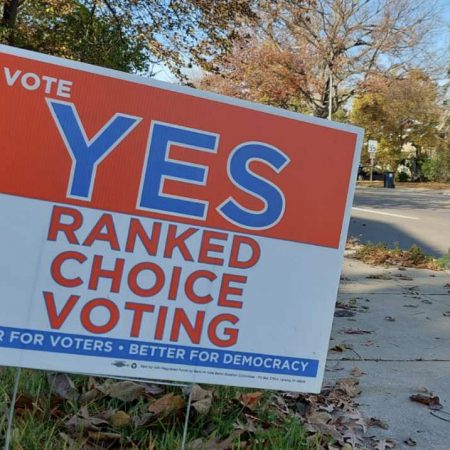
The Metro: The plan for getting ranked choice voting on Michigan’s November ballot next year

Two months ago, a campaign to enact ranked choice voting in Michigan got off the ground. 

Ranked choice voting lets you rank candidates in order of preference. If no one gets more than 50 percent at first, the last-place candidate is dropped and those votes go to your next choice. 

Supporters say that the process, if approved, will strengthen our democracy.

But it didn’t take long before Republicans in Lansing and political advocates began attacking the electoral process. 

Last month, state lawmakers passed a bill in the House along party lines to ban ranked choice voting. But even its Republican sponsor admitted that if voters approve it on the ballot, that would override the ban.

Nonetheless, state House Representative Rachelle Smit, who sponsored the legislation, says that ranked choice voting is confusing, and “only breeds skepticism, especially when every close contest invites lawsuits and recount battles.” 

How are the leaders behind ranked choice voting responding to this political fight — and what’s their plan to get it on the 2026 ballot?

Joe Spaulding, campaign director for Rank MI Vote, spoke with Robyn Vincent about why he believes ranked choice voting will make our system more, not less, democratic.

The Metro reached out to the group, Stop RCV and state House Rep. Rachelle Smit about why they’re against ranked choice voting. Rep. Smit directed us to her Detroit News column, which says ranked choice voting threatens election integrity. Stop RCV sent us a statement that “ranked-choice voting makes every part of the election process more difficult,” for both voters and election administrators. 

Trusted, accurate, up-to-date.

WDET strives to make our journalism accessible to everyone. As a public media institution, we maintain our journalistic integrity through independent support from readers like you. If you value WDET as your source of news, music and conversation, please make a gift today.

Donate today »

Listen to The Metro weekdays from 10 a.m. to noon ET on 101.9 FM and streaming on demand.

Subscribe to The Metro on Apple Podcasts, Spotify, NPR.org or wherever you get your podcasts.

Trusted, accurate, up-to-date.

WDET strives to make our journalism accessible to everyone. As a public media institution, we maintain our journalistic integrity through independent support from readers like you. If you value WDET as your source of news, music and conversation, please make a gift today.

Donate today »

The post The Metro: The plan for getting ranked choice voting on Michigan’s November ballot next year appeared first on WDET 101.9 FM.
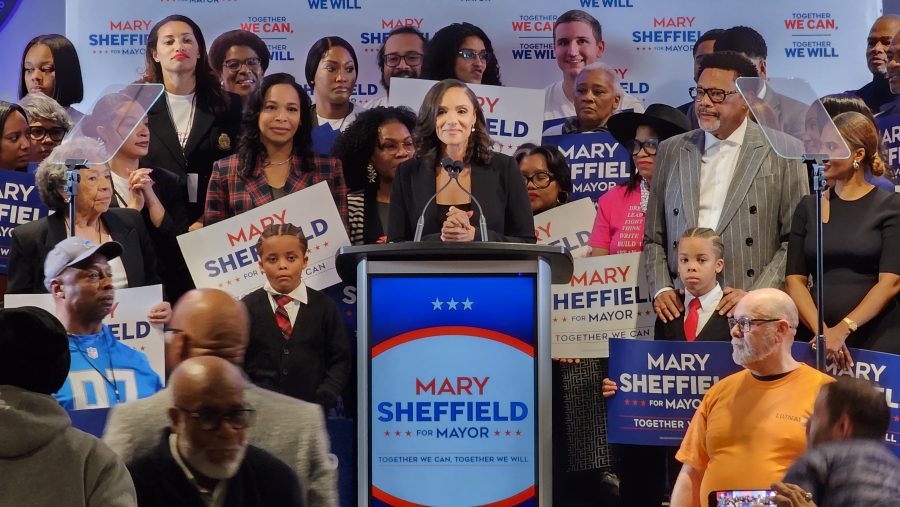
The Metro: What voters want from Detroit’s next mayor


What do Detroit voters want out of city’s next mayor? This summer, the WDET News team has been hitting the streets for a new project, Citizen Vox, to help us get a clearer picture of what Detroiters want out of the next mayor.

Ahead of Tuesday’s primary, WDET news director Jerome Vaughn joined the Metro to tell us more about what WDET reporters have been hearing from residents.

Detroit’s mayoral primary is Tuesday, August 5, 2025. The top two vote-getters will advance to the general election in November.

Follow all of WDET’s election coverage, including candidate interviews and Citizen Vox by visiting the 2025 Election Guide.

Listen to The Metro weekdays from 10 a.m. to noon ET on 101.9 FM and streaming on demand.

Trusted, accurate, up-to-date.

WDET strives to make our journalism accessible to everyone. As a public media institution, we maintain our journalistic integrity through independent support from readers like you. If you value WDET as your source of news, music and conversation, please make a gift today.

Donate today »

More stories from The Metro

The post The Metro: What voters want from Detroit’s next mayor appeared first on WDET 101.9 FM.
❌