Reading view

There are new articles available, click to refresh the page.

Detroit Evening Report: Dearborn receives firearm safety grant

Dearborn’s Department of Public Health has been awarded a $101,000 grant to advance firearm safety. The Michigan Department of Health and Human Services funding supports collaborative efforts to educate gun owners on safe handling and storage. 

Dearborn Mayor Abdulllah Hammoud says firearm injury prevention is a public health and safety priority. 

The city’s health department will distribute firearm safety kits, including gun locks, lockboxes, and educational materials.  Dearborn Chief Public Health Officer Ali Abazeed says the grant supports evidence-based education and access to safety tools. 

Additional headlines for Monday, Dec. 22, 2025

Michigan Chief Medical Executive makes Standing Recommendation regarding children’s vaccines 

Michigan’s Chief Medical Executive, Dr. Natasha Bagdasarian, made a Standing Recommendation to continue issuing vaccinations on schedule based on recommendations by the American Academy of Pediatrics (AAP) and the American Academy of Family Physicians (AAFP). 

Bagdasarian shared that public health experts are not in agreement with new federal vaccine recommendations, prompting the announcement. One of the recent changes was dropping the Hepatitis B vaccine at birth and removing the COVID-19 vaccine recommendation for healthy children and pregnant women. 

Bagdasarian’s Standing Recommendation was made with the Michigan Department of Health and Human Services’ Division of Immunization. 

She says the recommendation does not supersede clinical judgment. She also asks health care providers to make vaccines accessible by removing barriers for patients. 

Bagdasarian says vaccines keep people safe and potentially save lives. 

EGLE renews license for hazardous waste facility 

The Michigan Department of Environment, Great Lakes, and Energy (EGLE) has renewed the license for a hazardous waste treatment and storage facility in Detroit for the next 10 years.

Hazardous Waste Management Facility Operating License to EQ Detroit Inc., which does business as US Ecology Detroit South, was issued the license after regulatory review and a public comment process. Several people strongly opposed the facility because it emits strong odors leading to health concerns like asthma. The facility also has a history of clean air violations. 

EGLE renewed the license, adding new requirements, such as expanding air and groundwater monitoring. The facility must replace six tanks beginning in January 2026 and install odor control equipment by the end of Dec 2027.

Tunnel in southwest Detroit 

The Great Lakes Water Authority has started building a sewage relief system near the Rouge River in Southwest Detroit. Crews will spend at least two years digging a tunnel to carry excess stormwater to an underused retention and treatment center. Chief Operating Officer Navid Mehram says the $87 million project should reduce the risk of flooding and sewage backups during heavy rain. 

So this is an example where we’re making an investment in our existing system by rerouting some flows, so that we can leverage an existing facility that wasn’t receiving all the flow it can treat.”

Mehram says the project will not increase customers’ sewage bills. He says state and federal funding will help pay for the tunnel. 

New tech firm in town 

Detroit is getting a new high-tech security and AI solution firm, Eccalon. The defense tech company will create 800 new jobs ranging from $25-100 per hour. 

The facility will have manufacturing operations, training programs and an innovation center. 

The company’s headquarters is moving from Maryland to become a part of the tech innovation in Detroit. Eccalon will be located at the Bedrock-owned Icon building at 200 Walker Street. 

Eccalon Chairman and CEO André Gudger says the new headquarters will develop cybersecurity and advanced manufacturing and automation. 

The company hopes to open early next year. 

Listen to the latest episode of the “Detroit Evening Report” on Apple Podcasts, Spotify, NPR.org or wherever you get your podcasts.

Support local journalism.

WDET strives to cover what’s happening in your community. As a public media institution, we maintain our ability to explore the music and culture of our region through independent support from readers like you. If you value WDET as your source of news, music and conversation, please make a gift today.

The post Detroit Evening Report: Dearborn receives firearm safety grant appeared first on WDET 101.9 FM.

Here are the highest speeds recorded during Colorado’s severe windstorm

Hurricane-force winds battered Colorado’s Front Range this week, knocking out power to hundreds of thousands of homes and businesses, closing highways and dozens of schools and causing extensive delays at Denver International Airport.

While the highest winds were recorded in the mountains and foothills, National Weather Service records show most of the Front Range saw significant wind gusts.

148 mph?! How this week’s winds stack up to the biggest gusts in Colorado history.

Colorado wind gusts, Dec. 19, 2025

  • National Center for Atmospheric Research, Boulder: 112 mph
  • Niwot: 102 mph
  • Carter Lake: 95 mph
  • Berthoud Pass, 3 miles north: 94 mph
  • Lyons: 90 mph
  • Brookvale, west of Evergreen: 90 mph
  • Bellvue, west of Fort Collins: 89 mph
  • Cheesman Reservoir: 83 mph
  • Westcliffe: 82 mph
  • Eldorado Springs: 81 mph
  • Rocky Flats National Wildlife Refuge: 80 mph
  • Coal Creek Canyon: 73 mph
  • Cottonwood Pass: 72 mph
  • Manchester, near Cripple Creek: 70 mph
  • Superior: 64 mph
  • Erie Municipal Airport: 61 mph
  • Lyons: 61 mph
  • Longmont Airport: 59 mph
  • Loveland: 58 mph
  • Salida Airport: 56 mph
  • Colorado Springs Airport: 56 mph
  • Peyton: 51 mph
  • Pueblo West: 48 mph
  • Buena Vista: 47 mph
  • Leadville: 43 mph
  • Beulah: 40 mph

Source: National Weather Service Boulder and Pueblo offices

Get more Colorado news by signing up for our daily Your Morning Dozen email newsletter.

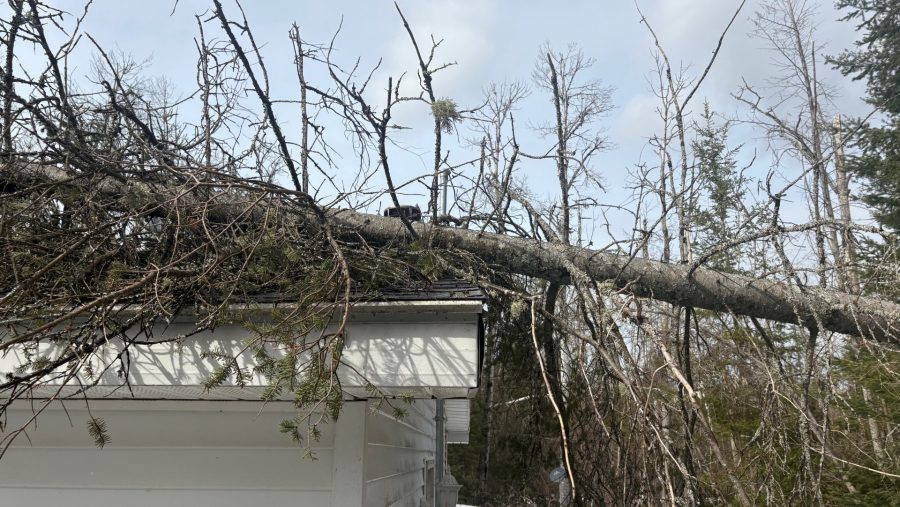
LONGMONT, CO – DECEMBER 19:A large tree lies across the roof of a house on Cornell Drive in Longmont on Friday, Dec. 19, 2025. A National Weather Service red flag warning covers the mountains and foothills along the Front Range from Castle Rock to Fort Collins. (Matthew Jonas/Staff Photographer)

Old-growth forest at Independence Oaks reveals Indigenous past

An area of very old trees at Independence Oaks County Park has been recognized as part of a national network of old-growth forests, drawing attention to both rare natural features and thousands of years of human history tied to the land.

Carol Bacak-Egbo is an Oakland County Parks historian. She says the newly designated old-growth forest lies within a landscape shaped by Indigenous peoples for 5,000 to 6,000 years. The park sits near historic Native American trail routes, and contains the headwaters of the Clinton River, once a major travel route for the Anishinaabe across what is now southeast Michigan.

“This history doesn’t start with log cabins and sawmills,” Bacak-Egbo says. “People lived with and cared for this land long before Europeans arrived.”

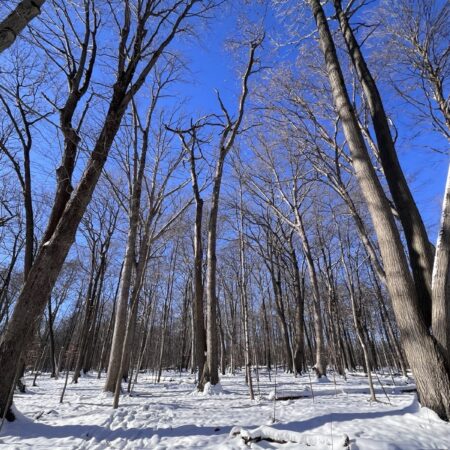
Even in winter, Independence Oaks’ old-growth trees tower above the landscape. (Photo by Amanda LeClaire, WDET News)

Artifacts indicate the area was likely used as seasonal camps rather than permanent villages. The park also contains one of only two remaining wild rice beds in southeast Michigan, a culturally and spiritually significant food source for the Anishinaabe.

The forest largely escaped widespread logging and farming in the 19th century, almost by accident.

In the early 1900s, a wealthy Detroit businessman purchased land around Crooked Lake but left it undeveloped. Later owners also did not farm the southern portion of the property, allowing the old-growth trees to remain intact.

Park naturalist Kegan Schildberg says the designation supports efforts to protect remaining natural areas in Oakland County, which has developed rapidly during the last century.

Bacak-Egbo encourages visitors to view parks as places where natural and human history intersect.

“When people walk these trails, they aren’t just connecting with nature,” says Bacak-Egbo.  “They are walking through the same forest people walked through hundreds and even thousands of years ago.”

This story is part of WDET’s ongoing series, The Detroit Tree Canopy Project.

Trusted, accurate, up-to-date.

WDET strives to make our journalism accessible to everyone. As a public media institution, we maintain our journalistic integrity through independent support from readers like you. If you value WDET as your source of news, music and conversation, please make a gift today.

Donate today »

The post Old-growth forest at Independence Oaks reveals Indigenous past appeared first on WDET 101.9 FM.
Lake Erie’s summer algal bloom was relatively mild

This year’s harmful algal bloom in western Lake Erie was among the mildest this century.

The National Oceanic and Atmospheric Administration monitors the development of algae in the lake each year.

On a scale of 1 to 10, NOAA rated this year’s bloom between 2 and 3, which is mild. Compare that with 2011’s very severe bloom, which peaked between 9 and 10.

NOAA researcher Rick Stumpf says each bloom is different. He and his colleagues use several factors to rate each one.

“The mildness is a reflection of how much bloom there is,” he says. “The amount of biomass, the quantity, and how severe it is over the peak 30 days.”

Weather is a big factor

The amount of rainfall in the spring also affects the bloom’s development. Algae feed on phosphorus, a common chemical in farm fertilizer. When farmers apply it to their fields, rain will wash some of it into streams and creeks. That water then flows into the lake through the Maumee River in Ohio.

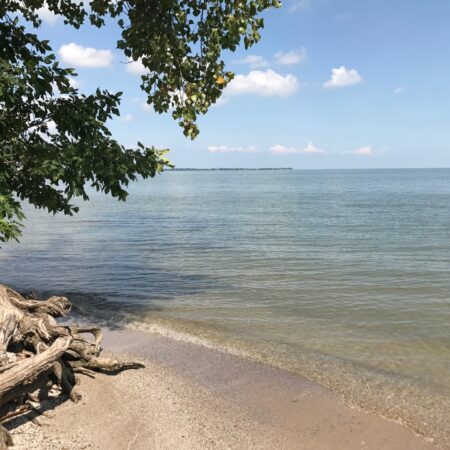
A view from Lake Erie Metropark.
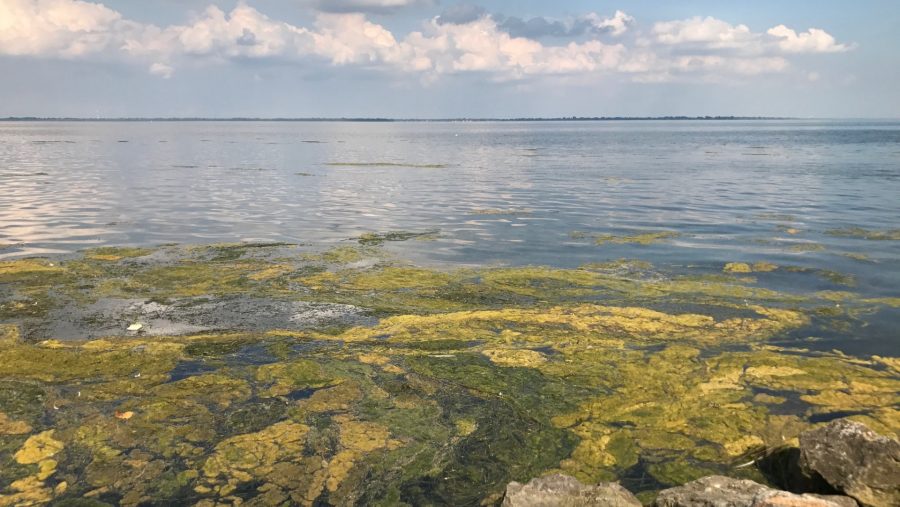
Algae can grow close to shoreline areas as in this photo of Lake Erie from 2017

Stumpf says lower-than-average rainfall in 2025 meant less phosphorus for algae to consume, and thus a milder bloom. He also says this year’s growth started later than usual.

“The last few years, the bloom’s been pretty well-developed in July,” Stumpf says. “This year, it wasn’t until well into August when you had the greatest quantity of bloom.”

Stumpf says one way farmers can limit the amount of phosphorus in the lake is to test their fields for it early.

“If you’ve got enough phosphorus in the field, you may not have to fertilize for a couple of years, and that can make a big difference.”

Navigating the shutdown

Stumpf says the federal government shutdown in October did affect some of NOAA’s observations. But he says by then, researchers had enough data to rate the bloom accurately.

“We do a lot with satellite data, and that data has continued throughout this year’s bloom,” he says.

That data will also help NOAA figure out what other factors affect harmful algal blooms and how they’ve changed over the last 25 years.

Size doesn’t always matter

The size of each bloom doesn’t necessarily reflect how toxic it is. For example, the 2014 bloom was rated moderate to severe (5 out of 10). But it produced enough toxin to contaminate Toledo’s municipal water system that year.

In general, Stumpf says algal blooms can harm people and animals who are exposed to them. He says the best way to prevent that is to avoid areas of green scum on the surface of the lake.

Trusted, accurate, up-to-date.

WDET strives to make our journalism accessible to everyone. As a public media institution, we maintain our journalistic integrity through independent support from readers like you. If you value WDET as your source of news, music and conversation, please make a gift today.

Donate today »

The post Lake Erie’s summer algal bloom was relatively mild appeared first on WDET 101.9 FM.
Macomb executive says county thrives despite economic uncertainty

The head of Macomb County’s government says the economic uncertainty felt in some sections of Michigan has yet to truly impact his area.

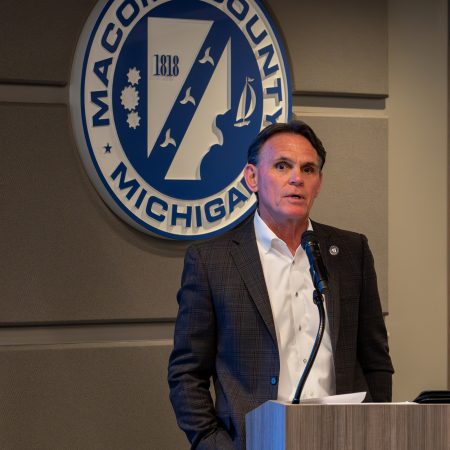
County Executive Mark Hackel summed up the situation in his annual State of Macomb County speech.

Hackel says the county is not just weathering the ebbs and flows of the overall U.S. economy but thriving in the midst of them.

Listen: Macomb executive says county thrives despite economic uncertainty

The following interview has been edited for length and clarity.

Mark Hackel: With our financial situation, our economic foundation, we’re in a great place. I know the things that you’re hearing across the country are challenging. But there’s so many things that kind of help lift us up. We’re pretty diverse too, though we rely heavily upon the automotive and defense industries and manufacturing. But the reality is Macomb is in a very sound place.

Quinn Klinefelter, WDET News: President Trump’s tariffs have impacted various segments of the U.S. economy, including the auto sector, which does have a pretty significant presence in Macomb County. Some of the prices for vehicles are starting to climb now. Do you have any concerns about how tariffs or the overall economic outlook are going to impact jobs or other parts of Macomb County’s economy?

MH: We’re always concerned about what happens at the federal and or state level that may have an impact on our economy. But look at what happened in 2010. There was a huge challenge with manufacturing, job losses, housing shortages that we faced back then. And we doubled down on manufacturing. By doing so, we’ve seen our economy continue to grow here.

Macomb County is a $54.2 billion economy. That’s bigger than the states of Vermont and Wyoming. We are right now at an all-time high. There’s never been a better time in Macomb County with our economy being as robust as it is right now. So whatever might happen with some of these tariffs or other economic concerns, we’re not seeing it directly have an impact right now. We’re in a good place with that.

QK: There is some financial stress in other parts of the country, other parts of Michigan, other parts of metro Detroit, for that matter. In your view, why is Macomb County doing well when some of these other places are having a bit of a struggle?

MH: We decided to double down on manufacturing. We retooled some of our manufacturing facilities. They’re different than they once were. We upgraded them. We really put a full-court press on making sure people understood that with our workforce, from concept to consumer, no one does it better than right here in southeast Michigan. And Macomb County is a major part of that. We are the defense capital of the Midwest. More contracts are awarded to Macomb County, as far as the actual number and the money associated with them, than anywhere else in the entire Midwest. So we keep promoting that, we keep pushing that.

And I think all the attention that we’ve been trying to drive has really helped us. We used a protecting growth strategy when we first got in and worked with the state on that. And we’ve done so well that we’re not really as worried about protecting anymore because we’re seeing that continuous growth. So we’re fortunate. Working with everybody has really had an impact on where we’re at today.

QK: In last year’s State of the County speech, you said that Macomb needed to focus on partnerships instead of partisanship. There was a line about not reaching across the aisle but getting in the aisle. How’s that bipartisan effort been going for you?

MH: Aside from a certain election here or there, for the most part, partisanship is not our conversation. None of that drives what we do here in Macomb County. People are willing to work with each other. You’ve heard that phrase, “Us versus everybody.” Some sports teams use it sometimes, municipalities or communities use it, as a sense of pride, a sense of esprit de corps. But when I look back on 15 years of how Macomb County has got to where it’s at and how we’ve evolved, we’ve kind of flipped the narrative on that. We look at it as, “Macomb with everybody.”

We’re trying to partner at the local, state and federal level. And never do we look at it as, “We can’t talk to them because they’re Democrats or Republicans. We can’t let their idea soak through or let them get successful because their party may get credit for it.” We don’t talk about that, don’t think about it. It’s a call for everybody who wants to come to be part of the solution. And if somebody looks more like they’re wanting to be part of the problem or be just a naysayer, we accept that. But the reality is we continue to forge ahead with people that want to provide solutions and help us get to where we need to go.

QK: When you talk about bipartisan cooperation, there are elections next year that could be pretty significant on a number of fronts. Michigan U.S. Rep. John James, for one, is running for governor and leaving a seat open that represents part of Macomb County. And there is a gubernatorial race underway. Whoever ultimately wins, what would you like to see from Lansing that you think could really affect Macomb County?

MH: That same willingness to partner and work with us rather than figure out how they could get credit by giving support to one particular area or segment of the state as opposed to somewhere else. Ensuring they are not ignoring any community within the state of Michigan. Specifically for Macomb County, whoever the governor is needs to realize they’re not the governor on behalf of the party, they’re the governor on behalf of the people. So govern on behalf of the people. That’s all I ask from whoever the next governor is. Work together on projects that matter, whether it’s in Macomb County, southeast Michigan or beyond.

QK: In terms of the partnerships that you’ve had, are there specific projects that you would like to see either the state or the federal government partner with Macomb on? Or projects that you’re pleased that they have partnered with you on to date?

MH: I’ll go with the ones I’m pleased that they have done to date. We got some support from the state because they realized the importance of our new jail project. It isn’t just about a jail. It’s about dealing with people that are going to be assessed for mental health or substance abuse when they’re brought in at the first point of contact. Every municipality now is partnered-in on this particular facility. We make a determination whether there’s any substance abuse, then decide what we need to do. The state partnered with us with some financial contributions because it impacts the state prison system too. When people are leaving our facility and sentenced on a felony, they’re going to the state facility. We look at what happened with Mound Road, a quarter of a billion dollar project. We got some state funding to help support that as well as federal and local. And then look what happened with Selfridge Air National Guard Base and us pushing the defense industry here in Macomb County. We are the defense capital of Midwest. And I do declare that at some point in time we’re going to be the defense capital of America.

There’s so much happening and we’re so excited about that. But there’s more to be done. We’re partnering on trying to figure out how we retool a facility or find a new use for the Romeo Ford engine plant. We’re looking at the Romeo airport. There’s a lot more that we need to do with our water quality. The support we get from Candice Miller and her team at Public Works. I’m telling you, there’s another trusted voice and a fierce advocate for cleaning our waterways and making sure we’re addressing underground issues. So, a lot has been happening. We’re going to continue those conversations and hopefully wherever the next governor is, they’re willing to address the issues that we’re talking about as opposed to politics.

The whole issue of where we’re headed as a region and even as a state is incredibly important. The biggest thing is that we all need to come together because we need to be competitive with other regions around the globe. And southeast Michigan is a major player. But our biggest challenge right now is our workforce, making sure that we’re attracting people to this area so they take on these jobs. That provides better opportunities for these manufacturers or companies that do the things that they do here in southeast Michigan. Us all coming together to promote the region as one.

Trusted, accurate, up-to-date.

WDET strives to make our journalism accessible to everyone. As a public media institution, we maintain our journalistic integrity through independent support from readers like you. If you value WDET as your source of news, music and conversation, please make a gift today.

Donate today »

The post Macomb executive says county thrives despite economic uncertainty appeared first on WDET 101.9 FM.

Saline residents mobilize against planned $7 billion data center

Residents in Saline Township are hoping to create a “critical mass” of concerned citizens  at a virtual public hearing Wednesday night over a proposed $7 billion data center backed by tech giants OpenAI and Oracle.

The Michigan Public Service Commission (MPSC) is holding the hearing to review DTE Energy’s application to supply power for the 1.4-gigawatt facility. DTE is also seeking approval for an additional $300 million substation dedicated to the project.

Saline Township resident Tim Bruneau is helping mobilize local residents to stop the project’s construction. He says he fears the plan is being pushed through too quickly and worries about how the data center could influence future policy.

“This is going to affect every DTE customer and it might set a precedent for other utilities in our state and possibly even nationally,” Bruneau said.

Bruneau says he had a disturbing conversation with a DTE spokesperson at a recent Saline Township board meeting regardingt how the company would prioritize power during outages.

“He told me that number one priority is hospitals, fire and police stations, and number two would be senior citizen facilities,” Bruneau said. “I asked him if data centers would be number three and he refused to reply.”

In a press release, MPSC Chair Dan Scripps said Wednesday’s hearing will “add an important element of transparency in evaluating DTE Electric Co.’s proposed special contract.”

Find a link to join the virtual public meeting here.

The post Saline residents mobilize against planned $7 billion data center appeared first on WDET 101.9 FM.

The Metro: How to choose the right tree for the right place in 2026

Choosing the right tree to plant that will thrive long into the future just got easier.

Michigan’s tree canopy is changing due to climate change. Whether it’s due to invasive species, flooding and drought, or extreme heat, some species will do better than others.

The Michigan Department of Natural Resources recently released a 57 page species selection guide that rates species for climate change resiliency and hardiness using characteristics like size, shade and rainwater absorption.

Lawrence Law is an urban and community forester and partnership coordinator with the Michigan Department of Natural Resources. He led the development of the Michigan Communities Tree Species Selection Guide.

He says some species that are ubiquitous in Southeast Michigan, like Silver Maple (rated 1 of 10), are poor choices compared to lesser-known ones like Kentucky Coffeetree (rated 10 of 10) due to climate adaptability.

“I have seen so many good examples of Kentucky Coffeetree in the area. It’s just a powerhouse. You can get cultivars that are seedless and it’s like boom, plant and forget, almost.”

Law spoke with David Leins on The Metro about how people can use the guide to choose the right tree for their yard or right-of-way.

WDET’s Detroit Tree Canopy Project is supported by a grant from the Michigan Department of Natural Resources. 

Listen to The Metro weekdays from 10 a.m. to noon ET on 101.9 FM and streaming on demand.

Subscribe to The Metro on Apple Podcasts, Spotify, NPR.org or wherever you get your podcasts.

Trusted, accurate, up-to-date.

WDET strives to make our journalism accessible to everyone. As a public media institution, we maintain our journalistic integrity through independent support from readers like you. If you value WDET as your source of news, music and conversation, please make a gift today.

Donate today »

The post The Metro: How to choose the right tree for the right place in 2026 appeared first on WDET 101.9 FM.

DNR makes progress in months-long ice storm cleanup

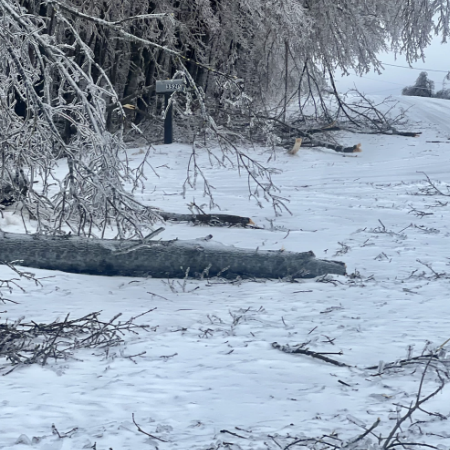
The Michigan Department of Natural Resources has cleaned up most of the tree damage from last winter’s historic ice storm in the northern Lower Peninsula.

But crews are not done yet.

Many broken limbs still dangle from treetops, while fallen branches block backroads in many counties.

DNR fire management specialist Nate Stearns says debris shut down more than 3,000 miles of state forest roads at one point. Since then, they have fully or partially reopened most of them.

“We’re at 366 miles of impassable roads and 169 miles of partially closed roads, so we’ve made some really good progress,” he says.

A tree rests on the roof of a house in northern Michigan.

Fire danger looms in 2026

Fallen timber remains on the ground in some hard-to-reach areas, providing potential fuel for wildfires. Stearns says that hasn’t been a problem this year, but it could cause trouble next spring.

“As that dries out and starts to decay, it’ll be like tinder for starting a campfire,” he says. “And any fire that does start on state land could give responders a more difficult time with access and fire intensity.”

Stearns says property owners in the northern Lower Peninsula and the eastern U.P. should consider composting or chipping wood debris instead of burning it. He says that will reduce the risk of wildfires.

More work to do

The DNR took a break from cleanup during Michigan’s firearms deer hunting season. But crews will try to pick up as much debris as they can before heavy snow forces them to wait until the spring to resume.

The ice storm also caused widespread power outages in 12 counties. The Federal Emergency Management Agency granted Gov. Gretchen Whitmer’s initial request for disaster aid. In October, she asked for more assistance, but FEMA rejected it.

Trusted, accurate, up-to-date.

WDET strives to make our journalism accessible to everyone. As a public media institution, we maintain our journalistic integrity through independent support from readers like you. If you value WDET as your source of news, music and conversation, please make a gift today.

Donate today »

The post DNR makes progress in months-long ice storm cleanup appeared first on WDET 101.9 FM.

Spotting the invasive spotted lanternfly in Dearborn

Last month, a highly invasive insect was spotted for the first time on the University of Michigan-Dearborn’s campus. The Environmental Interpretive Center (EIC) identified the spotted lanternfly, a sap-sucker that has been making its way across the U.S. since 2014. 

The first confirmed colony in Michigan was found in Oakland County in 2022

Program and natural areas manager for the EIC Rick Simek says that spotted lanternflies don’t usually kill their host trees outright, but as their numbers grow, so does the damage they can do to the environment as they feed.

Environmental harm

Infestation weakens the host tree’s ability to withstand disease, drought, and other pests.

“They have been known to kill off the saplings of a couple of native tree species,” says Simek. He lists black walnuts and maples as examples. 

Spotted lanternfly displaying its bright red underwing.

Simek said that the spotted lanternfly’s dietary habits are especially hard on fruit-bearing plants, like the river grapes that provide nutrition for birds in the EIC’s natural area. 

The spread of the spotted lanternfly poses trouble for Michigan’s produce, predicts Simek. “Lanternfly infestations can cause real harm to grapes, both cultivated and wild… [which is] cause for  serious agricultural and economic concern.”

Thankfully, the spotted lanternflies do not bite or pose direct harm to humans. However, the sugary “honeydew” that they excrete attracts mold, wasps, and other pests. 

Squish and scrape

What should you do once you identify a spotted lanternfly?

“One of the control methods—I’ve seen actual videos on this, it’s fairly commonly practiced—is to squish them!” says Simek. “Just make sure to become familiar with what lanternflies look like before squishing, but they are easy to identify.”

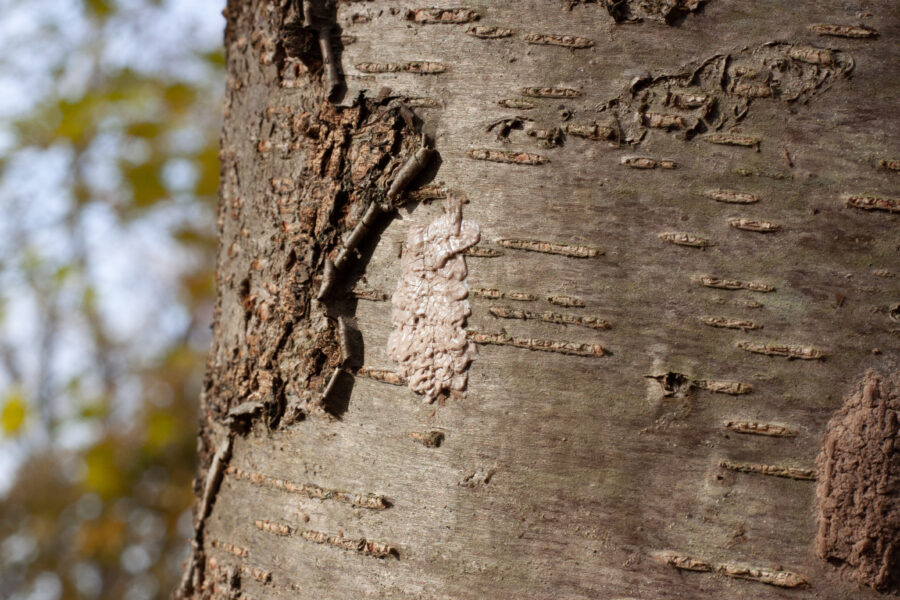
Spotted lanternfly egg mass.

Also, it’s good to remove their egg masses, which look a bit like chewed gray-brown gum, advises Simek. And definitely check for hitch-hiking lanternflies while entering and exiting natural areas. 

Fall is the season to look for and remove egg masses before they hatch in spring. 

Vigilance helps slow the spread

It’s important to reduce the spotted lanternfly’s ability to reproduce and spread as much as possible. 

“One of the things we don’t want to see here on campus, of course, is for it to become a breeding area that produces lanternflies that can spread around the area even more,” says Simek. Thankfully, the EIC is well maintained and better prepared for invasive visitors.

The spotted lanternfly’s preferred host, tree of heaven, has been regularly removed from the Environmental Interpretive Center’s grounds for years. Tree of heaven is a particularly entrenched invasive plant that comes from the same region as the spotted lanternfly. As a favorite food source, it is a marker of where to look for the insect. 

Additionally, birds and bats are beginning to recognize spotted lanternflies as a food source. The near 121 acres of the EIC’s natural center helps support those populations. Though, Simek notes, its being theorized that spotted lanternflies become less appetizing after eating tree of heaven. 

That’s one more reason to be diligent about removing the invasive plant. 

Report sightings

The spotted lanternfly’s impact on the tree canopy at large remains to be seen. 

The DNR says all sightings by the public should be reported

So far, spotted Lanternflies have been seen in Wayne, Oakland, Lenawee, and Macomb counties.

“It’s the new invasive kid on the block,” says Simek. “We’re probably going to see them more and more, and then we’re all going to find out what their impacts are.”

Trusted, accurate, up-to-date.

WDET strives to make our journalism accessible to everyone. As a public media institution, we maintain our journalistic integrity through independent support from readers like you. If you value WDET as your source of news, music and conversation, please make a gift today.

Donate today »

The post Spotting the invasive spotted lanternfly in Dearborn appeared first on WDET 101.9 FM.
Michigan Congresswoman Dingell fears Trump’s proposed limits to Clean Water Act

The Trump administration wants to cut the number of waterways protected under the Clean Water Act.

Some business owners and developers say the move would help them operate better because it would change which wetlands and streams legally count as an “official water of the United States.”

Those designations are covered by the Clean Air Act, which was originally written in part by the late Michigan Congressman John Dingell.

His wife, current U.S. Rep. Debbie Dingell, says protecting streams and wetlands helps stop pollution from flowing to large bodies of water like the Great Lakes.

Listen: Rep. Debbie Dingell on cuts to the Clean Water Act

The following interview has been edited for length and clarity.

U.S. Rep Debbie Dingell: People that are seasoned, like myself, know what our waters used to look like. And John Dingell was really the significant author of the Clean Water Act, along with the late former U.S. Sen. Ed Muskie. And he did it because the Rouge River caught on fire. Now, the consequences of what this administration is going to do would undermine the strong protections that have kept our water safe and healthy and have cleaned them up. So I’m very concerned that we not go backwards. We see the Great Lakes and our Detroit water system is significantly improved from where it was 30 years ago, 40 years ago. But we have to keep cleaning it up. And taking away those safeguards endangers our water.

Quinn Klinefelter, WDET News: Some environmental groups often raise concerns about runoff from farmland into waterways or companies dumping there illegally at times. Now they say this change proposed by the Trump administration could increase the chance of those types of activities happening. Do you agree with those kinds of concerns?

DD: I’m very, very concerned about what this means and what the real consequences are. Lake Erie has seen very significant experiences of algae blooms. People have actually been told not to drink tap water. So I think it’s very important that we make every effort to continue to clean up our water, protect our waters. And the administration’s announcement that they were going to roll back Clean Water Act regulations worries me greatly.

QK: On the other side, some business owners and farmers, among others, have said that they think the change will help them. It’ll limit the costs and regulatory red tape, they say, of having to check if a stream or other waterway on their property is covered under the Clean Water Act. They say it should be something that states regulate more than the federal government. What’s your reaction to those comments?

DD: We need to have federal regulation. Because here’s the reality. Water doesn’t say, “oops, I’m at a state line.” Do you think Lake Erie or the Detroit River know when they’ve crossed a state border? I think we should all be working together to keep our water safe. But when water runoff is going into major tributaries like the Huron River, the Rouge River, then goes into the Detroit River, which goes into the Great Lakes, there are consequences when there are things in those waters that are not safe. Things the public needs to be protected from. I want to reduce regulation. I want to look at how we can simplify. But undermining the goal of clean water is something that worries me greatly and something I will always fight for.

Trusted, accurate, up-to-date.

WDET strives to make our journalism accessible to everyone. As a public media institution, we maintain our journalistic integrity through independent support from readers like you. If you value WDET as your source of news, music and conversation, please make a gift today.

Donate today »

The post Michigan Congresswoman Dingell fears Trump’s proposed limits to Clean Water Act appeared first on WDET 101.9 FM.
Rochester’s ‘micro forest’ celebrates a successful season

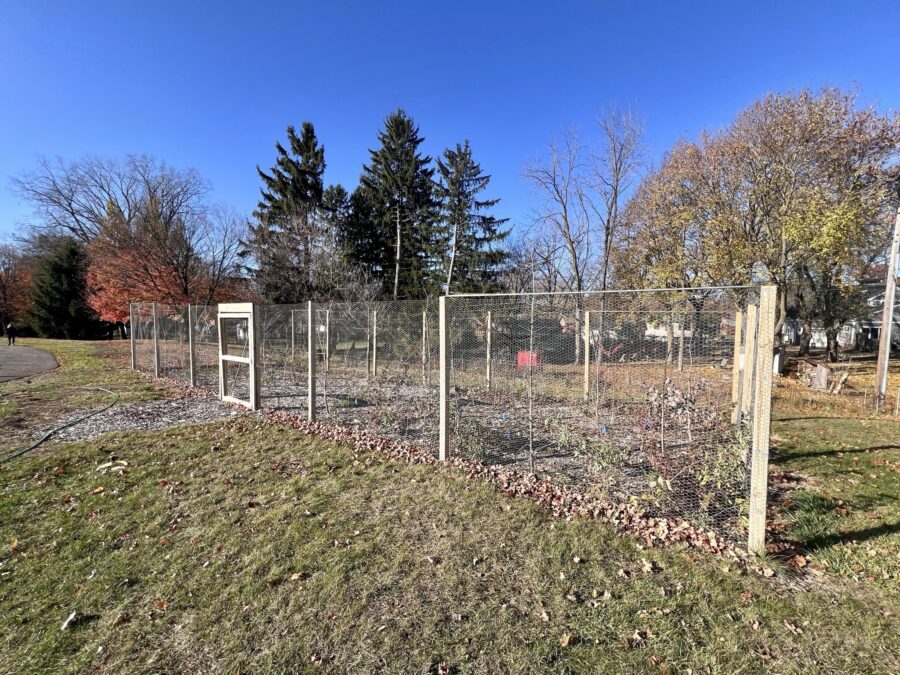
This past spring, the city of Rochester became home to a ‘micro forest,’ a dense grove of trees and shrubs planted in an area as small as 1,000 square feet. 

The micro forestry concept began in Japan and aims to support birds, insects, and other pollinators in heavily urbanized communities. Specifically helping to remediate degraded soil caused by human development. 

Rochester City Council member Marilyn Trent spearheaded the project with the help of volunteers, arborists, and city officials. 

“The response from the community was absolutely phenomenal,” she says. 

Trent based Rochester’s micro forest on the famous Miyawaki method of planting native plants, trees and shrubs thirty times as dense as usual, a very different method of helping water mitigation, pollinator species support, and carbon capture than re-foresting or rewilding land. “We’re not trying to replicate a forest,” Trent adds.  

Trent says other cities in metro Detroit have reached out with interest in replicating the project in their communities. With one growing season successfully over, she says the biggest lesson so far is be prepared to water, water, water. 

“Keep it watered…that is one thing. And thank goodness for the DPW [Department of Public Works] when the drought starts coming in July or August, you have to keep it watered,” she says.

This story is a part of WDET’s Detroit Tree Canopy Project

Support local journalism.

WDET strives to cover what’s happening in your community. As a public media institution, we maintain our ability to explore the music and culture of our region through independent support from readers like you. If you value WDET as your source of news, music and conversation, please make a gift today.

The post Rochester’s ‘micro forest’ celebrates a successful season appeared first on WDET 101.9 FM.
The Metro: Big Tech eyes Michigan, but at what cost for residents?

Michigan is racing toward the data center boom that powers artificial intelligence and cloud computing. Lawmakers have approved generous tax breaks, and utilities are courting multi-billion-dollar projects, including a proposed $7 billion “hyperscale” campus in rural Saline Township, backed by tech giants OpenAI and Oracle. 

Supporters promise investment and new tax revenue. But critics warn that these vast, windowless buildings could come with higher electric bills, heavy demands on local water supplies, and pressure to keep fossil fuel plants running long past Michigan’s clean energy deadlines. 

So who really pays for Michigan’s data-center gold rush, and who gets to decide?

Brian Allnutt, a senior reporter and contributing editor at Planet Detroit, has been following Michigan’s data center deals from the state capitol to township board meetings and courtroom settlements. He joined Robyn Vincent to help make sense of the choices Michigan faces.


Listen to The Metro weekdays from 10 a.m. to noon ET on 101.9 FM and streaming on demand.

Subscribe to The Metro on Apple Podcasts, Spotify, NPR.org or wherever you get your podcasts.

More stories from The Metro

The post The Metro: Big Tech eyes Michigan, but at what cost for residents? appeared first on WDET 101.9 FM.

The Metro: The case for a Detroit land conservancy

Detroit has finally started to regain some population, but it has a long way to go. And that means there’s still a lot of vacant land — 18 square miles of it — that’s just sitting around. What should be done with it?

The local think tank Detroit Future City has an idea

They are creating a conservancy to protect and steward the land today and well into the future. The Detroit GreenSpace Conservancy wants to protect forests and meadows, and build walking paths and opportunities for agriculture. 

Producer Sam Corey spoke with Kimberly Faison, the vice president for thriving and resilient neighborhoods and Sarah Hayosh, the director of land use and design for Detroit Future City.

Listen to The Metro weekdays from 10 a.m. to noon ET on 101.9 FM and streaming on demand.

Subscribe to The Metro on Apple Podcasts, Spotify, NPR.org or wherever you get your podcasts.

Support local journalism.

WDET strives to cover what’s happening in your community. As a public media institution, we maintain our ability to explore the music and culture of our region through independent support from readers like you. If you value WDET as your source of news, music and conversation, please make a gift today.

More stories from The Metro

The post The Metro: The case for a Detroit land conservancy appeared first on WDET 101.9 FM.
Muck runs amok in Lake St. Clair

Harmful algal blooms form in western Lake Erie every summer. Scientists monitor the water for toxic bacteria and caution people not to swim in areas where they see green scum on the surface.

Lake St. Clair has its own algae problem. It has fascinated scientists and frustrated lakeshore residents.

What is it?

Its scientific name is Microseira wollei, but folks in Macomb County have their own name for it—the “muck.”

M. wollei has been a problem in the lake since at least 2010. That’s when large mats of algae were seen floating on the surface of the water near the Lake St. Clair Metropark beach in Harrison Township.

It caught the attention of biologists, including Donna Kashian. She’s the director of Environmental Science at Wayne State University. Kashian and three other scientists went to the beach in 2010 to take water samples and study the algae, which had a different name at the time, Lyngbya wollei. Whatever one calls it, Kashian says it’s not hard to spot.

Donna Kashian is Wayne State University’s Director of Environmental Science.

“It forms these little balls,” she says. “When you’re walking along the beach, you’ll see these ribbons, essentially along where the water’s washing up, where you’ll see the muck accumulating.”

How bad is it?

The muck has spread to other parts of Lake St. Clair over the last 15 years. Steve Dobreff owns the Freedom Boat Club in Harrison Township. He says it has grown so thick in some places that people can’t use their docks.

“That guy over there has a boat launch,” Dobreff says, pointing to an area on Campau Bay near the boat club. “This guy over here used to have a dock…that’s gone.”

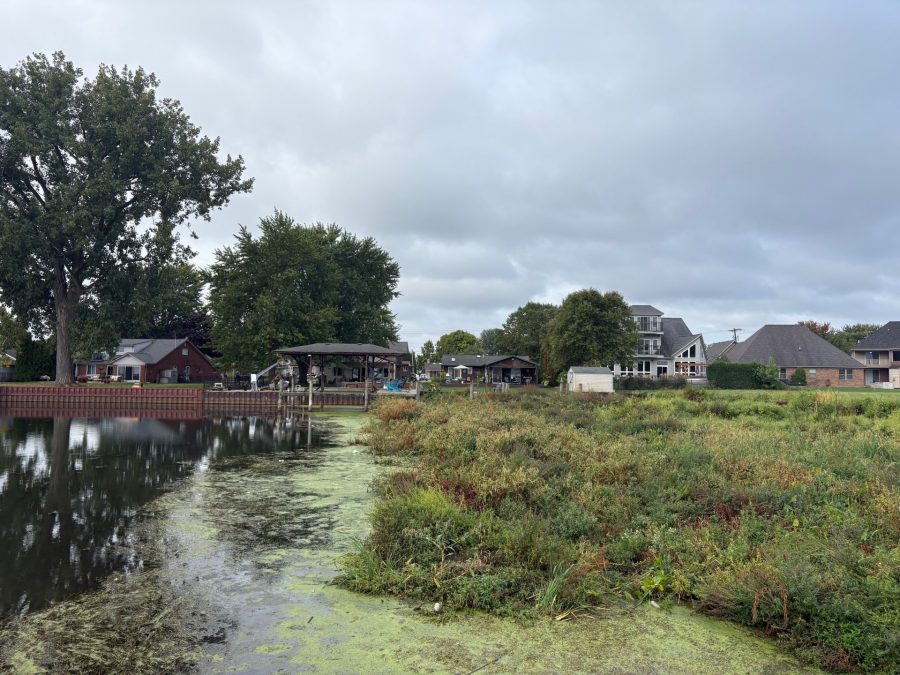
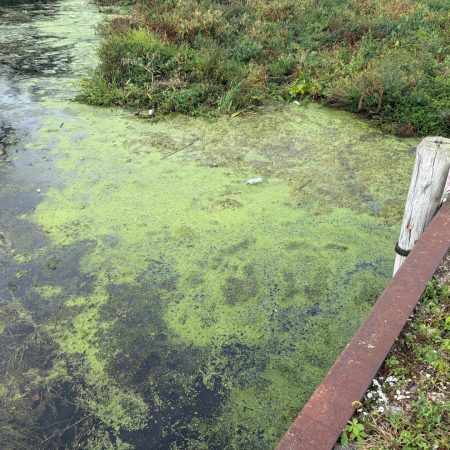
Algae and weeds have grown so thick in parts of Lake St. Clair that people can’t use docks.

Dobreff says the muck has even fouled the water near the lakeshore neighborhood where he grew up near L’anse Creuse Bay. 

“This was beautiful water, and it was all sandy beaches,” he says. “This is where we spent the majority of our time growing up right here on this dock and hanging out right here in this area.”

Now, Dobreff says, the muck has made it unswimmable.

Steve Dobreff owns the Freedom Boat Club in Harrison Township.

How did it get here?

But where did the muck come from? Prof. Kashian says the explanation is murky. She says it turned up in Lake Erie years before appearing upstream in Lake St. Clair, which is kind of backwards.

“Usually things move downstream, not upstream,” she says. “So we don’t know if it was transported by boats or it was possibly there at some low level.”

However long it’s been there, Kashian says removing the muck won’t be easy. She says warmer water, more frequent storms, sewage discharges, and fertilizer runoff are all variable factors in its growth.

“I think we’re going to see patterns where some years we have more of it, and then other years we won’t see it,” she says.

Cutting off its “food” might help

One way to see less muck might be to reduce combined sewer overflows into the lake. Kashian says the algae trap E. coli, a common cause of beach closures.

Macomb County Public Works Commissioner Candice Miller says her department has reduced CSOs by half since she took office and will expand its infrastructure in 2026 to keep more sewage out of the lake.

“We’re going to be announcing another project, which will take us really just about to 0%,” Miller says. “I mean, you might have an occasional discharge, but we are doing pretty darn good.”

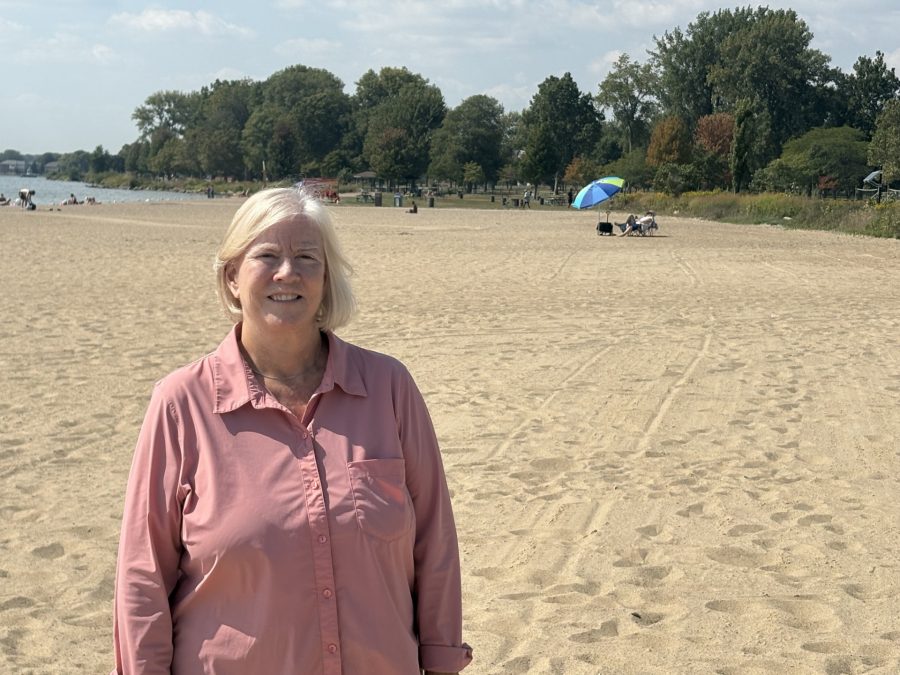
Candice Miller smiles on the beach
Candice Miller is Macomb County’s Public Works Commissioner.

Miller says she’s working with state and federal agencies to solve the muck problem. The Michigan Legislature set aside $800,000 in its 2026 budget to start the process.

State Representative Alicia St. Germaine sponsored that appropriation. She says that’s how Alabama tackled the problem in its lakes.

“They removed it and then treated it with an algaecide, and they mitigated it by more than 80%” St. Germaine says.

What’s being done about it?

The Army Corps of Engineers published a study in 2023 showing that algaecides are effective at controlling M. wollei. But eradicating the muck is unlikely because it’s so widespread. Instead, the corps has proposed a plan to manage the algae growth and limit its effects.

Rep. St. Germaine says the sooner officials can attack the muck, the sooner people in her lakeshore district can get some relief.

“I have visited several constituents who can’t even go outside and sit on their patio because this algae, this toxic algae, is smelly and gross and even hard to look at,” she says.

Like the algae that grow in Lake Erie, M. wollei can produce toxins that can cause liver and neurological damage. Prof. Kashian says she and her colleagues looked for the gene that produces those toxins and did not find it in this strain of algae.

For now, the muck has given Kashian and her classes at Wayne State plenty to study.

Trusted, accurate, up-to-date.

WDET strives to make our journalism accessible to everyone. As a public media institution, we maintain our journalistic integrity through independent support from readers like you. If you value WDET as your source of news, music and conversation, please make a gift today.

Donate today »

The post Muck runs amok in Lake St. Clair appeared first on WDET 101.9 FM.

DNR awards new community grants to grow Southeast Michigan’s urban tree canopy

The Michigan Department of Natural Resources is giving money to 25 communities and organizations to help grow local urban tree canopies.

Awardees include the cities of Oak Park, Ferndale, Port Huron, and St. Clair Shores, as well as non-profit groups like Arboretum Detroit and Detroit Horsepower.

Kerry Gray, who works with the DNR’s Urban and Community Forestry program, explains that these grants are part of a long-standing partnership with the DTE Energy Foundation.

The DNR has worked with the DTE Energy Foundation since probably almost 30 years now, providing grants to communities and organizations for tree planting to help expand their tree canopy and strengthen local green infrastructure,” Gray says.

She says one goal of the grant is making sure the new trees are species diverse to help prevent problems like the widespread tree loss caused by invasive pests.

“I think we’ve all seen the devastation that happened when the emerald ash borer came in and attacked [a] species that we had an overabundance of, which was ash,” Gray says. “We really focus on making sure that all of our grantees are using a diverse palette of species…we work with them and provide support to help them select species that are suitable for their sites and locations.”

More information about Michigan’s tree canopy initiative can be found through the Mi Trees program, which aims to plant and care for 50 million new trees across the state by 2030.

This story is part of WDET’s ongoing series, The Detroit Tree Canopy Project.

Trusted, accurate, up-to-date.

WDET strives to make our journalism accessible to everyone. As a public media institution, we maintain our journalistic integrity through independent support from readers like you. If you value WDET as your source of news, music and conversation, please make a gift today.

Donate today »

The post DNR awards new community grants to grow Southeast Michigan’s urban tree canopy appeared first on WDET 101.9 FM.

The Metro: How healthy is the Huron River?

The Huron River is one of the most prominent in our state, and 650,000 people live in the watershed. But you can’t eat fish from the Huron River. After years of unregulated industry, dumping and pollution, PFAS, also known as ‘forever chemicals’ are part of the Huron.

There’s also a toxic Dioxane bloom moving through groundwater towards the Huron River—the source of drinking water for Ann Arbor.

But it’s not all doom and gloom. Awareness about PFAS is increasing, and so are the solutions that can improve river health. Some are policies being introduced at the state level, like so-called “Polluter Pay Laws” introduced by Michigan Democrats and supported by environmental organizations.

On Wednesday, November 12, the Huron River Watershed Council will host a one-day conference, “State of the Huron” to discuss the health of the Huron River and chart its next chapter.

Rebecca Esselman, Executive Director of the Huron River Watershed Council, joined the Metro to talk about the present and future health of the Huron River.

Listen to The Metro weekdays from 10 a.m. to noon ET on 101.9 FM and streaming on demand.

Subscribe to The Metro on Apple Podcasts, Spotify, NPR.org or wherever you get your podcasts.

Trusted, accurate, up-to-date.

WDET strives to make our journalism accessible to everyone. As a public media institution, we maintain our journalistic integrity through independent support from readers like you. If you value WDET as your source of news, music and conversation, please make a gift today.

Donate today »

The post The Metro: How healthy is the Huron River? appeared first on WDET 101.9 FM.
Don’t toss your Halloween pumpkin — bake, compost or feed it to farm animals instead

By KIKI SIDERIS

Don’t let your Halloween pumpkin haunt the landfill this November.

More than 1 billion pounds of pumpkins rot in U.S. landfills each year after Halloween, according to the Department of Energy.

Yours doesn’t have to go to waste. Experts told us your pumpkins can be eaten, composted or even fed to animals. Here’s how.

Cooking with pumpkin waste

If you’re carving a jack-o’-lantern, don’t throw away the skin or innards — every part is edible.

After carving, you can cube the excess flesh — the thick part between the outer skin and the inner pulp that holds the seeds — for soups and stews, says Carleigh Bodrug, a chef known for cooking with common food scraps. You can also puree it and add a tablespoon to your dog’s dinner for extra nutrients. And pumpkin chunks can be frozen for future use.

“The seeds are a nutritional gold mine,” Bodrug said. They’re packed with protein, magnesium, zinc and healthy fats, according to a 2022 study in the journal Plants.

FILE - Children visit a pumpkin farm ahead of Halloween in Warsaw, Poland, Oct. 29, 2024. (AP Photo/Czarek Sokolowski, File)
FILE – Children visit a pumpkin farm ahead of Halloween in Warsaw, Poland, Oct. 29, 2024. (AP Photo/Czarek Sokolowski, File)

One of Bodrug’s recipes involves removing the seeds, rinsing and roasting them with cinnamon for a crunchy snack or salad topper. Then you can use the stringy guts to make a pumpkin puree for muffins. This version differs from canned purees in grocery stores — which typically use a different type of pumpkin or squash — because carving pumpkins have stringier innards and a milder flavor. A carving pumpkin’s guts can still be used for baking — you’ll just have to amp up the seasoning to boost the flavor.

If you don’t want to eat your pumpkins, you can donate them to a local farm, which might use them to feed pigs, chickens and other animals.

Edible parts should be collected while you’re carving and before it’s painted, decorated or left on your porch for weeks. Paint and wax aren’t food-safe, and bacteria and mold can grow on the skin in outdoor climates.

Once you’ve cooked what you can and donated what’s safe to feed, composting the rest is the easiest way to keep it out of the landfill.

“That way, even though they’re not safe to eat, they can still give back to the earth,” Bodrug said.

Composting at home or donating to a farm

Composting pumpkins keeps them out of methane-emitting landfills and turns them into nutrient-rich soil instead. You can do this at home or drop them off at a local farm, compost collection bin or drop-off site.

FILE - Pumpkins sit at the Tougas Family Farm on Oct. 5, 2025, in Northborough, Mass. (AP Photo/Charles Krupa, File)
FILE – Pumpkins sit at the Tougas Family Farm on Oct. 5, 2025, in Northborough, Mass. (AP Photo/Charles Krupa, File)

“A large percentage of what ends up going to the landfill is stuff that could have been composted,” said Dante Sclafani, compost coordinator at Queens County Farm in New York. “So even just cutting down something like pumpkins could really help curb how many garbage bags you’re putting out every week.”

Before composting, remove any candles, plastic, glitter, or other decorations — they can contaminate the compost. A little glitter or paint won’t ruin the pile, but it’s best to get it as clean as possible before tossing it in. Then, chop up the pumpkin in 1-inch pieces so it can break down easier.

“Pumpkins are full of water, so it’s important to maintain a good balance of dried leaves, wood chips, sawdust, shredded newspaper, cardboard, straw — anything that’s a dry organic material — in your compost bin,” Sclafani said. If you don’t maintain this balance, your compost might start to stink.

According to the Environmental Protection Agency, a healthy compost pile should include a mix of “greens” — like pumpkin scraps and food waste — and “browns” like dry leaves, straw or cardboard, in roughly a three-to-one ratio. That balance helps the pile break down faster and prevents odors.

And if your pumpkin’s been sitting on the porch all month? That’s actually ideal. “It’s never too far gone for compost,” Sclafani said. “Even if it’s mushy or moldy, that actually helps, because the fungus speeds up decomposition.”

“Composting anything organic is better than throwing it out because you’re not creating more refuse in landfills, you’re not creating methane gas,” said Laura Graney, the farm’s education director.

Graney said autumn on the farm is the perfect opportunity to teach kids about composting since it gives them a sense of power in the face of big environmental challenges.

“Even though they’re little, composting helps them feel like they can make a difference,” Graney said. “They take that message home to their families, and that’s how we spread the word.”

The Associated Press’ climate and environmental coverage receives financial support from multiple private foundations. AP is solely responsible for all content. Find AP’s standards for working with philanthropies, a list of supporters and funded coverage areas at AP.org.

FILE – A kid carves a pumpkin on the front porch of her home Oct 20, 2023, in Auburn, Maine. (Andree Kehn/Sun Journal via AP, File)

Oakland schools tech administrator earns national award

Oakland ISD administrator Dwight Levens Jr. has been awarded the 2025 Exemplary Service and Innovation for Technological Advancement Award.

This national award recognizes individuals who have demonstrated outstanding leadership and innovation in advancing educational technology.

Levens, Jr. is the chief technology and information officer for Oakland Schools, which serves over 175,000 students and 40,000 educators across 28 public school districts.

Levens’ team is responsible for instructional technology coaching and infrastructure modernization to cybersecurity and statewide application support.

The department’s initiatives include the AI Collective, which explores artificial intelligence applications in education in all 28 districts.
“Dwight’s leadership has fostered a culture where operational excellence meets educational innovation,” said Oakland Schools Superintendent Kenneth Gutman. “Oakland Schools Technology Services exemplifies the very mission of an educational service agency: to deliver visionary leadership and equitable access to high-quality services that improve outcomes for all learners.”

Levens' department oversees a cybersecurity ecosystem and manages large-scale consortia like MISTAR and MIPEER. Photo courtesy Oakland ISD

Explore Sand Point, a preserve with rare hemlocks and old growth potential

In the interior arch of Michigan’s “thumb” lays the Saginaw Basin Land Conservancy, a group dedicated to protecting and restoring surrounding natural areas. 

The conservancy currently owns and manages 9 properties in the region. One property, the Sand Point Nature Preserve, was recently recognized by the Old Growth Forest Network for its potential. 

As a well-established woodlot with trees over a hundred years old, Sand Point hosts migratory birds and and diverse species. Its wetlands aid in flood management. The property also has a rare grove of hemlock trees. 

Although the Old Growth Forest distinction doesn’t immediately grant the property strong legal protections, it does aid the Saginaw Basin Land Conservancy when they work to apply for grants and the like. And any additional support to protect the unique ecosystem right off the shores of Lake Huron is welcome. 

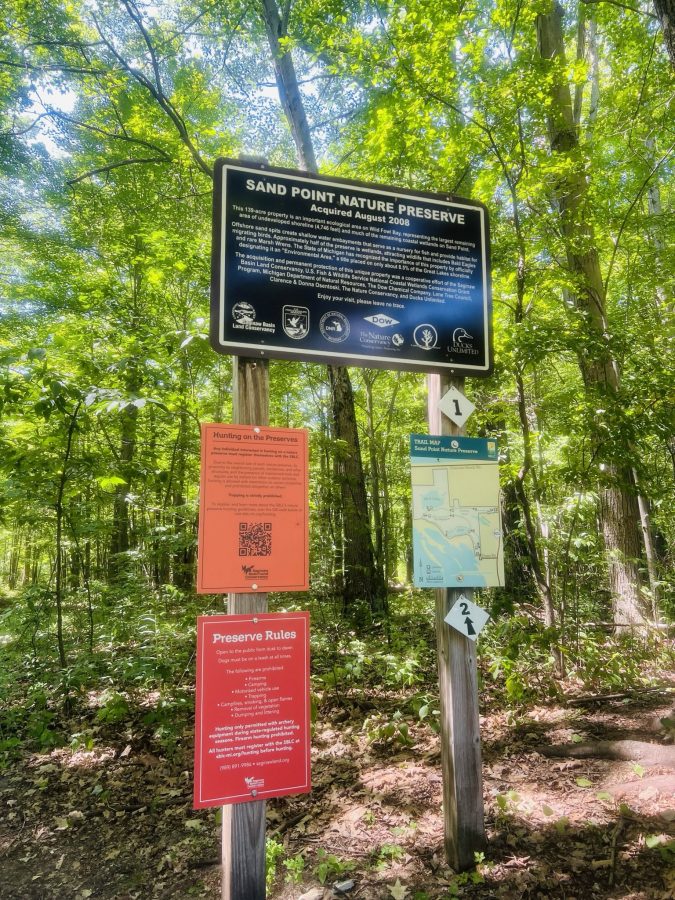
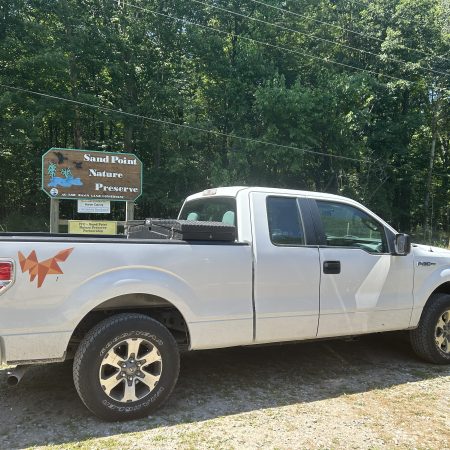
More signs at Sand Point showing the coordination to protect and preserve the healthy natural area.

Beyond the ecological, the Saginaw Basin Land Conservancy continues to protect the surrounding areas for the community to have access to the green space. Executive Director of Saginaw Basin Land Conservancy, Zachary Branigan emphasizes the importance of preserving nature.

Listen: Saginaw Basin Land Conservancy talks Sand Point, Old Growth Forest recognition

“ Having access to high quality outdoor recreation spaces is important, for any community. You know, that’s one thing that, that the highest quality communities in the nation have in common,” says Branigan. And nature preserves like Sand Point provide a space for hikers and dog-walkers, as well as a glimpse into more heavily wooded past. 

Exploring Sand Point

The Saginaw Basin Land Conservancy gained ownership over the 220 acres of undeveloped land through a series of land acquisitions between 2008-2012. 

Sand Point is the largest of the properties they oversee, and includes a wide range of features that make it a gem in the region that was hit hard by deforestation in the logging boom. Program Director Trevor Edmonds highlights some of the features on property.

Listen: Program Manager Trevor Edmonds walks us through Sand Point

 ”There’s some pretty dense mature forests. Like kind of open meadow areas, and then some, various types of wetlands on the property. There’s a lake, there’s kind of like a seasonal pond, on the property as well,”” says Edmonds. He adds that because of the diverse array of habitats, there’s diverse fauna, including reptiles and amphibians.

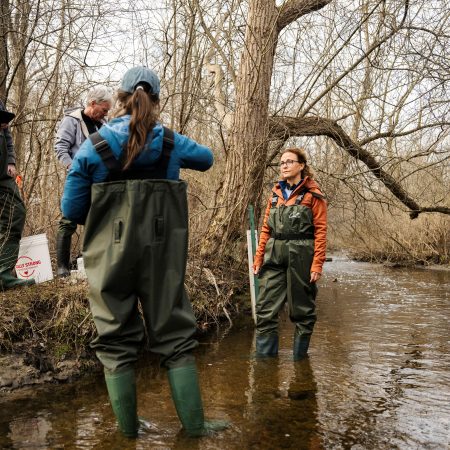
As a part of their mission to maintain high quality natural areas the Saginaw Basin Land Conservancy takes inventory of signs of health and potential threats to the established landscape. 

Signs of ecological health at Sand Point include different species of trees—Edmonds points out maple, black cherry, and paper birch in the immediate area. He also looks for indicator species, which foreshadow what kinds of vegetation will thrive in the future. 

Understory vegetation is another noted feature. “There’s a very robust canopy throughout much of this preserve’s acreage, which really kind of speaks to the overall health of the forest on this preserve.”

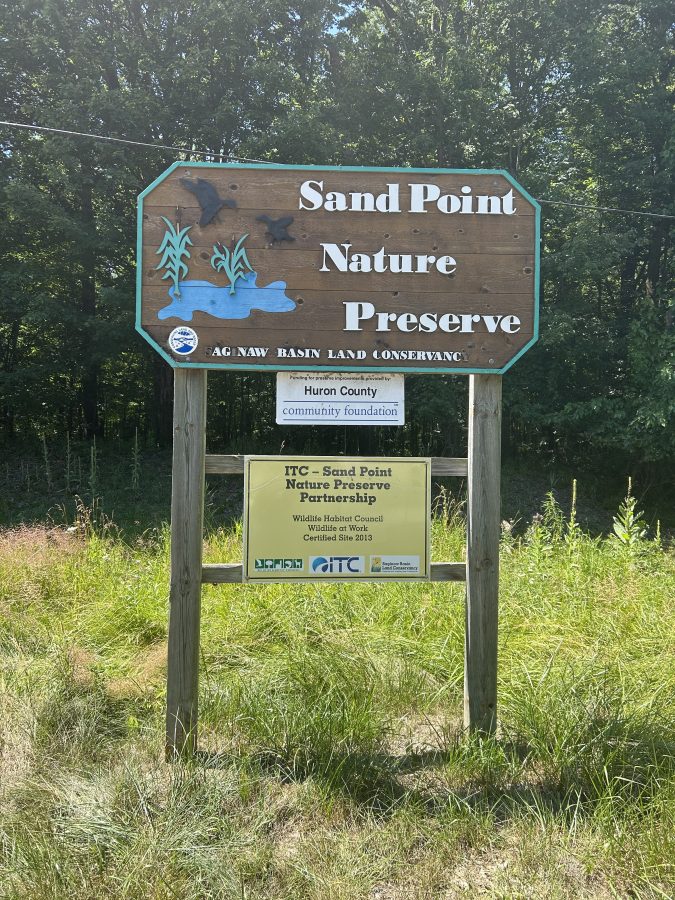
Sand Point Nature Preserve sign near the entrance of the property

Caretaking in nature

Edmonds then got into the weeds of property management at Sand Point. 

Since acquiring the property in full, the conservancy has become experts on the wetlands and woods that make up Sand Point, as well as the pests, diseases, and invasives that threaten them. 

The most present invasive on the property is phragmites, which Edmonds generally treats with hand-swiping—placing herbicide on a glove and targeting the undesirable plants in order to leave “the lightest touch possible” on the landscape. 

A deep knowledge of the environment helps Edmonds monitor for invasive species and disease in the areas they are most likely to appear in, and the places they can do the most harm. 

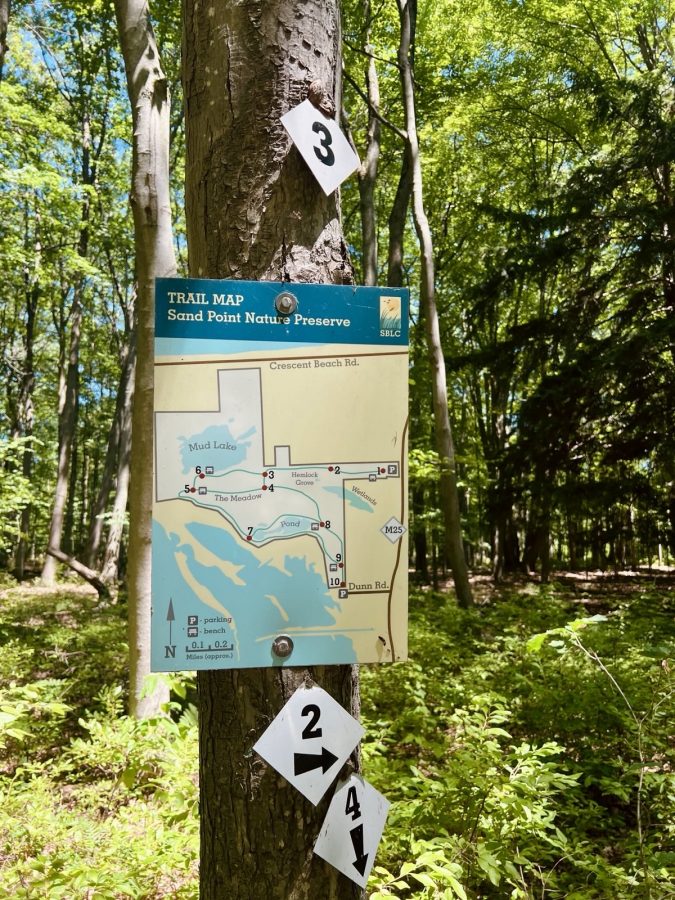
A trail map of Sand Point.

Eastern Hemlocks

One of the key features that garners attention at Sand Point is the Eastern Hemlocks. They aren’t a common tree throughout Michigan, and especially not in the thumb. Part of that is because they need a healthy tree canopy above them to grow. 

Branigan describes the hemlock groves as dark and brooding, and Edmonds say that they’re a part of why Sand Point is his favorite property— in addition to its reliable five lined skink sightings. 

However, hemlocks face a threat in the hemlock woolly adelgid. 

 Edmonds shares how the conservancy monitors for the threat. “You’re actually trying to look specifically at like the undersides of the needles. And if you actually see, like at the base of the needles where they connect to the branches, it basically will look…almost like kind of a white cottony mass that starts to like develop at the base of the needles, under the branches.”

Thankfully, Sand Point hasn’t caught any sign of the harmful pest so far. Edmonds says that its more present in the west side of the state. 

But, if woolly adelgid does appear, there are ways to treat it if its detected early. “You can do like a treatment around the base where the, the roots will bring it up into the canopy of the tree and basically like eliminate the infestation.”

For now, he and other conservationists in the area maintain a careful watch. 

Safeguarding access to a healthy environment

Conserving a large undeveloped land like Sand Point provides space for recreation, mitigating effects and causes of climate change, and a place for wildlife to thrive. 

It’s also an education in nature. Saginaw Basin Land Conservancy’s restoration and conservation efforts uplift their preserves as healthy ambassador landscapes, environments that serve as an example of what natural areas should be at their best. “While it does obviously serve an important purpose in and of itself, hopefully the people that come and visit our properties, across all the counties that we work in… take a little something home from that as well,” says Branigan. 

Additionally, it provides another place for people to fall in love with the environment.

Edmonds reflected on what it means to him as a new parent to see his daughter’s connection to nature grow. Although it’s more common to fall in love with the outdoors in one’s youth, he notes that it’s never too late for someone to click with nature. 

“Nature’s always here, and we want to be an entity that makes it be the case. We want nature to be here for people and then when they’re ready to receive it and you know, be a part of it and do what they can to protect it, then like that’s on them. But we just want to be facilitators for those times when they become receptive and ready for it.”

This story is a part of WDET’s Detroit Tree Canopy Project

Trusted, accurate, up-to-date.

WDET strives to make our journalism accessible to everyone. As a public media institution, we maintain our journalistic integrity through independent support from readers like you. If you value WDET as your source of news, music and conversation, please make a gift today.

Donate today »

The post Explore Sand Point, a preserve with rare hemlocks and old growth potential appeared first on WDET 101.9 FM.

❌