Tenants of Detroit’s historic Leland House plan to rally Saturday afternoon, accusing city officials of blocking them from retrieving their belongings after a sudden evacuation earlier this month and raising alarms about what they call a “hostile takeover” of the troubled and storied downtown building.
The first floor of the historic Leland House in downtown Detroit felt as cold as the street outside. That’s where Dianne Lamb stood on a recent morning, bundled in a hooded winter coat, her breath visible in the unheated air. She’d slept two hours and was worn out from packing. For the past 12 years, […]
State energy regulators heard from people last night who oppose a large data center project near Saline. The Michigan Public Service Commission held a virtual hearing on DTE Energy’s request to fast-track contracts with the project’s developers.
The data center would require DTE Energy to substantially increase its peak electrical load. The company says that won’t raise customer’s rate.
Cadillac resident Cody Gilbert spoke at the hearing. Gilbert is concerned about how the data center would affect that state’s goal to be carbon neutral by 2050.
“A project that uses thousands of gallons of water and tons of electricity, enough for thousands of home is not advancing that goal.”
Opponents say the facility would draw almost as much power as the city of Detroit.
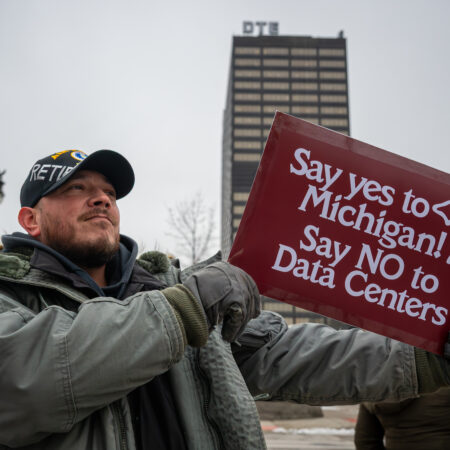
Protestors rallied Wednesday in Beacon Park near DTE Headquarters.
Elijah Williams lives in Detroit but is originally from Mississippi.
He says he feels his home state and Michigan are attractive to data companies because they have access to the large amounts of water needed to cool a data center.
“The access to the Great Lakes… they’re definitely taking advantage of whatever God-given resource in order to just implement whatever quantum…. whatever new level of science and technology that they haven’t got consent from the people on if they even want it in the first place.”
Sarah Brabbs is from York Township, next to Saline. While she is not totally opposed to the data center, she says she isn’t a fan of DTE trying to keep the public out of the process.
“Putting rate payers in a situation that you know we will be paying for…probably on multiple levels…is disingenuous, dysfunctional…and unacceptable.”
DTE said the data center’s operators would pay for the energy they use, almost 1.5 gigawatts.
Additional headlines from Thursday, December 4, 2025
VERDAD tool
Wayne State’s Damon J. Keith Center for Civil Rights received a $350 thousand grant for its AI powered tool “VERDAD”, which stands for Verifying and Exposing Disinformation and Discourse.”
VERDAD founder and journalist Martina Guzman says the tool started monitoring ethnic radio stations for disinformation in Latino communities.
“The tool records 24 hours a day… And once it hears misinformation… And it hears it based on hundreds and hundreds of disinformation keywords that we’ve uploaded into its system… once it hears one of those words, it begins to really focus and it has an analysis component.”
Since VERDAD launched last year, more than 320 academics and journalists have registered to use the free tool. It will expand to all 50 states in multiple languages, including Arabic, Haitian Creole, and Vietnamese.
Robocop statue
A long awaited 11-foot-tall bronze sculpture of Robocop has finally taken its permanent place in Eastern Market. The statue is located at 3434 Russell St.
Listen to the latest episode of the “Detroit Evening Report” on Apple Podcasts, Spotify, NPR.org or wherever you get your podcasts.
Support local journalism.
WDET strives to cover what’s happening in your community. As a public media institution, we maintain our ability to explore the music and culture of our region through independent support from readers like you. If you value WDET as your source of news, music and conversation, please make a gift today.
Michigan residents demanded more scrutiny of the plan to provide electricity to a proposed data center in rural Washtenaw County on Wednesday night.
They also expressed frustration and distrust with DTE Energy. The utility is asking the state for expedited approval of the company’s contracts with Oracle Corp. for a data center planned in Saline Township, near Ann Arbor.
The facility would require 1.4 gigawatts of power from the electricity provider. The data center is part of Stargate, OpenAI’s $500 billion investment in AI infrastructure around the United States.
DTE Electric has asked the Michigan Public Service Commission to fast-track approval for its plan with Oracle to power the data center. That would bypass a process called a “contested case” that requires the commission to consider evidence and testimony from a variety of sources. Michigan’s Attorney General expressed alarm about the process, calling the hearing “performative listening” in a rebuke last month.
Protest
A small group of protesters gathered Wednesday afternoon across the street from DTE Energy’s Detroit headquarters. They were unhappy that DTE has tried to push plans for the data center through without public hearing.
Sarah Brabbs is from York Township, next to Saline. While she is not totally opposed to a data center, she said she’s not a fan of DTE trying to push the project through without allowing the public in on the process.
“Putting rate payers in a situation that you know we will be paying for, probably on multiple levels, is disingenuous, dysfunctional, and unacceptable,” Brabbs said.
Others at the protest said they’re concerned about the potential environmental impact, like how much water the facility could use and the amount of energy it would need to function.
“The access to the Great Lakes, they’re definitely taking advantage of whatever God-given resource in order to just implement whatever quantum, whatever new level of science and technology that they haven’t got consent from the people on if they even want it in the first place,” said Elijah Williams.
Michigan Public Service Commissioners Katherine Peretick, Daniel Scripps, and Shaquila Myers listen to public comments about a proposed data center near Saline, Michigan on Wednesday, December 3.
A virtual hearing Wednesday evening drew almost 90 participants. About 45 people spoke over the two and a half hours, with more in queue when the meeting ended at 9 p.m.
Appealing to Michigan’s workforce
A few speakers voiced support for the project. Most of the supporters represented trade unions or business associations who supported the project for creating jobs.
Randall Whitaker is the president of the Washtenaw County Skilled Building Trades Council. He said the project was an investment in Michigan’s workforce.
“A project like this is huge for workers,” he said.
Constructing the data center would create about 2,500 union jobs, according to DTE’s application. Other supporters argued that the facility would generate millions in tax revenue and attract talent to Michigan.
Burdening the electric grid?
DTE has said it expects the facility to increase its current peak electrical load by about 25%, but building out the capacity to accommodate that demand would not affect current ratepayers. DTE argues in its application that the data center won’t impact existing customers’ rates because of safeguards they’ve placed in the contracts with Oracle.
“The project strengthens Michigan’s long-term competitiveness in the fast-growing AI and advanced computing sectors, helping ensure our state remains a destination for innovation and talent,” Gov. Gretchen Whitmer said in a statement supporting the project.
But most participants opposed DTE’s request, citing the same concerns as the protesters – future electricity costs, how much water the facility would use, and whether the data center would actually benefit the local community.
A lack of transparency
Nichole Biber is a member of the Little Traverse Band of Odawa Indians, one of the 12 federally recognized tribes in Michigan. She said she doesn’t trust DTE or Oracle to do what’s best for residents.
“These ‘meaningful guardrails,’ from what I’ve heard so far, are all on the assurances of DTE and the multibillion dollar corporations that are pushing AI and data centers on us,” she said. “That does not reassure me.”
DTE’s application, which includes the contracts with Oracle, is partially redacted.
Maggie Kaercher, who runs a small fish farm in Dexter and also attended the hearing, said she wants the commission to deny DTE’s request and have the application available for a more thorough review.
“You can’t pretend that there’s transparency when there is so much redacted out of the papers that we’ve been able to see,” she said.
“What we are asking, and what many other people are asking for as well, is that the Commission give DTE’s proposal the proper scrutiny and ensure transparency,” said Katie Duckworth, an attorney with the Environmental Law and Policy Center. “Because this is the largest data center to be proposed in Michigan, and it’s one of the largest in the nation.”
Renewable energy or more fossil fuels?
Duckworth said the organization is concerned with how the data center’s power load will impact DTE’s ability to comply with Michigan’s climate change plans.
“It would also significantly increase the company’s renewable energy obligation under Michigan’s clean energy laws,” she said.
DTE is prepared for that challenge, the company said.
“Bringing on a data center of this size means more renewables, and more battery storage,” DTE said in a statement. The company also said the data center’s operators will finance the energy generation and storage needed to run the facility.
Duckworth said that solution would be “transformational” for DTE’s grid – if it happens.
“It raises a lot of questions including as to how those batteries would be charged and whether they will be charged by renewable energy, or whether it would involve prolonging the life of polluting fossil fuel plants or even building additional fossil fuel plants in the future,” she said.
Oracle expects the facility to open in December 2026. It won’t reach its maximum capacity of 1.4 gigawatts until December 2027, according to DTE’s application to the commission.
In October, DTE asked the commission to issue a decision by Friday, December 5. The commission is meeting at 1 p.m. that day.
At the virtual hearing, commissioners encouraged members of the public to attend a hearing on December 18 about the facility’s wetland impact permit, hosted by the state Department of Environment, Great Lakes, and Energy.
This story was initially published on Michigan Public Radio’s site and was produced in partnership with WDET.DTE is among WDET’s sponsors.
Trusted, accurate, up-to-date.
WDET strives to make our journalism accessible to everyone. As a public media institution, we maintain our journalistic integrity through independent support from readers like you. If you value WDET as your source of news, music and conversation, please make a gift today.
Residents in Saline Township are hoping to create a “critical mass” of concerned citizens at a virtual public hearing Wednesday night over a proposed $7 billion data center backed by tech giants OpenAI and Oracle.
The Michigan Public Service Commission (MPSC) is holding the hearing to review DTE Energy’s application to supply power for the 1.4-gigawatt facility. DTE is also seeking approval for an additional $300 million substation dedicated to the project.
Saline Township resident Tim Bruneau is helping mobilize local residents to stop the project’s construction. He says he fears the plan is being pushed through too quickly and worries about how the data center could influence future policy.
“This is going to affect every DTE customer and it might set a precedent for other utilities in our state and possibly even nationally,” Bruneau said.
Bruneau says he had a disturbing conversation with a DTE spokesperson at a recent Saline Township board meeting regardingt how the company would prioritize power during outages.
“He told me that number one priority is hospitals, fire and police stations, and number two would be senior citizen facilities,” Bruneau said. “I asked him if data centers would be number three and he refused to reply.”
In a press release, MPSC Chair Dan Scripps said Wednesday’s hearing will “add an important element of transparency in evaluating DTE Electric Co.’s proposed special contract.”
Find a link to join the virtual public meeting here.
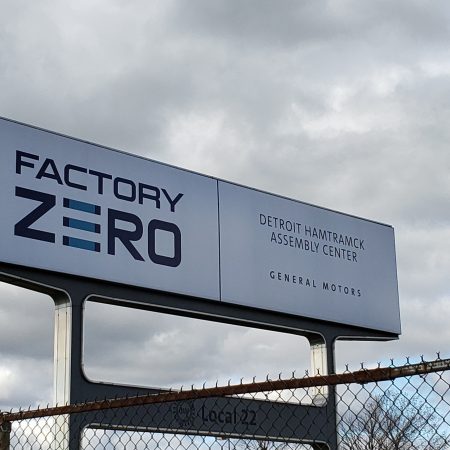
General Motors says it’s laying off more than a thousand workers at its Detroit-Hamtramck electric vehicle plant due to weak demand.
The Detroit News reports GM is cutting production at Factory Zero to a single shift. It’s also cutting hundreds of jobs at EV battery plants in Ohio and Tennessee.
The layoffs follow the expiration of federal tax credits for EV buyers and pressure from the Trump administration to build more gasoline-powered cars and trucks.
Additional headlines from Thursday, October 30, 2025
Detroit settles lawsuit over pedestrian death
The city of Detroit has agreed to pay nearly $6 million to settle a lawsuit over the death of a pedestrian who was struck by a bus. It was the second fatality involving the same driver since 2015.
A Wayne County judge signed off on the deal last week. Janice Bauer, 67, was hit by a city bus while walking in a downtown crosswalk in 2023. The driver, Geraldine Johnson, was sentenced to six months in jail a year ago after pleading no contest to a moving violation causing death.
DTE Energy is reporting net profits of $419 million in the third quarter of this year. The earnings, not including non-recurring costs, hit $2.25 per share. That beat Wall Street analysts’ expectations. The company says it has invested $3 billion this year to improve electric and natural gas infrastructure.
Short-term rental tax
A state House bill would let local governments ask voters to approve taxes on short-term rentals.
Republican Representative Mark Tisdel is one of the sponsors. He says communities are incurring costs that exceed existing tax revenue from rentals.
“If you’re renting that out to different short-term renters all summer long, that’s their week on the beach to howl. And it creates a problem for the houses on either side, which creates a problem for the police. Those expenses have to be covered.”
The Michigan Association of Realtors says it wants lawmakers to include limits on local regulations meant to shut out short term rentals.
Honorary street signs
Detroit City Council approved several honorary street signs for local leaders and influencers, including Imam Abdullah El-Amin. El-Amin was a prominent faith leader in Detroit and co-founder of the Muslim Center of Detroit.
Among other recipients are Reverend JoAnn Watson, Mudgie’s Deli founder Gregory Mudge, and Viola Liuzzo.
Listen to the latest episode of the “Detroit Evening Report” on Apple Podcasts, Spotify, NPR.org or wherever you get your podcasts.
Trusted, accurate, up-to-date.
WDET strives to make our journalism accessible to everyone. As a public media institution, we maintain our journalistic integrity through independent support from readers like you. If you value WDET as your source of news, music and conversation, please make a gift today.
As the temperature has climbed this summer, so have energy bills—and frustrations. These higher costs are driven by more than extreme summer temperatures. Factors like outdated power grids and a recent $217 million rate hike approved for DTE Energy by state regulators earlier this year are also at play.
Nicholas Schroeck, dean of the University of Detroit Mercy School of Law, and an expert in environmental law and justice, joined The Metro’s Robyn Vincent to discuss energy affordability and sustainability and what residents can do about it.
Editor’s Note: DTE Energy and Consumers Energy are financial supporters of WDET.
Listen to The Metro weekdays from 10 a.m. to noon ET on 101.9 FM and streaming on demand.
Support local journalism.
WDET strives to cover what’s happening in your community. As a public media institution, we maintain our ability to explore the music and culture of our region through independent support from readers like you. If you value WDET as your source of news, music and conversation, please make a gift today.
A ballot campaign plans to launch in July to ask voters to ban political donations from committees affiliated with utility monopolies and from businesses with substantial state contracts.
A coalition of progressive organizations are behind the campaign for a voter-initiated law to reign in the influence of utilities and insurance companies with market dominance as well as contractors that do more than $250,000 in business annually with the state, which would appear to include Blue Cross Blue Shield of Michigan — a prolific political donor.
“This isn’t just another policy tweak,” said Sean McBrearty, Michigan director for Clean Water Action, one of the groups backing the proposal. “It’s a line in the sand. We want to stop corporations from buying off our democracy.”
The Michiganders for Money Out of Politics campaign said Consumers Energy and DTE Energy, in particular, have used their clout to fend off efforts to award bigger paybacks to customers for power losses.
“One of the biggest reasons we don’t see progress in Lansing is because too many politicians are bought and paid for,” said Ken Whittaker with Michigan United. “The political will to fix this mess just isn’t there, but that’s by design. We’re not new to this.”
But they say it will be very similar to legislation that has stalled in the Legislature already.
The campaign said utility influence has held back reforms that would improve service and make rates more affordable. Spokespersons for two large Michigan utilities said their companies behave ethically. They said donation decisions are made independently by political action committees run by employees and shareholders.
Statements from Consumers Energy and DTE Energy said they and their corporate political action committees strictly abide by existing campaign finance laws. DTE spokesperson Ryan Lowry noted the utility agreed to publicly disclose all political donations of $5,000 or more as part of a 2023 rate settlement agreement with the Michigan Public Service Commission.
Lowry also said political action committee decisions are made by employees and shareholders.
“These disclosures showcase DTE’s commitment to our customers and communities we serve, helping us meet our aspiration of being best in the world and best for the world,” he said in an emailed statement. “The political contributions the company makes are supported by the DTE voluntary employee PAC or DTE shareholders — not from customer revenue.”
Trusted, accurate, up-to-date.
WDET strives to make our journalism accessible to everyone. As a public media institution, we maintain our journalistic integrity through independent support from readers like you. If you value WDET as your source of news, music and conversation, please make a gift today.

 Login
Login