Reading view

There are new articles available, click to refresh the page.

College student sues Genesee County over Flock records

Josh Tewolde said he hopes the lawsuit prompts conversation about transparency.
Josh Tewolde said he hopes the lawsuit prompts conversation about transparency.(The Mackinac Center for Public Policy)

A college student is suing Genesee County after he says the county unlawfully refused to provide him with public records about its use of Flock Cameras.

Josh Tewolde is a Genesee County resident and a student at Kettering University. He’s been interested in automated license plate readers — like those produced by Flock Safety — for years, even constructing one while in high school.

Earlier this year, he filed a Freedom of Information Act request with Genesee County, asking for information about its use of Flock cameras. That included the county’s contract with the company, a map of the camera’s locations, access logs for the camera's data, and records of scans involving his own vehicle.

Tewolde said he planned to make the data public so Genesee County residents can make a informed decision about the future of Flock in their community.

“As it stands now, it's a one-way camera,” Tewolde said. “The government can see you, but you cannot see back into the government. The government is not transparent. And so long as it remains this way, I think that the cameras are a threat to privacy rights more broadly”

According to the lawsuit, the county denied most of the request, claiming the majority of the documents are property of Flock and therefore not subject to public records requests.

But Flock publicly maintains that its customers own the data its cameras collect. Moreover, according to the suit, Genesee County’s contract with the company — which it provided to Tewolde — says the same thing.

“To see Genesee County, where I lived all my life, use a reason that's contradicted by their own internal policy to deny the public their right to government transparency was really disappointing,” Tewolde said.

So, he reached out to Steve Delie, a senior attorney at the Mackinac Center Legal Foundation. The foundation is part of the Mackinac Center for Public Policy, a free-market think tank.

Delie agreed to take the case, and on Tuesday they filed a complaint in the Genesee County 7th Judicial Circuit Court. Delie said if the government is working with a private company like Flock — even if Flock does own the records — those records are public property.

"Government can’t simply contract away transparency obligations,” Delie said. “You can't rely on a third party and then say ‘well, that's a third party, those records are no longer public.’”

Tewolde said he hopes the court forces Genesee County to give him the records, and that it prompts a broader conversation about transparency.

“With this, we have a chance to really draw a line in the sand and say that government cannot hide behind contractors or third parties to prevent the release of government records,” Tewolde said. “If we're paying for something with our tax dollars, we deserve to know what's going on.”

Genesee County and Flock Safety did not respond to a request for comment.

CORRECTION: An earlier version of this story spelled Tewolde incorrectly. It has been fixed.

Michigan’s free pre-K program receives record number of applications

Student in international preschool reading a magazine book together in school library, education, kid and study concept
Student in international preschool reading a magazine book together in school library, education, kid and study concept(anekoho - stock.adobe.com / 167598373)

Applications for Michigan's Great Start Readiness Program, which offers free preschool for eligible 4-year-olds, have reached a record high.

About 53,000 children have applied as of July, a 16% increase from the same time last year, according to the state Department of Lifelong Education, Advancement, and Potential.

The program has removed income restrictions in recent years. It is funded through the state budget, and the state estimates it saves a typical family $14,000 annually in child care costs.

The program is hosted in local public schools, public school academies, and community-based childcare centers. Families can choose from half-day and full-day options, with four- or five-day weeks available. In some areas, free transportation is offered.

JoAnne Elkin is an early literacy and early childhood consultant at Macomb Intermediate School District. At a press conference Tuesday, she said sees the benefits of well funded early learning every day.

"When children have a strong start and access to high quality early learning, they are positioned to reach their full potential throughout their educational journey," Elkin said.

Michigan has provided publicly-funded pre-K options since the 1980s, but now they've opened to all families regardless of income for the 2024-2025 school year.

Jordan Ewert, a Wayne County parent whose son will attend a free Pre-K program in the fall, said the program eases financial pressure on his family.

"The free program allows me to focus on paying back my student loans," Ewert said. "His mom and I both work full time, so knowing that he's improving his social and academic skills while we're working is really important to us."

Children who will be 4 years old by December 1, 2026, are eligible to enroll for the upcoming school year, and enrollment is still open in most intermediate school districts across the state. Families can learn more at MiPreKForAll.org.

Communities across Michigan move to ditch Flock cameras

A solar-powered security camera is mounted on a tall black metal pole outdoors. The rectangular solar panel sits angled at the top of the pole, while the small black camera module is attached just below it. Green and brown autumn tree foliage blurs softly in the background.
Law enforcement agencies across the state use Flock cameras or other license plate readers to prevent and solve crimes by automatically recording vehicle details and license plates.(AARON LEMAY/Aaron - stock.adobe.com / 1111650518)

Another Michigan community has ended its contract with Flock Safety.

Sumpter Township in southwest Wayne County began a free trial of Flock’s automated license plate reader cameras in April. The township police department announced Monday on Facebook that — after considering public feedback — it decided to discontinue the agreement.

“While the national debate over technology in policing—ranging from ALPRs to drones—has sparked passionate views, our focus remains local,” the statement read. “Our approach is always centered on the unique needs of Sumpter Township’s 36 square miles and, most importantly, on the well-being of our residents.”

Sumpter Township joins at least four other metro Detroit communities that have cancelled Flock contracts, including Clawson, Ferndale, Westland, and Milford. Others across the state, including Oceana County, Menominee, and Dickinson County, have also ended or shot down agreements

This comes amid a broader debate over surveillance technology, spurred by accusations of misconduct and concerns over data privacy. Michigan policymakers across the political spectrum have proposed regulating the cameras.

Dawud Walid heads the Michigan chapter of the Council on American-Islamic Relations. CAIR-MI has been vocal about concerns that the technology could be used to over-surveil minority communities or that data from it could be shared with Immigration and Customs Enforcement.

Walid says police might not be using Flock to target minorities on purpose, but that law enforcement's historical relationship with communities of Color cannot be ignored.

“Policing in the United States of America has colorblind policies but has never been instituted in a colorblind fashion,” Walid said. "We can't erase race and national origin out of the equation when there are police departments using such technology.”

He says he is encouraged by community activism against Flock cameras.

"Citizens still have a voice here in our state and in our county,” Walid said. “When we organize and raise our concerns about wanting to keep America free and a land of liberty… this is what democracy is supposed to look like.”

However, supporters maintain that the technology can be a vital tool to locate stolen vehicles and track vehicle movements during criminal investigations when paired with common-sense regulation. The cameras are used by over 100 law enforcement agencies in Michigan.

Westland is a metro Detroit community that discontinued its Flock contract in early July.

Melissa Sampey is a member of Westland City council. She said the city had 29 Flock cameras, but the city council was divided over the issue of contract renewal earlier this summer.

“One school of thought was that we were going to make sure that, if there is a crime that occurred in our city, that we do understand that extra surveillance does help,” Stampey said. “The concern that many of us had was… all the data that was collected from individuals and the platform that it's stored on.”

She said the council received broad feedback that the community was not interested in continuing to work with Flock.

“The common theme is that people don't feel like they have a sense of privacy, and people don't want to be tracked and documented by a system and that's kind of what we were hearing from people on all sides,” Sampey said.

Westland Police Chief Kyle Dawley eventually decided not to bring renewal before the council and let the contract expire. The cameras will be gradually removed in the coming months.

Last week, Flock updated its privacy, accountability, and transparency policies including shifting from a default 30-day data retention period to a 7-day one. It also introduced an opt-in feature to flag suspicious usage of ALPR databases

Flock Safety did not respond to a request for comment.

University of Michigan chooses site for controversial "computing center" near Ypsilanti

(espiegle - stock.adobe.com / 266647902)

The University of Michigan has moved further toward realizing a controversial project it is calling a “research computing center” in Ypsilanti Township.

The university announced Tuesday that it selected a 144-acre parcel on Textile Road for the $1.25 billion project, pointing to the spot’s preferable zoning, development flexibility, and proximity to existing electrical and data infrastructure. It borders the Huron River and a public park.

The planned development has drawn ire from activists and local officials, many of whom are concerned about its future resource usage and role in nuclear weapons development — though the university says its work in partnership with the Los Alamos National Laboratory will only include "computational modeling for nuclear stewardship — helping ensure the safety and reliability of the nation’s existing nuclear stockpile without live testing."

Regardless, said Ypsilanti Township attorney Doug Winters said, “we don't want them anywhere in this township."

In the University Record article announcing the site selection, U-M president Domenico Grasso applauded the decision.

“Universities like Michigan are built by generations willing to invest in discoveries and opportunities they may never live to see,” Grasso said. “We have that same responsibility today — to build for the students, researchers and communities who will follow us.”

The university maintains that the planned facility is not a data center but a “computing and research hub designed to advance science and education” and has made commitments to reduce water use, protect natural resources, and prioritize energy efficiency.

The U-M Board of Regents approved the purchase of the parcel in June 2025, and the university bought it in March. Officials had also considered an alternate location at an industrial site owned by the American Center for Mobility in Willow Run.

Local officials dissatisfied with university communication

According to Winters, local officials oppose locating the project anywhere in Ypsilanti Township, and are exploring options to oppose the development. “We don't feel like this is a done deal,” he said.

“Would you want death by gunshot or by poison? The results are the same,” Winters said.

Public universities in Michigan have a degree of constitutional autonomy that means they are not required to abide by local zoning laws and do not need local governments to approve their land uses.

"Each of Michigan's 15 public universities can buy land anywhere in the state and determine what it will be used for," as The Detroit News put it.

Even if the university is not required to get the township's approval for its land use, Winters said, it was wrong to have “no communication” from the university about the decision.

“I mean, my goodness, they are a university,” Winters said. “Is there no moral authority left anymore at the decision-making level? Of course, they should involve the local officials, the local communities.”

U-M spokesperson Paul Corliss wrote that the university is planning future public engagement opportunities — including a community town hall on the project for September 9 at Ann Arbor Marriott Ypsilanti at Eagle Crest — with additional details to come.

“The University of Michigan is committed to creating opportunities for meaningful dialogue as plans for the high-performance research computing center move forward,” Corliss wrote. “We have heard from Ypsilanti Township residents and local leaders who want more opportunities to learn about the project, ask questions and share their perspectives, and we take that feedback seriously.”

What will the facility be used for? 

The university said it will use its share of the facility’s computing power for projects like using advanced computational modeling to speed up drug discovery, and to run artificial intelligence tools that analyze brain tumors.

Los Alamos specializes in nuclear weapons research, and officials have confirmed that it will use its portion of the facility’s computing power to support the production of plutonium pits — the cores of nuclear weapons — offsite.

However, according to the university's announcement, the facility itself will not be used for nuclear weapons production, storage, or real-time operations.

Its work will focus on the safety and reliability of existing nuclear weapons, "as well as well as broader national security research in areas such as energy infrastructure and cybersecurity,” the post read.

Editor's note: The University of Michigan holds Michigan Public's broadcast license.

University of Michigan will switch to pass/fail grades for most first-semester students

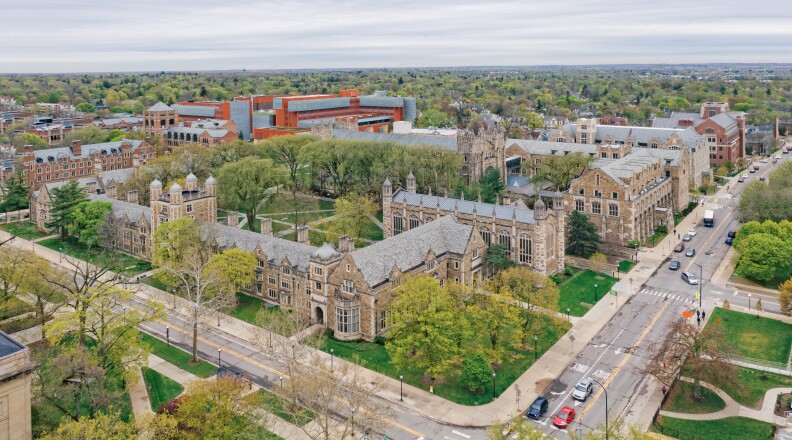
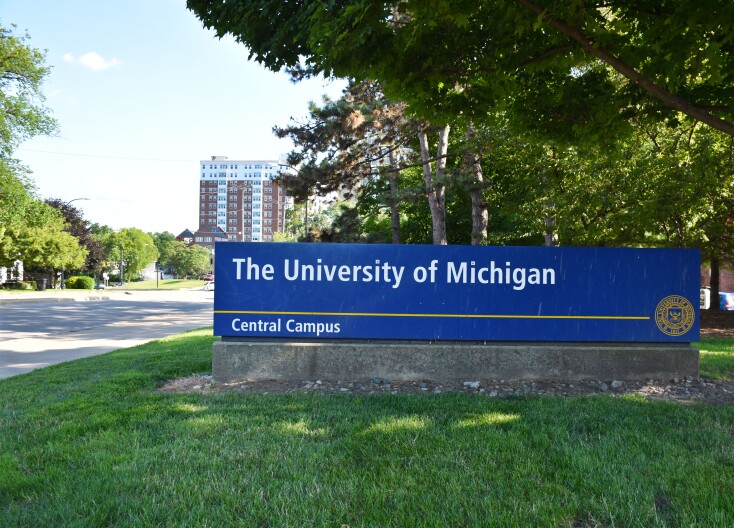
University of Michigan Central Campus sign
(Anna Schlutt / Michigan Radio)

As part of a new pilot program starting fall 2027, many first-semester students at the University of Michigan will no longer receive letter grades on their transcripts.

According to a post on the website of the College of Literature, Science, and the Arts — by far the largest college at the university — final letter grades for first-semester freshmen will be replaced with a designation of either “pass” or “no credit.”

“We believe that covering grades will help students start strong and curb the mental health crisis unfolding among college-aged individuals,” the post reads. “Our goal is to help first-year students acclimate to the demands of college and allow intrinsic motivations to guide personally meaningful academic journeys — core elements of a liberal arts and sciences education.”

The Healthy Minds Study — co-based at U-M — is a survey assessing the mental health of students at colleges and universities across the county. While the most recent findings show improvement, 32% of college students still experience "moderate to severe" anxiety symptoms. Many experts feel that de-emphasizing grades could reduce the pressure that contributes to those symptoms.

Rosemary J. Perez, an associate professor in the University of Michigan's Center for the Study of Higher and Postsecondary Education, said the university’s high-pressure environment — which she sees reflected in her own students — isn't always conducive to actual learning.

“You hear from somebody like, ‘if I don't get an A in this class, I'll never be able to —’ and fill in the blanks with a hundred different things — ‘get into this next course, get the internship, get into graduate school, get this job I want,’” Perez said. “They're already feeling that if they make one misstep it's just going to knock everything down.”

Matthew Kaplan is the associate vice provost for learning and teaching at the university. He was consulted in the development of the pilot, and said he hopes students use the flexibility it offers to explore subjects outside of their comfort zone.

“There's so much such richness in the curriculum in LSA and, in fact, across the university,” Kaplan said. “Freeing students from worrying about their grades — letting them experiment in that first semester — might open them up to ideas that they hadn't thought about.”

Kaplan also pointed to a concept in higher education called “early momentum” — the link between meeting academic milestones early in college and both on-time graduation and earning a degree. He said he feels the change in grade reporting could help students build long term confidence.

All first-year students will be automatically enrolled in the program in Fall 2027, but new transfer students will not be eligible.

Students will still receive grades and feedback from their instructors, but they will not be recorded or impact a student’s overall GPA. The university will maintain internal records of the grades for advising, scholarship and internship applications, and certain other purposes.

LSA already allows first-semester students to drop courses late without penalty. Kaplan said many in the field of higher education are focusing on improving learning quality and shifting toward more flexible systems of assessment. He pointed to the recent replacement of curved grading at the Ross School of Business and an increasing number of instructors who are already using alternative grading approaches.

“It's part of a larger movement around student success,” Kaplan said. “How do we make sure that students can succeed here, fulfill their goals as well as the university's goals for them?”

College leaders plan to hold public engagement sessions before implementing the program next fall. U-M spokesperson Chris Sebastian wrote that the full details of the pilot have not yet been finalized.

“The first-semester grade covering pilot program, designed to help first-year students better acclimate to the demands of a University of Michigan education, is still in its development phase,” Sebastian wrote. “We will have more details to share this fall, as faculty, staff and students in the College of Literature, Science, and the Arts continue to inform the design, development and implementation of a pilot program.”

Editor's note: The University of Michigan holds Michigan Public's broadcast license.

Proposal for city takeover of power grid qualifies for Ann Arbor's November ballot

(Lester Graham / Michigan Radio)

Ann Arbor voters will decide this November whether to create a new municipal electric utility, paving the way for the replacement of DTE Energy as the city's electricity provider.

The nonprofit group Ann Arbor for Public Power led the initiative, gathering more than 5,000 signatures on a petition to amend the city charter. Ann Arbor city clerk Jacqueline Beaudry confirmed via email Thursday that the petition had been certified and will appear on the November 3 midterm election ballot.

Municipal utilities are owned and operated by local authorities and tend to have lower rates and better reliability scores and are structurally more accountable to customers, according to the American Public Power Association.

What could a public power transition look like?

Most communities in Michigan get their electricity from investor-owned utilities like DTE and Consumers Energy. They are privately-owned but their rates are regulated by the Michigan Public Service Commission.

A much smaller number of Michigan communities are served by municipal utilities owned by local governments. Prominent examples include the Lansing Board of Water & Light, Traverse City Light & Power, and the Holland Board of Public Works.

Ann Arbor for Public Power’s initiative comes amid growing concern over high energy costs and the lower-than-ideal reliability of DTE’s grid.

DTE spokesperson Ryan Lowry said the company is making improvements to its infrastructure.

“Last year, DTE delivered the best electric reliability Ann Arbor has experienced in nearly 30 years,” Lowry wrote. “It’s proof that DTE’s five-year, $270 million plan to modernize Ann Arbor’s electric system is working. We will remain focused on our work and will continue to deliver the reliable, affordable, clean energy future Ann Arbor deserves.”

He also wrote that the Ann Arbor proposal would increase costs for consumers.

“The proposal to take over Ann Arbor’s electric grid will cost the City of Ann Arbor nearly $1 billion on day one, leading to skyrocketing costs for Ann Arbor businesses and residents,” Lowry wrote.

The public power group’s proposed amendment would establish a framework and election process for a public utility board by 2028. The board would handle planning, oversight, and feasibility studies regarding the city's energy future.

Justin Schott is the director of the Energy Equity Project at the University of Michigan. He said approving the city charter amendment is a preliminary step and that city-owned power would require further public engagement.

“These early steps, things like establishing an unpaid governance board conducting a deeper feasibility study, are the kind of small actions that give the city more leverage in its whole relationship with DTE,” Schott said. “We don't really have anything to lose at this stage.”

Although the board would not be authorized to do so without a public vote, it would eventually need to purchase DTE Energy’s local poles, wires, and infrastructure to begin municipalization.

Erik Nordman, the director of the Institute of Public Utilities at Michigan State University, said it is hard to predict how those negotiations would play out.

“If DTE sells that capital – the source of their profits – to the municipality, then DTE has less capital available on which their shareholders can earn a profit,” Nordman said. “So, they're probably not going to be excited about this proposal, and they'll want to make sure that they get a good price for the capital that they would be selling.”

Nordman also said a municipal utility would give local residents more power over the speed of the city’s transition to renewable energy. The city currently plans to achieve carbon neutrality by 2030.

"It's an opportunity for self-governance and that's going to be especially – not going to be, it is – really important as we are undergoing an energy transition away from fossil fuels and the pollution that they produce and towards a clean energy system. I think that will be especially important to the people of Ann Arbor.”

The city currently offers the Sustainable Energy Utility, a city-owned clean energy service that residents can opt in to. It provides supplemental renewable power — such as rooftop solar, battery storage, and geothermal systems — while users stay connected to the DTE grid.

Brian Geiringer, the executive director of Ann Arbor for Public Power, said 120 volunteers gathered more than 5,300 signatures to get the proposal on the ballot.

“There’s a lot of energy right now for everyday people wanting to help — in small or big ways — help make real change,” Geiringer said. “With DTE, it's something that is tangible, in your face. Your power goes out, you get your power bill and it is way too much, and you want to do something about it.”

DTE has contributed funding to the Ann Arbor Responsible Energy Coalition, an organization opposing the ballot measure, campaign finance disclosures show. Michigan Campaign Finance Network Executive Director Neil Thanedar told MLive the amount of the utility's spending on the city-level issue is "pretty unprecedented."

Editor's note: DTE is among Michigan Public's corporate sponsors.

Donavan McKinney ousts Democratic incumbent Shri Thanedar in 13th Congressional District

(Julia Demaree / AP Photo)

Democratic Socialist challenger Donavan McKinney won the Democratic primary for Michigan's 13th Congressional District Tuesday.

McKinney, a member of the Michigan House of Representatives, won 51.9% to 48.1% with all precincts reporting, ousting two-term U.S. Congressman Shri Thanedar.

The 13th District is located within Wayne County and includes portions of Detroit and some of its suburbs. The Cook Political Report rates the district as solidly Democratic, the New York Times says, meaning the McKinney is "expected to have a strong advantage in November" for the general election, where he will face Republican nominee T.P. Nykoriak.

In a press release, McKinney said he was honored to accept the nomination.

"I am so proud that our community is sending me to Congress to fight for a better future — because that means our movement has shown them a fighter is what they truly deserve in Washington," McKinney said.

Both Thanedar and McKinney ran as anti–President Donald Trump candidates backing progressive priorities, including universal health care, abolishing U.S. Immigration and Customs Enforcement, and ending the war in Iran.

However, McKinney pushed to the left of Thanedar, advocating to end military aid and arms to Israel and opposing corporate money in politics. He gained backing from prominent progressives like U.S. Sen. Bernie Sanders of Vermont, U.S. Rep. Rashida Tlaib of Michigan, and U.S. Senate hopeful Abdul El-Sayed.

In the release, McKinney denounced corporate influence and said he would work to represent the district's many diverse interests.

"Today, we showed why being always with the people is more than a slogan — it’s a roadmap for the Democratic Party on how to move forward to defeat the fascism and divisiveness harming our country, and to deliver the leadership the Mighty 13th deserves," McKinney said.

Thanedar ran as a progressive in 2022 but split with the Democratic Socialists of America in 2023 and has since "rebranded" himself around strong support for Israel, NBC News reports.

The race was called Wednesday by the Associated Press at 9:55 a.m.

❌