Reading view

There are new articles available, click to refresh the page.

Mayor Sheffield: Free bus rides for students now permanent, new rideshare pilot

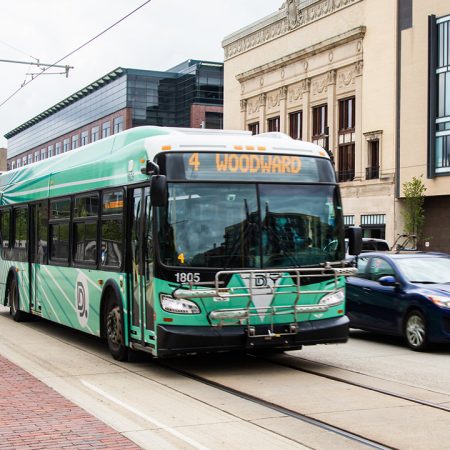
Detroit Mayor Mary Sheffield announced an expansion to the Ride to Rise transportation program aimed at addressing chronic absenteeism in schools.

The program allows students for all schools in Detroit, including charter schools, to ride city busses for free. Now the program will be permanent thanks to a $1 million in state funding.

Sheffield also announced the city will be adding ambassadors to the buses to routes citywide to address parents’ concerns about safety.

We have heard that having trusted adults riding alongside our students could provide additional level of support to help students navigate their trips to and from school,” Sheffield said.

Ambassadors are DDOT employees who will be trained in interacting with students and keeping a watchful eye. They will ride the busses during peak hours before and after school.

Sheffield also announced a rideshare pilot program. The pilot will be available to select high schools with students who have unique transportation barriers.

Detroit’s Senior Director of Youth and Education Chanel Hampton said the pilot will pick up and drop off 150 high school students across 4 schools.

“So this pilot will go through about two months, the first couple months of school, and then we’re really excited again to take that data, see what we’re learning, and frankly, we’re working on a larger agenda around all things transportation, not just with the city, but also with our schools,” Hampton said.

The city also announced an ambassador program where DDOT employees will ride the busses during peak hours before and after school to ensure safety for the students.  

Listen above to the full interview with Chanel Hampton about the new additions to Ride to Rise.

Support local journalism.

WDET strives to cover what’s happening in your community. As a public media institution, we maintain our ability to explore the music and culture of our region through independent support from readers like you. If you value WDET as your source of news, music and conversation, please make a gift today.

The post Mayor Sheffield: Free bus rides for students now permanent, new rideshare pilot appeared first on WDET 101.9 FM.

Detroit Evening Report: Cyclosporiasis cases decline

The Michigan Department of Health and Human Services has lifted the precaution to avoid bagged mixed salad mixes. Officials say new cyclosporiasis case reports and emergency department visits are on the decline. Data show most exposures occurred in late June and early July.

Officials are saying the majority of contaminated lettuce is likely no longer available for consumption. The department will continue updating outbreak data every Thursday. Officials continue to recommend avoiding the recalled lettuce. 

 Additional headlines for Aug. 6, 2026

Dearborn Homecoming

The City of Dearborn’s 45th Homecoming Festival starts tomorrow Aug.7. The festival opens at noon at Ford Field Park with an official ribbon cutting will take place under the park’s covered bridge at 12:30 p.m.

The event will feature live music, carnival rides, an arts district, a vendor village and more. Musical headliners include country singer Martina McBride on Saturday and Grammy award winning artist Chance the Rapper on Sunday. Both performances will be followed up by a fireworks show at 10 p.m.

Festival hours are noon to 10:30 p.m. daily. After 4 p.m., children under the age of 18 must be accompanied by a parent or guardian.

Admission is free. The festival runs this weekend only.

 Supplemental food program expands income threshhold

More Michigan families may qualify for Woman, Infant, Children (WIC) benefits. The state health department has increased the income threshold for the program, which provides women, infants, and children with supplemental food, breastfeeding support, and referrals to health and social services. A family of four can now qualify with an annual income of up to $61,050.

WIC helps about 187,000Michigan residents every month. 

 DDOT public hearing

The Detroit Department of Transportation (DDOT) is hosting a public hearing on August 20 at 4 p.m. to discuss and receive feedback on potential service changes taking effect on Sept. 7. The public hearing will be virtual.

The public can submit feedback through email to ddotcomments@detroitmi.gov  until Friday, Sept. 4.

 Asian American artist showcase

The Asian American based non-profit Rising Voices is announcing their 2026 artist and creative cohort exhibition. Titled “Revolution, Resistance, and Joy”, the exhibition showcases the work of Michigan Asian American artists.

The show starts August 7 with an opening reception from 6-9 p.m. at the Swords into Plowshares Gallery located on 33 East Adams Street in Detroit. The exhibition runs through Aug. 22.

Listen to the latest episode of the “Detroit Evening Report” on Apple Podcasts, Spotify, NPR.org or wherever you get your podcasts.

Support the podcasts you love.

One-of-a-kind podcasts from WDET bring you engaging conversations, news you need to know and stories you love to hear. Keep the conversations coming. Please make a gift today.

The post Detroit Evening Report: Cyclosporiasis cases decline appeared first on WDET 101.9 FM.

Detroit Evening Report: Detroit Children’s Museum reopens after 14 years

The Detroit Children’s Museum has reopened for the first time in 14 years. The museum originally closed due to financial crisis within the school district. With the help of a grant of over $800,000  from the Michigan Department of Labor and Economic Opportunity, the institution was able to open it again to the public.

During its closure, the museum still lent out artifacts and STEM tools to teachers. The museum has now expanded it collection to 2.5 million artifacts including historical objects, science materials, and global treasures.

Schools are open to schedule field trips to the museum. Its open to the public for free every fourth Saturday of the month.  

Additional headlines for Tuesday, July 28, 2026

Ride to Rise program increases student ridership

Detroit’s Ride to Rise program has doubled ridership on city busses among Detroit students. That’s according to the Detroit Department of Transportation (DDOT).

The program allows all youth to ride DDOT busses year-round for free when they show drivers their student IDs.  

Detroit Mayor Mary Sheffield announced the program in April to reduce absenteeism in schools and provide reliable transportation for students to after school programs.  

DDOT Director Robert Kramer says the department has secured a million dollars in funding in the 2027 state budget to continue the program.  

Cyclospora outbreak continues

The state health department says more than 9,000 people in Michigan have reported coming down with a parasitic infection linked to contaminated lettuce. That’s more than twice the number of cases the Centers for Disease Control and Prevention have confirmed nationwide. 

The CDC estimates Michigan has between 900 and 2,100 people who’ve gotten sick since May 1. That does not include probable cases. 

Whitmer signs new bills

Governor Gretchen Whitmer signed a bill to help people avoid losing their homes to foreclosure. The new law makes programs such as installment plans for delinquent property taxes permanent.

She also signed bills banning state lawmakers from lobbying while they’re in office and prohibiting former legislators from becoming lobbyists for two years after they leave office. 

Community Contractor Fair

The development program Ignite Detroit is hosting a Community Contractor Fair on Wednesday. The fair is for Detroit residents, homeowners, and small business owners to connect with contractors, explore home and property improvement resources, and learn about the Homeowners Property Exemption program.

The event takes place at the Northwest Activities Center—that’s 18100 Meyers Rd., Detroit, on Wednesday, July 29 from 6:30-8 p.m.  

Listen to the latest episode of the “Detroit Evening Report” on Apple Podcasts, Spotify, NPR.org or wherever you get your podcasts.

Support the podcasts you love.

One-of-a-kind podcasts from WDET bring you engaging conversations, news you need to know and stories you love to hear. Keep the conversations coming. Please make a gift today.

The post Detroit Evening Report: Detroit Children’s Museum reopens after 14 years appeared first on WDET 101.9 FM.

Transportation advocates tour transit systems across the state

Transportation Riders United (TRU) is forming a statewide coalition to advocate for better transit options throughout Michigan called Move MI.

The Detroit-based group toured the state on their Around the Mitten Transit Tour, visiting and riding public transit in 16 cities.

TRU Executive Director Megan Owens spoke with WDET’s Bre’Anna Tinsley about the tour and the issues other transit systems face.

Listen: Transportation advocates tour transit systems across the state

The following interview was edited for time and clarity.

Executive Director Megan Owens: TRU has worked for 25 years now in the metro Detroit area. And we know a lot about the benefits and the challenges of public transportation in metro Detroit. But we know that there’s another 70+ transit agencies around the state of Michigan, and that there are millions of people who depend on transit. So, we wanted to get a better understanding of the strengths and challenges of public transit all across the state of Michigan.

We traveled for 14 days over 1,800 miles, went all the way up to Port Huron, Alpena, Marquette, Traverse City, Benton Harbor—all over the state, 16 different cities, all to learn how public transit works, and where there are gaps, and where it needs improvement. And to think about how the state, the next governor, and other state leaders can be better supporting opportunities for Michiganders who don’t drive or don’t want to drive to still be able to get around and visit friends, family, and all of Michigan’s beautiful locations.

Bre’Anna Tinsley, WDET: So, after seeing all of those different transportation organizations, is there some trend, maybe, that you’ve discovered across the state that’s happening among our transit systems?

MO: There were a couple of things we learned. One that I don’t think a lot of people realize is that you can, in fact, take public transportation across the state of Michigan. It’s not always as convenient or easy as it should be, but we were able to visit 16 different cities using Amtrak, using regional busses, using inner city busses, and could visit all sorts of great places. So one, it was exciting to know that you can do all of these things, but we also learned that the service is way too limited, whether you’re talking about traveling between cities or traveling within any different metropolitan area. There are options to get around, but they’re not nearly as frequent, as reliable, they don’t go as many places as many people want to go.  

So while there are transit agencies that are working extremely hard to provide the very best service that they can, they’re all limited by funding and are really torn to try to provide the very best they can with extremely limited resources.

BT: The reason for the limited resources, did you discover if that was something that’s happening at the state level, or do all of these communities have their own individual limitations?

MO: One of the reasons we did want to explore all of these different areas is that the state does fund an important component of transit in every single community. There’s something called the “local bus operating budget item” (LBO) that we’ve been fighting for years to get the state to increase to make sure that Smart and DDOT have the resources they need. But it funds every one of the 77 transit agencies across the state. At one point in time, the LBO, as it’s called, covered half the costs of running local transit service, so the state covered half the costs, and the local communities came up with half the costs.

But, as costs have gone up and the state budget allocation has not. It’s cover and the state funds are covering barely a third of the of what it costs to run local transit services across the state. And right now it’s one of those things that’s debated in the state budget every year. How much is going to go into this local bus type operating? So, we did make sure one of our last stops was at the state capitol to make sure legislators knew just how important this local bus operating budget is.

Just about every legislator and most of the people they deal with every day are people who drive, and a lot of us are used to driving everywhere. But we wanted to remind legislators that every community has thousands of people who don’t drive, whether that’s seniors, whether that’s students, whether that’s somebody who is saving up for their first car, whether that’s a person with a disability, whether they’re in a wheelchair or have epilepsy or have a developmental disability. There are thousands of people all around us who don’t drive, who deserve to have just as full and robust lives as everyone else. They should be able to see the Great Lakes, they should be able to visit, so many of these wonderful places that we have in our state, even if they don’t drive.

BT: So, are there any takeaways from this trip that you think maybe we can implement here that might help improve the systems?

MO: We learned some great things about the different transit agencies around the state and what they are doing. Flint has been working with a lot of alternative fuels. DDOT and  Smart have tested out electric buses that have had mixed success. But Flint is working with compressed national natural gas and with hydrogen, and so even as diesel prices shoot up, several of the systems, like Flint and Port Huron, have not had to deal with those skyrocketing costs. So, exploring different types of fuels for the buses.

There are a number of the systems around the around the state, you can just use any old credit card and tap as you enter the bus, and use that as a way to pay. So that’s something I know that our local agencies are looking into, but it was neat to see just how quick and easy it was. You didn’t need any special app, you didn’t need any official pass…if you got a credit card, you tap it, and you enter. So, I think that’s something that could make it again even easier to ride transit in our areas as well.

Support local journalism.

WDET strives to cover what’s happening in your community. As a public media institution, we maintain our ability to explore the music and culture of our region through independent support from readers like you. If you value WDET as your source of news, music and conversation, please make a gift today.

The post Transportation advocates tour transit systems across the state appeared first on WDET 101.9 FM.

❌