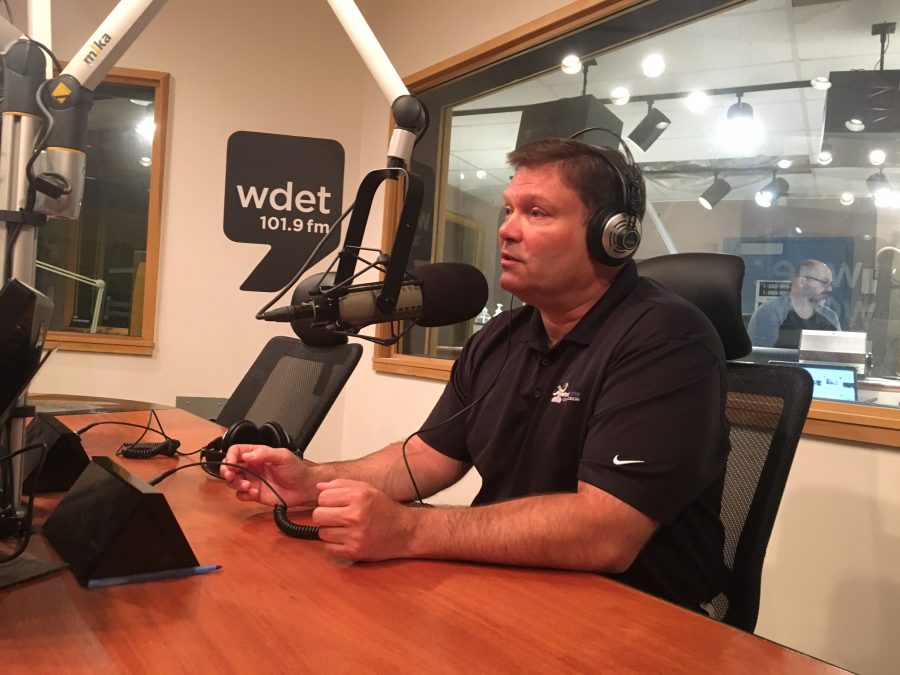
“When you launch a campaign and you’re trying to get money out of politics,” he told The Metro, “that invites record amounts of spending against you.”
More than $60 million in outside money went into last week’s Michigan Senate primary, most of it aimed at stopping him. The largest single source was AIPAC, whose super PAC spent about $30 million backing U.S. Rep. Haley Stevens — the most the pro-Israel group has ever put into a congressional primary.
El-Sayed won by fewer than 15,000 votes.
He ran health departments in Detroit and Wayne County, and he now faces Republican Mike Rogers for a seat that could decide control of the Senate. If he wins, he would be the first Muslim to serve there.
He sat down with The Metro’s Robyn Vincent — in the same studio where he announced his run in April of last year.
The money that defined the race
El Sayed came back to the spending repeatedly, including when asked why he lost Detroit. “Ask yourself, if there was no outside spending in this campaign, where do we think votes would have gone?”
He won’t stop saying genocide
Did calling the war in Gaza a genocide drown out his message on health care? He said it isn’t a trade he’ll make: “The job’s not worth it. The work is worth it.”
To Jewish voters who hear his criticism of Israel as criticism of them: “Judaism and the Jewish people are a light unto the world. But Judaism and the Jewish people are different than AIPAC and the Israeli government.”
Black Democrats and the ‘uncommitted’ vote
Many Black Democrats in Michigan blame the 2024 “uncommitted” protest vote, which El-Sayed backed, for costing Kamala Harris the state. Keith Williams, who chairs the state party’s Black Caucus, endorsed Stevens and said El-Sayed was with uncommitted only when it suited him.
“Convenience would have been to say nothing and stay quiet,” El-Sayed said. He noted that Harris endorsed him Friday. “I don’t think she thinks I’m the reason that she lost.”
On mistrust between Black and Arab Detroit, he said Arab and Muslim Michiganders can’t object to anti-Arab racism while tolerating racism toward Black Detroiters. “Standing up against racism is about principle. It’s not about tribalism.”
Data centers and health care
El-Sayed said what he’d write into federal law on data centers, after campaigning against the Oracle and OpenAI project in Saline Township: protections for local water, no utility rate increases, guaranteed union jobs, and money held in escrow before construction begins.
On Medicare for All, he acknowledged a freshman senator can’t deliver it alone. “You can’t get it all in one shot. But politics, as all of us know, doesn’t just move linearly.”
The Metro has invited Republican candidate Mike Rogers on the program several times and has not heard back.
Hear the full conversation using the media player above.
Listen to The Metro weekdays from 10 a.m. to noon ET on 101.9 FM and streaming on-demand. Never miss an episode — subscribe to The Metro onApple Podcasts,Spotify,YouTube, orNPR, or wherever you get your podcasts. Have thoughts? Email the show at metro@wdet.org.
Support the podcasts you love.
One-of-a-kind podcasts from WDET bring you engaging conversations, news you need to know and stories you love to hear. Keep the conversations coming. Please make a gift today.
Michigan’s Democratic U.S. Senate Primary is one of the most closely watched and deeply debated in the country.
With less than two weeks to go before election day, Congresswoman Haley Stevens and Dr. Abdul El-Sayed have gained supporters from across the state.
Retired General Motors worker Theresa Landrum backs Stevens and her “fight” for the US Senate seat.
“We need a fighter like that to fight tooth and nail for the people that are going to be harmed by this current administration,” Landrum said.
El-Sayed supporter Andrew Lyon of Ferndale was originally set to support State Senator Mallory McMorrow’s bid, but a friend offered other options.
“My friend was like, ‘Oh no, you gotta check out Abdul.’ And then I looked him up. I think it was on TikTok,” Lyon said. “(I) started following him, and then instantly (switched). What he wants to fight for is exactly what I believe in.”
What are they fighting for?
Stevens has promised to push back on the Trump Administration and the president himself.
“I’m just fired up to be out here putting my hand up for Michigan in this serious moment,” Stevens said. “It’s no joke what is going on, with Donald Trump stealing from people, illegal impoundments of funds, going after voting rights.”
El-Sayed says he has no love for the president, but he’s fighting against the Democratic Party’s centrist establishment too.
“I’m not dangerous if you’re someone who needs government to work for you. But if you’re Chuck Schumer, damn right I’m dangerous,” El-Sayed said. “If you are someone who wants to stand in the way of government working for people, I am dangerous.”
According to Adam Carlson, founding partner of Zenith Research, only 47% of democrats have a favorable opinion of Schumer. He was commissioned to do a poll for the pro-El-Sayed veterans group Common Defense.
It’s not like Democrats couldn’t see this coming. One of the first things that Mallory McMorrow did when she announced her run for Senate in 2025 was call for Schumer’s removal as Senate Minority Leader.
In New York and Colorado, progressive candidates have primaried centrist incumbents and won. The big question is whether wins in deep blue districts can be replicated in purple states like Michigan.
Carlson said the rage against the Democratic political machine leaves voters open to a left-wing populist.
“I’ve never seen in my 13 years doing this voters so angry, frustrated with like conventional wisdom, and being told who is electable, and just inflation, cost of living, and all that. Just much more responsive to populism, more than a left-right divide,” Carlson said.
Stevens – who has been supported by Schumer from the beginning of her run – doesn’t see this race as a referendum on Democratic Party leadership.
“There are some people who are running who assume that’s what this race is all about, and I don’t think that’s fair to the people of Michigan,” Stevens said. “I believe that this race is about the future of Michigan and our workforce, and who’s going to get points on the scoreboard for organized labor.”
What do voters want in their candidates?
A recent poll by the Michigan-based Glengariff Group showed that the top two things voters want out of a Democratic senate candidate are “fighters” and someone who is “electable.”
For Stevens supporters, electability is all about the general.
Retired U.S. Senator Debbie Stabenow and retiring Senator Gary Peters both believe Stevens can beat Republican Senate candidate Mike Rogers. Peters thinks Stevens will be able to face down a ton of money from Republicans in the general.
“That’s why you have to have someone who has a proven track record of actually winning tough races. And that’s Haley Stevens,” Peters said. “She’s won tough races. She’s had that kind of money spent against her from outside forces. She’s an independent voice who stands up for Michigan folks.”
But in this primary, those outside forces are on her side.
Independent Vermont Senator Bernie Sanders spoke at a recent El-Sayed campaign event in Detroit about how he views this race.
U.S. Senate candidate Abdul El-Sayed with Vermont Senator Bernie Sanders during a rally in Detroit on July 18 2026.
“With all due respect to Congresswoman Stevens, everyone knows that this is not an election between her and Abdul El-Sayed,” Sanders said. “This is an election between Abdul and the billionaire class.”
Stevens doesn’t care for that characterization, but seems to agree that getting money out of politics is a good thing.
“The thing is, is that we have to pass the laws to stop dark money. It is not about whether I say it or not as a point of altruism. This is actually about changing our laws,” Stevens said.
With nearly $70 million spent so far, MIRS news is reporting that this is the second most expensive Democratic Senate primary ever, with a chance to supplant the 2024 Democratic primary in California.
But it’s not just the money, it’s where it is coming from. El-Sayed is running the stronger grassroots campaign, taking money and ground game support from unions and related PACs totaling $850,000.
He’s consistently been in the top 5 fundraisers on the Democratic fundraising platform Act Blue, a site that specializes in small dollar donations. Last quarter, El-Sayed outgained Stevens $4.5 million to $2 million in grassroots support and drew $65,000 more in individual donations than Stevens.
More than $50 million has been spent on Stevens, largely in the form of TV and streaming ads. If you’ve turned on something with a screen in the past month, you’ve likely seen one.
Since her first run for Congress in 2018, Stevens’ ties to the Obama-era auto bailout have been a center point of her campaign – though she’s never earned the endorsement of the United Auto Workers.
What are the demographics of voters?
Micqoua Franklin was one of the many that chatted with Stevens at a Juneteenth event in Detroit, and she said that as a Black voter, Stevens is “for us.”
“Obama had her. That’s Obama girl. Obama girl is my girl. I know she’s gonna do right by us,” Franklin said.
Polling backs up at sentiment too, with Stevens often having a 2 to 1 advantage among Black voters. However, President Obama has not made an endorsement in this race.
At the rally in Detroit that featured Senator Sanders and Congresswoman Alexandria Ocasio-Cortez, the demographics of the largely white crowd didn’t match up with that of America’s largest majority-Black city. El-Sayed, who was the health department director for the city and the county writ-large, said he’s put in the work.
Supporters of Dr. Abdul El-Sayed watch as Vermont U.S. Senator Bernie Sanders speaks to the crowd in Detroit on July 18, 2026
“I’ve chosen to work in communities like Detroit and Wayne County, majority Black communities, to take on inequities my whole career. People are going to say what they say,” El-Sayed said. “My job is just to focus on defending the folks that I’ve been defending since I got into public service and let my work speak for itself.”
There’s also the matter of the 2024 presidential election where many in the Black community felt betrayed by the Muslim and Arab American communities, resulting in a lingering resentment being heaped upon El-Sayed.
Detroit political fixer Adoplh Mongo is one voter who echoes this sentiment.
“He didn’t support Kamala Harris when she ran for president,” Mongo said. “He was like vote for none of the above that that sort of thing, and then when he did come to support, it was half-ass support.”
However, El-Sayed did endorse Vice President Harris soon after she became the presumptive nominee. Fair or not, it’s a common perception among Black voters and politicos.
Mongo is not a fan of Stevens either… citing her ‘yes’ vote for a resolution honoring slain conservative provocateur Charlie Kirk. Even so, Mongo says Black voters will likely support whomever in the general election.
“Democrats, they the most unloyal people in the world in Detroit. And you know we love them—I’m saying Black folks—when they don’t even love us,” Mongo said.
Campaign ads and Middle Eastern conflict
A Stronger Michigan is one of the dark money groups putting up millions in ads for Stevens. There’s also UDP, or the United Democracy Project. Sounds bland enough, but it’s a front for AIPAC – the American Israel Political Affairs Committee.
Stevens is not Jewish but is an advocate for Israel.
“I will continue to fight for the people of Israel. I will continue to fight for Israel’s existence,” Stevens said. “Israel comes to me in my dreams. I see Israel’s future. And I know that Israel will continue to exist for the Jewish people!”
Congresswoman Haley Stevens speaks to reporters in Farmington, Mich. on July 17, 2026.
Four years ago, when redistricting had Stevens and former Congressman Andy Levin – who is Jewish – battling it out in a primary, AIPAC kicked in millions to help Stevens win.
This time, AIPAC is helping to defeat El-Sayed, a Muslim.
AIPAC wants to keep American money and weapons flowing to Israel. American taxpayer support of Israel’s attacks in Gaza and Lebanon has become a political flashpoint.
Last year, the United Nations and the International Association of Genocide Scholars have released reports classifying Israel’s attacks in Gaza as genocide.
El-Sayed—and many of his supporters— believe that too.
Robert Baker, a voter from Westland, considers this issue to be “right at the top of” his list.
“For the last three years, we’ve been seeing nonstop destruction in Gaza. We’ve seen what it was and what it is now, and all the people that are dead, all the people missing, and all the war crimes that are being recorded by IDF soldiers and published,” Baker said. “I feel like Abdul is someone that is going to take charge to make sure that this kind of stuff stops happening in our politics, and that our politics stops getting sold out to AIPAC and other big corporation PACs.”
When Mongo talks about feeling betrayed by Muslim and Arab American voters who did not lend their support to Kamala Harris, US foreign policy toward Israel was the reason. Harris refused to distance herself from President Biden’s position, and it cost her politically.
In a general election, her Pro-Israel stance could cost Stevens too. Data from Carlson’s poll seems to suggest it could have an impact.
“31% of very progressive and liberal voters hold a strongly unfavorable view of Haley Stevens,” Carlson said. “26% of very progressive liberal voters say they’re undecided if Stevens is nominee against Mike Rogers.”
El-Sayed knows he has an uphill battle when it comes to electability and likeability because of his faith. The Michigan Republican Party has already taken to referring to him by his full name: Abdulrahman Mohamed El-Sayed. It’s a scaremongering tactic and why everyone know President Obama’s middle name is Hussein.
El-Sayed brushes off things like that because getting angry about it gives them what they want.
Dr. Abdul El-Sayed speaks to rallygoers at an informational picket for public defenders in Detroit on June 17, 2026
“I’ve been Abdul my whole life,” El-Sayed said. “I was Abdul when I got voted captain on my high school football team and wrestling team and lacrosse team by people who weren’t named Abdul, who didn’t have names like mine. The reason they supported me is because my whole life I’ve been explaining myself, and so you get pretty good at explaining yourself, and I’ve learned that when people get past the name, they’re a lot more interested in what you have to say.”
Who will win on August 4?
Stevens is less reliant on charm and more reliant on millions being pumped into TV and streaming ads. Her canvassing efforts have been lacking.
El-Sayed has over 10,000 campaign volunteers. His lawn signs are everywhere – not just in Metro Detroit but outstate as well. Recent rallies drew thousands in a way Stevens has been unable to replicate. But lawn signs don’t vote, and rallies are often packed with volunteers.
Will El-Sayed prove that charisma and lefty populist politics can be palatable in a purple state?
Can Stevens get by on her stay-the-course center left politics and campaign ad ubiquity?
Michigan’s primary election is August 4.
Trusted, accurate, up-to-date.
WDET strives to make our journalism accessible to everyone. As a public media institution, we maintain our journalistic integrity through independent support from readers like you. If you value WDET as your source of news, music and conversation, please make a gift today.
Democrats are locked in a three-way primary battle in the race for US Senate. The candidates are Abdul El-Sayed, Congresswoman Haley Stevens and Senator Mallory McMorrow.
El-Sayed spoke with WDET about how he sees himself reaching key demographics among Democratic voters. He says his experience leading health departments in Wayne County and Detroit steers his views on policy.
Listen: Dr. Abdul El-Sayed speaks to Russ McNamara at the Mackinac Policy Conference
El-Sayed: Well, you have to ask Columbia University’s College of Physicians and Surgeons about the MD they gave me. I might have have gotten duped. Maybe it was just a fake one, but I did put in the work. And then there was also the matter of the doctorate from Oxford University. But honestly, I don’t really care as much what people think about my education. I care that people in Michigan get a good education. I don’t care if you think I’m a doctor, I want you to be able to see a doctor. And those are the issues that we really ought to be talking about.
McNamara: Stevens, yourself, McMorrow, you’re all very polite in person. Everybody’s really, really nice. It seems like there’s a lot of dirty work being done in the media right now. Every once in a while, stories will appear in Politico. Are we gonna actually take some of this mudslinging to each other, or are we just going to work through the media?
El-Sayed: I will tell you this, I’m not here to sling mud, and when you see those stories, they’re not coming from our team. We’re a lot more focused on getting our message out to the people. I’ve been to 96 different cities now. On the way up here, we were in Cheboygan and Gaylord, and I want folks to understand what I’m about. I want to get money out of politics, put money in your pocket, pass Medicare for all. I think part of what people hate about the politics is that too many politicians run with no message at all, so instead their message is about how the other candidate is so much worse. You don’t have to do that when you actually have a message about what you want for people in our state.
I’ve known exactly what I want for people, because I took the time to listen through my 10 years in public service, leading Detroit’s health department, running for governor back in 2018, leading Wayne County’s Department of Health, Human, and Veteran Services. People tell me it shouldn’t be this hard to afford a second bag of groceries, shouldn’t be this hard to send your kid to a dignified school, should not be this hard to see a doctor in the richest, most powerful country in the world, and I agree.
And so our politics is not about slinging mud at other people, our politics is about trying to bring ease to the 10 million people in this state who have had a bad go of things as a function—frankly, of deals that are being cut right behind us on that porch between corporations and corporate ball politicians. I don’t play that game. I don’t think anybody should. I’d like to make it illegal, and that’s a big reason why I’m running for U.S. Senate.
McNamara: Your message has been resonating with younger voters, according to polling. What are you doing to reach out to Gen Xers, boomers who are hesitant?
El-Sayed: Look, we’ve been talking to everyone, going everywhere, and I think what we’re seeing is overwhelming support among young people and very strong support among millennials, Gen X and baby boomers, and I think what’s always interesting to me is when I was in Cheboygan, I had this older woman come up to me. She said “You’re the first candidate about whom my granddaughter has been excited, and she turned me on to you.”
I think the most important thing any of us do every single day is care for our future that gets manifested in the in the bodies of our kids and our grandkids. We spend so much time taking care of them, and I think when young people are inspired by something, by a movement to actually bring politics back to the problems that we want to solve with them, I think what happens is you start to see older folks take note and take heed, and we’ve been seeing that up and down the state.
McNamara: Black women make up the base of the Democratic Party, the most consistent voting bloc. What are you doing to reach out to them specifically?
El-Sayed: I think the most important thing you can do is have listened, and as I said, we spend a lot of time in local communities, whether it’s Bible study, whether it is church on Sunday, whether it’s block clubs, whether it’s local democratic groups listening and learning. I think the most important thing is a message that is resonant. You think about the challenges facing Black women in our state, there are many of the same challenges everybody faces—the affordability of housing, the affordability of groceries, whether or not you could see a doctor, but those problems are exacerbated by structural racism in our state. The fact that too often Black women are left to Medicaid, which reimburses at half the rate, which is part and parcel why we continue to have the kind of maternal and child health epidemics that we see in our state, issues that I worked on.
My background is as health director for the city of Detroit, health director for Wayne County. Our work has been about trying to care for Black moms and babies. We led the single biggest expansion of Rx Kids in state history, built a program called Sister Friends back when I was in the City of Detroit that did things like provide free lift rides for prenatal care, so these are communities that I’ve been thinking about, listening to and delivering for for most of my career in public service, and you see that reflected in what we’re running on.
When I talk about Medicare for all, everybody focuses on the “all” part, because I want everyone in, nobody out. But ask yourself, for whom that Medicare for all is going to be the most important. Yes, it’s going to be in rural communities, very close to here, but it’s also going to be in urban communities, where too often, even if you are covered on Medicaid, your Medicaid reimbursement is so low that you can’t actually find a primary care doc, and you know that you’re going to be discriminated against at the point of care. These are all issues that come up when I’m in communities, and issues that we’re talking about and bringing to the fore in this campaign.
McNamara: Do you have TV ads? Because the only ones I’m getting are for Haley Stevens and for Shri Thanedar. Those make up most of my TV watching experience right now.
El-Sayed: I’m sorry to hear that, and I’ve seen those ads. They are very boring, but I will also tell you this: I don’t have AIPAC behind me, and AIPAC moves its money through a whole system of shell PACs, and those are the ads you’re seeing. So, we’ve seen what $7 (million), $8 million are spending already on behalf of Congresswoman Stevens by AIPAC–not telling you about her record on sending your tax dollars to a foreign government, but instead talking about, I don’t know what they’re talking about now, but, but that’s exactly how they work.
They flood the airwaves with ads, disinforming you about a particular record, because what they really care about is making sure that our foreign policy is driven by the interests of a foreign government, rather than for you. And I am going to be the biggest opponent that they have in the 2026 cycle, and they’ve already said I’m the single biggest danger to the U.S.-Israel relationship, and it has nothing to do with my position on any one group of people, because frankly, I don’t think we should be sending foreign military aid to Egypt either, where my family came from.
It has everything to do with the fact that I was the health director in a city, Detroit, watching kids try to go to school in classrooms with icicles hanging off of them, trying to provide kids glasses, trying to make sure that people didn’t fall into medical debt, and I happen to think that we should be using our tax dollars here to invest in health care here and education here, rather than sending it over there to buy bombs and tanks that get used to drive apartheid and genocide there. That should not be a difficult opinion to hold, but that kind of money is what gets spent on you when you say things like I just said.
Trusted, accurate, up-to-date.
WDET strives to make our journalism accessible to everyone. As a public media institution, we maintain our journalistic integrity through independent support from readers like you. If you value WDET as your source of news, music and conversation, please make a gift today.
The progressive wing of the Michigan Democratic Party made its voice heard over the weekend during the party’s endorsement convention.
Democrats gathered in Huntington Place in Detroit Sunday to endorse party candidates for some statewide offices, like attorney general and secretary of state. Party leadership said the convention hit record numbers, and nearly every candidate backed by the party’s progressive wing won their endorsement races.
Campaigns brought drums, photo backdrops, and people in orange jumpsuits and sunglasses to carry billboards, all to stand out from the field.
But the delegates seemed to care most about substance and the issues. Often, those issues involved progressive themes like limiting corporate and outside political spending, providing universal healthcare, and ending U.S. involvement in foreign wars.
Many delegates, like Dearborn Public Schools Board member Adel Mozip, wanted candidates who inspire them.
“We’re looking forward to electing people who are going to be working for the people and not paid for by corporations and interests groups,” Mozip said outside a meeting of the Michigan Democratic Party’s Yemeni Caucus Sunday.
Campaign spending
Around the convention, canvassers gathered petition signatures for a ban on some corporate political spending. Candidates bragged about not taking money from corporate political action committees while speaking to the main crowd and in smaller meetings.
Still, attendees worried party leadership hadn’t gotten the message.
Jessie Hishon and Susan Sylvester, first-time delegates from metro Detroit who attended the party’s Progressive Caucus meeting — which spilled out of a crowded room — said they felt the party didn’t trust progressive candidates enough to win against Republicans.
“I think there are too many people who don’t believe that it can happen,” Hishon said.
Sylvester said her top issue was the influence of outside spending on Michigan campaigns.
“All of the issues are important to me but we have to take the money out of politics so we can have representation in our so-called democracy,” Sylvester said.
Who takes the blame?
Democrats lost in 2024 because of splits within their traditional coalition of moderates, progressives, and racial and ethnic minorities. With Michigan possibly deciding control of Congress this November, party leaders want to change that story.
A few 2028 presidential maybes spoke at a pre-convention event on Saturday, including former Vice President Kamala Harris, Kentucky Governor Andy Beshear, and New Jersey Senator Corey Booker. He warned Democrats that not voting is what let President Donald Trump retake the White House.
“You let somebody get in office who is locking up our children. You let somebody in office who is taking away our healthcare. You let somebody in office who’s taking away workers’ rights. You let somebody in office who got rid of the Department of Education,” Booker said to a cheering crowd at the Women’s Caucus luncheon.
At the convention, some delegates echoed calls for unity and engagement, even though that often requires listening to dissenters.
Detroiter Michelle Broughton said she’s been coming to Democratic Party conventions for over four decades.
“Our message needs to come across to all of us, whether we’re a young Dem or an old Dem,” Broughton said. “They need to talk about tabletop issues: food, gas, education, affordability, housing.”
But old battle lines remained visible on the convention floor.
Tensions over Palestine-Israel conflict
Progressive U.S. Senate candidate Dr. Abdul El-Sayed received massive applause during his speech that criticized outside spending in Michigan races from the American Israel Public Affairs Committee, or AIPAC. Congresswoman Haley Stevens (D-MI 11), who is running against El-Sayed on a more traditional Democratic platform of affordability and re-shoring American manufacturing, followed and received boos.
In the University of Michigan regents race, incumbent Jordan Acker lost his reelection bid. Acker had faced criticism for his handling of pro-Palestine student protests — a fault line that’s grown increasingly fraught for Democrats in recent years. Amir Makled, a lawyer who represented one of those protestors, beat him.
During parts of the program, some attendees said they noticed some fellow delegates causing a disruption when a proposed resolution in support of Palestinians wasn’t taken up. Videos of the crowd appear to show a handful of convention members yelling at presenters.
Kalamazoo delegates Michelle Zukowski-Serlin and her husband Troy said they felt the jeering and booing of candidates crossed a line.
Both attended the party’s Jewish Caucus meeting. They said delegates at that meeting showed more respect to candidates that opposed support for Israel than supporters of those opponents showed pro-Israel candidates on stage.
“This is a bigger issue and that is mutual respect and acting with diplomacy, I would never boo one of their candidates,” Michelle Zukowski-Serlin said.
Could a primary fix the problems?
While many agreed the Democrats should learn from 2024, not everyone agreed on the lesson. Some want a wholesale change to how the party chooses nominees for statewide office, calling for a switch from party conventions to primary elections.
Oakland University political science professor David Dulio said Michigan is a rarity: most other states do use primaries for those down-ballot races — but there is no cure-all for messy nomination fights.
“I think there’s a temptation to think the grass is always greener and that isn’t always the case,” Dulio said.
States started moving toward primaries in the early 20th century to take power away from party insiders and test candidates’ ability to win elections, Dulio said.
“That has become the dominant form of candidate selection from within a political party, but that doesn’t mean the other options aren’t legitimate or that they can’t work,” said Dulio.
Michigan Democratic Party Chair Curtis Hertel said he believes a primary would be better because it would be open to all voters who choose a Democratic Party ballot.
Making that change would require voters to approve a constitutional amendment.
Michigan Republican Party Chair Jim Runestad said there’s little interest in the idea on his side of the aisle, arguing that convention nominations are less susceptible than primaries to big-money spending by outside interest groups.
Progressive surge
For some convention attendees, the lesson was to work within the current framework: support the Democratic nominees that they mostly agree with, even if the nominee is not their top choice. For others, it was that party leadership needs to get behind candidates who inspire, so voters want to support their nominee.
University of Michigan graduate student Nathan Kim said it’s not enough for the party to choose a “status quo” candidate.
“I think the Michigan Democratic Party and the party in general needs to face consequences. They need to know that they can’t get away with failing over, and over, and over again,” Kim said.
Likewise, Katarina Keating, another Michigan graduate student, said some candidates just aren’t worth supporting, even against Republicans.
“You need to draw the line somewhere. Right? If you’re going to vote for anybody if they’re in the right party, no matter what they’ve done or what they’ve said, what are you doing, what are you really voting for, what are you really trying to change?” Keating said.
At the end of the day, nearly every progressive-backed candidate won a party endorsement.
Both the upcoming August primary election, in which the U.S. Senate race remains close, and the November general election could show whether that support extends broadly outside of the convention walls — or if it’s a sign of progressive strength, just within the party’s base.