WASHINGTON (AP) — The Trump administration is bringing back dozens of Education Department staffers who were slated to be laid off, saying their help is needed to tackle a mounting backlog of discrimination complaints from students and families.
The staffers had been on administrative leave while the department faced lawsuits challenging layoffs in the agency’s Office for Civil Rights, which investigates possible discrimination in the nation’s schools and colleges. But in a Friday letter, department officials ordered the workers back to duty starting Dec. 15 to help clear civil rights cases.
A department spokesperson confirmed the move, saying the government still hoped to lay off the staffers to shrink the size of the department.
“The Department will continue to appeal the persistent and unceasing litigation disputes concerning the Reductions in Force, but in the meantime, it will utilize all employees currently being compensated by American taxpayers,” Julie Hartman said in a statement.
In the letter to employees, obtained by The Associated Press, officials said the department needs “all OCR staff to prioritize OCR’s existing complaint caseload.” The office handles everything from complaints about possible violations of disability rights to racial discrimination.
More than 200 workers from the Office for Civil Rights were targeted in mass layoffs at the department, but the firings have been tied up in legal battles since March. An appeals court cleared the way for the cuts in September, but they’re again on hold because of a separate lawsuit. In all, the Education Department workforce has shrunk from 4,100 when President Donald Trump took office to roughly half that size now, as the president vows to wind down the agency.
The department did not say how many workers are returning to duty. Some who have been on administrative leave for months have since left.
The Office for Civil Rights had a backlog of about 20,000 discrimination cases when Trump took office in January. Since then, with a significantly reduced workforce, the backlog has grown to more than 25,000, AP reporting has shown using department data.
Trump officials have defended the layoffs even as complaints pile up, saying the office wasn’t operating efficiently, even at full staff.
The Office for Civil Rights enforces many of the nation’s laws about civil rights in education, including those barring discrimination based on disability, sex, race and religion. It investigates complaints from students across the country and has the power to cut funding to schools and colleges that violate the law, though most cases are resolved in voluntary agreements.
Some former staffers have said there’s no way the office can address the current backlog under the staffing levels left after the layoffs. Families who have filed discrimination complaints against their schools say they have noticed the department’s staffing shortages, with some waiting months and hearing nothing.
The Associated Press’ education coverage receives financial support from multiple private foundations. AP is solely responsible for all content. Find AP’s standards for working with philanthropies, a list of supporters and funded coverage areas at AP.org.
FILE – The U.S. Department of Education building is seen in Washington, Nov. 18, 2024. (AP Photo/Jose Luis Magana, File)
A federal law enforcement operation at an Arizona taco shop resulted in a fracas on Friday, with agents deploying pepper spray as a group of protesters tried to stop authorities.
Two agents were injured, and U.S. Rep. Adelita Grijalva was in the vicinity as protesters were sprayed. The Democratic congresswoman from Arizona took to social media, claiming she was sprayed in the face and accused immigration enforcement officers of operating without transparency or accountability.
“While I am fine, if that is the way they treat me, how are they treating other community members who do not have the same privileges and protections that I do?” she said in a statement.
It was less than a month ago that Grijalva was sworn in as the newest member of Congress. She won special election in September to fill the House seat last held by her late father.
In a video posted to social media, Grijalva said she, two members of her staff and members of the media were harassed and sprayed by agents during a federal immigration raid that local residents had interrupted “because they were afraid that they were taking people without due process, without any kind of notice.”
The video shows a man stepping in front of Grijalva, raising his arm and turning the congresswoman away as a federal agent sprays nearby protesters. Later in the video, as Grijalva continues walking in the street, a projectile is seen landing near her foot.
She said she did not know what substance she was sprayed with, but it was “still affecting” her with a cough.
Federal officials confirmed that Grijalva was not pepper sprayed and that agents with Homeland Security Investigations were targeting multiple Tucson restaurants as part of a years-long investigation into immigration and tax violations. Several search warrants were served across southern Arizona on Friday as part of the operation.
In a statement, Department of Homeland Security Assistant Secretary Tricia McLaughlin described the group gathered in Tucson as a mob. She said two agents were seriously injured during the clash and took issue with Grijalva’s account of what happened.
“If her claims were true, this would be a medical marvel. But they’re not true. She wasn’t pepper sprayed. She was in the vicinity of someone who (asterisk)was(asterisk) pepper sprayed as they were obstructing and assaulting law enforcement,” McLaughlin wrote. “Presenting one’s self as a ‘Member of Congress’ doesn’t give you the right to obstruct law enforcement.”
Authorities used yellow tape to cordon off the restaurant and its parking lot as agents removed boxes from the building early Friday. By mid-morning, protesters had gathered outside with signs and whistles. Some in the group were hit with pepper spray as they tried to keep federal vehicles from leaving the area.
Tucson police said federal tactical agents responded to extract investigative special agents from the area where the protesters were gathered. After deploying chemical munitions, police said federal agents then requested emergency support from local authorities to help with exiting the area.
Grijalva thanked officers from the Tucson Police Department for “making sure everyone is safe” and stressed that the local officers had not interrupted traffic or harassed local residents. They did not make any arrests. “They were not the aggressors here,” she said.
The Arizona Democrat’s experience is the latest incident this year of members of Congress being stonewalled by or put in physical altercations with federal law enforcement officers while attempting to conduct congressional oversight. The incidents have typically involved congressional Democrats appearing at federal immigration facilities or at immigration raids.
U.S. Rep. LaMonica McIver, a New Jersey Democrat, is in an ongoing legal dispute with the Trump administration after a May altercation at a Newark immigration facility in her district. And Sen. Alex Padilla, a California Democrat, was thrown to the ground and detained by federal agents in June after appearing at a press conference for Homeland Security Secretary Kristi Noem.
Associated Press writer Matt Brown contributed to this report from Washington, D.C.
FILE – Rep. Adelita Grijalva, D-Ariz., speaks during a news conference at the U.S. Capitol, Wednesday, Nov. 12, 2025, in Washington. (AP Photo/Rod Lamkey, Jr., File)
U.S. airlines were notified this week that an investigation is underway into whether they complied with an emergency order requiring flight cuts at 40 major airports during the record government shutdown, the Federal Aviation Administration said Friday.
The FAA warned in letters sent Monday that the airlines could face fines of up to $75,000 for each flight over the mandated reductions, which fluctuated between 3%, 4%, and 6%. The airlines have 30 days to provide documentation showing they complied with the order, the agency said Friday in a statement.
The 43-day shutdown that began Oct. 1 led to long delays as unpaid air traffic controllers missed work, citing stress and the need to take on side jobs. The FAA said requiring all commercial airlines to cut domestic flights was unprecedented but necessary to ensure safe air travel until staffing at its control towers and facilities improved.
After the shutdown ended Nov. 12, airlines seemed to anticipate that the FAA would lift or relax the restrictions. With the order still in place on Nov. 14 requiring 6% cuts, just 2% of scheduled U.S. departures that day were canceled, according to aviation analytics firm Cirium.
Transportation Secretary Sean Duffy hasn’t shared the specific safety data that he and the head of the FAA said prompted the cuts, but Duffy cited reports during the shutdown of planes getting too close in the air, more runway incursions and pilot concerns about controllers’ responses.
Large hubs in New York, Chicago, Los Angeles and Atlanta were impacted by the cancellations. The FAA originally had a 10% reduction target.
An American Eagle plane moves past the FAA Air Traffic Control tower at LaGuardia Airport (LGA) in the Queens borough of New York, Sunday, Nov. 9, 2025. (AP Photo/Adam Gray)
The government picked a company with little experience working with the Federal Aviation Administration called Peraton to oversee the roughly $31.5 billion overhaul of the outdated air traffic control system.
Transportation Secretary Sean Duffy said Thursday evening that Peraton was chosen in the hope that its innovative approach will make it possible to complete the upgrades within the next three years before the end of President Donald Trump’s term in office ends. Peraton was chosen over Parsons Corp., which does have extensive experience with FAA contracts.
“Working together, we are going to build on the incredible progress we’ve already made and deliver a state-of-the-art air traffic control system that the American traveling public — and our hard-working air traffic controllers — deserve,” Duffy said in the announcement.
Here’s what to know about the modernization project and the company hired to oversee it:
A $12.5 billion down payment on the project
Earlier this year, Congress approved $12.5 billion as a down payment on the project after technical problems twice knocked out the radar for air traffic controllers managing planes around Newark Liberty International Airport. This year began with the worst American aviation disaster in years when an airliner collided with an Army helicopter over Washington D.C., killing 67 people.
Duffy has said he’ll need roughly $20 billion more to complete the upgrade.
This effort to upgrade the technology controllers use is on a much more aggressive timeline than the previous NextGen effort that began shortly after the turn of the century and failed to deliver all the benefits it promised even after an investment of $36 billion. The Biden administration had estimated that upgrading the system might take more than a decade.
The FAA hasn’t yet released the details of how much Peraton will be paid for this contract, but the agency said it includes incentives to reward good performance and penalties for shortcomings.
Upgrades needed to avoid delays and prepare for drones and flying taxis
The technical problems that disrupted flights at the Newark airport in the spring demonstrated just how fragile the nation’s aging air traffic control system is. And Duffy has said those kind of technical failures in a system that too often still relies on copper wires and floppy discs could happen anywhere unless the system is upgraded.
Hundreds of flights were canceled or delayed in Newark. After the radar outages, the facility in Philadelphia that controls the flights in and out of Newark had a half dozen controllers go on leave, which forced the reductions in flights.
The number of flights across the country each day that the FAA has to safely manage is expected to continue growing in the years ahead. And drones will continue to proliferate across the country as flying taxis start to take to the air.
Everyone agrees that the air traffic control system must be modernized to be able to handle those future demands.
United Airlines aircraft move from the gate at Fort Lauderdale-Hollywood International Airport, Thursday, Nov. 13, 2025, in Fort Lauderdale, Fla. (AP Photo/Lynne Sladky)
Ambitious timeline for the upgrades
John Rose, chief risk adviser for global travel management company ALTOUR, said the three-year timeline is “extremely aggressive” but partially realistic. He said it’s plausible for the FAA to build the foundation for a modern air traffic control network in its tight timeline, with more advanced capabilities layered on later.
“You need to build the base before you can have all the bells and whistles,” he said. “If the project gets to the core structure in three years, I think we’ve accomplished the mission.”
He likened it to an iPhone where once you have a robust base system you can upgrade the software like when the phone gets an iOS update. “If they build the infrastructure, then as things change from a technology capability, it’s almost like a plug and play,” he said.
Air Traffic Control Association President and CEO Stephen Creamer represents the companies that make the gear that Peraton and the FAA will use to complete the upgrades. He said it helps that the new system won’t have to be built from scratch.
“The technology that’s needed in the system is not cutting edge technology. It’s been tested and trialed all over the world in various places. We know what the capabilities of it are. We know what the risks of those installations are in a way that we wouldn’t know if we were trying to do it and be the first one out of the gate,” Creamer said.
Why is this contract needed?
Duffy said that putting a private company in charge should help this project get done more quickly, and Peraton’s expertise with complex technical systems and artificial intelligence will help.
Peraton has said the fact that it doesn’t have a history of work at the FAA might actually help because it won’t be biased to working with the same companies that have failed in the past.
And after all the cuts to the federal workforce Trump made this year and the early retirements. Creamer said that FAA needs the help to complete this project because it no longer has the staff to do it.
The expectation is that Peraton will be able to award contracts to other companies more quickly than FAA would be able to because it won’t be limited by the same process. That does introduce the possibility that mistakes could be made, but Creamer said “I think there’s plenty of checks and balances in the administrative system to ensure that there’s not gonna be substantial waste or fraud or abuse.”
Peraton has worked on other government tech upgrades
Peraton has worked on multibillion-dollar technology contracts for the Department of Homeland Security, the U.S. Special Operations Command and the National Park Service along with the military and other agencies.
The company is owned by Veritas Capital private equity firm, so it doesn’t have shareholders. Its board of advisers is full of an assortment of former military and intelligence officials. A Peraton spokesman said the company was too busy getting started on the contract to do any interviews Friday, but its CEO Steve Schorer promised in a statement that his team is committed to completing this project.
“Our highly-skilled, dedicated, and talented team of engineers, technologists, and mission experts stands ready to hit the ground running to deliver a system Americans can count on — one that is more secure, more reliable, and a model for the world to follow,” Schorer said.
The company’s political action committee donated a quarter-million dollars to politicians last year with a little over half of that going to Republicans, according to www.opensecrets.org.
Improvements already underway
Duffy said that the FAA has already been working on making improvements and more than one-third of the old copper wires that air traffic controllers were relying on have been replaced with fiber optic lines or other modern connections.
But some of the advancements like installing new systems to help controllers keep track of planes on the ground at 44 airports began during the last administration.
And significant work remains ahead to install more than 27,600 new radios and 612 new radar systems. The old connections still need to upgraded at thousands of additional facilities, and six new air traffic control centers are scheduled to be built.
FILE – An American Airlines American Eagle jet flies past the air traffic control tower at Phoenix Sky Harbor International Airport, Nov. 8, 2025, in Phoenix. (AP Photo/Ross D. Franklin, file)
A federal judge on Friday took one step toward making this happen by giving the department permission to release transcripts of a grand jury investigation into Epstein’s abuse of underage girls in Florida. The judge said the new law overrode the usual rules about grand jury secrecy.
While there’s sure to be never-before-seen material in the thousands of pages likely to be released in the Florida transcripts and other Epstein-related records, a lot has already been made public, including by Congress and through litigation.
And don’t expect a “client list” of famous men who cavorted with Epstein. Though such a list has long been rumored, the Justice Department said in July that it doesn’t exist.
Here’s a look at what’s expected to be made public, what isn’t, and a refresher on how we got to this point:
Who is Jeffrey Epstein?
Epstein was a millionaire money manager known for socializing with celebrities, politicians, billionaires and the academic elite who was accused of sexually abusing underage girls.
His relationships with powerful men, including Trump, former President Bill Clinton and the former British prince Andrew Mountbatten-Windsor, have been the subject of endless fascination and speculation. Neither Trump nor Clinton has been accused of wrongdoing. Andrew has denied abusing anyone.
Police in Palm Beach, Florida, began investigating Epstein in 2005 after he was accused of paying a 14-year-old girl for sex. The FBI then joined the investigation, but Epstein made a secret deal with the U.S. attorney in Florida to avoid federal charges, enabling him to plead guilty in 2008 to a relatively minor state-level prostitution charge. He served 13 months in a jail work-release program.
In 2019, during Trump’s first term, Manhattan federal prosecutors revived the case and charged Epstein with sex trafficking, alleging he sexually abused dozens of girls. He killed himself in jail a month after his arrest.
In 2021, a federal jury in Manhattan convicted Epstein’s longtime confidante and former girlfriend Ghislaine Maxwell of sex trafficking for helping recruit some of his underage victims. She is serving a 20-year prison sentence.
What’s in the Justice Department’s Epstein files?
Records related to the aborted Florida investigation, the Manhattan investigations, and anything else the Justice Department did to examine Epstein’s dealings in the time in between.
They could include notes and reports written by FBI agents; transcripts of witness interviews, photographs, videos and other evidence; Epstein’s autopsy report; and some material that may already be public, such as flight logs and travel records.
The law, dubbed the Epstein Files Transparency Act, mandates the Justice Department to release all unclassified documents and investigative materials, including files relating to immunity deals and internal communications about whom to charge or investigate.
The transcripts that will be released after Friday’s ruling by a Florida federal judge could shed more light on federal prosecutors’ decision not to go forward with their case from two decades ago. It’s not known when the transcripts will be made public.
A World Without Exploitation projection is seen on the wall of the National Gallery of Art calling on Congress to vote yes on the Epstein Files Transparency Act in Washington, Monday, Nov. 17, 2025. (AP Photo/Jose Luis Magana)
What isn’t authorized for release under the law?
Anything containing a victim’s personally identifiable information.
The law allows the Justice Department to withhold or redact records that, if made public, would constitute “a clearly unwarranted invasion of personal privacy.” It also bars the release of any materials depicting the sexual abuse of children, or images of death, physical abuse, or injury.
That means that if videos or photos exist of Epstein or anyone else sexually abusing underage girls, they can’t be made public.
However, the law also makes clear that no records shall be withheld or redacted — meaning certain parts are blacked out — solely because their release would cause embarrassment or reputational harm to any public figure, government official or foreign dignitary.
When will the files be available to the public?
The legislation requires the Justice Department to make the documents public in a searchable and downloadable format within 30 days of Trump signing it into law. That means no later than Dec. 19.
However, the law also allows the Justice Department to withhold files that it says could jeopardize an active federal investigation. That’s also longstanding Justice Department policy. Files can also be withheld if they’re found to be classified or if they pertain to national defense or foreign policy.
While investigations into Epstein and Maxwell are long over, Attorney General Pam Bondi last week ordered a top federal prosecutor to lead an investigation into people who knew Epstein and some of Trump’s political foes, including Clinton.
That investigation, taken up at Trump’s urging despite the Justice Department previously finding no evidence to support such a probe, could give the government grounds to temporarily withhold at least some of the material.
What about the so-called client list?
Epstein’s so-called “client list” — a purported collection of his famous associates — has been the white whale of Epstein sleuths, skeptics and conspiracy theorists alike.
Even Bondi got in on the act, telling Fox News in February that the “client list” was “sitting on my desk right now to review.”
The only problem: the Justice Department concluded it doesn’t exist, issuing a letter in July saying that its review of Epstein-related records had revealed no incriminating “client list.” Nor was there credible evidence that Epstein had “blackmailed prominent individuals as part of his actions,” the unsigned memo said.
Why are these records being released now?
Congress is forcing the government to act after Trump reneged on a campaign promise last year to throw open the files. The Justice Department did release some records earlier this year — almost all of them already public — but suddenly hit the brakes in July after promising a “truckload” more.
That prompted a small, bipartisan group of House lawmakers to launch what was initially seen as a longshot effort to compel their release through legislation. In the meantime, lawmakers started disclosing documents they’d received from Epstein’s estate, culminating in a 23,000-page release last week.
As public and political pressure mounted, including from some Trump allies, Congress swiftly passed the Epstein Files Transparency Act on Nov. 18 and Trump signed it into law the following day.
Haven’t some Epstein files already been made public?
Yes. Before Congress got involved, tens of thousands of pages of records were released over the years through civil lawsuits, Epstein and Maxwell’s public criminal case dockets, public disclosures and Freedom of Information Act requests.
Many documents — including police reports written in Florida, state grand jury records, depositions of Epstein’s employees, his flight records, his address book — are available already. In July, the Justice Department released surveillance video from the jail on the night Epstein died.
Even the FBI has previously released some Epstein-related files, posting more than 1,400 pages to its website, though much of the material was redacted and some hidden because it was under seal.
Sky Roberts, brother of prominent Epstein accuser Virginia Giuffre, speaks as his wife Amanda holds her photograph during a news conference as the House prepares to vote on the Epstein Files Transparency Act, at the Capitol in Washington, Tuesday, Nov. 18, 2025. Rep. Marjorie Taylor-Greene, R-Ga., and Rep. Thomas Massie, R-Ky., listen at right. (AP Photo/J. Scott Applewhite)
Wayne State University Law School’s Damon J. Keith Center for Civil Rights received a $350,000 grant to expand a disinformation tool, “VERDAD: Verifying and Exposing Disinformation and Discourse.”
The AI-powered tool monitors U.S.-based ethnic radio stations for disinformation in Latino media.
VERDAD Founder and journalist Martina Guzmán says the tool will expand to all 50 states in multiple languages and also globally.
“Oftentimes, people think there’s going to be like, this commercial that’s complete disinformation. And what happens is on Latino radio stations, on ethnic radio stations, people have talk shows. And on those talk shows, it is often those people that host the talk shows that are spreading disinformation,” she says.
Guzmán says the tool began monitoring Latino radio stations in battleground states ahead of the 2024 election.
“We felt that the election would be won or lost in those states at the time. And that was the capacity we had that we could do these eight battleground states and maybe a few more,” she says.
The grant was awarded to the Wayne State University Law School’s Damon J. Keith Center for Civil Rights by the John D. and Catherine T. MacArthur Foundation to expand its reach of languages and locations.
Guzmán says the tool works as a civil rights safeguard to empower voters.
“The tool records 24 hours a day, and once it hears misinformation, right? And it hears it based on hundreds and hundreds of disinformation keywords that we’ve uploaded into its system. And once it hears one of those words, it begins to really focus… it has an analysis component,” she says.
Since the VERDAD tool’s inception last year, more than 320 academics and journalists have registered to use the free tool on Verdad.app to write articles and research trends of LatinX voters.
The tool will add several languages, including Arabic, Haitian Creole, and Vietnamese to inform voters.
Trusted, accurate, up-to-date.
WDET strives to make our journalism accessible to everyone. As a public media institution, we maintain our journalistic integrity through independent support from readers like you. If you value WDET as your source of news, music and conversation, please make a gift today.
Michigan residents demanded more scrutiny of the plan to provide electricity to a proposed data center in rural Washtenaw County on Wednesday night.
They also expressed frustration and distrust with DTE Energy. The utility is asking the state for expedited approval of the company’s contracts with Oracle Corp. for a data center planned in Saline Township, near Ann Arbor.
The facility would require 1.4 gigawatts of power from the electricity provider. The data center is part of Stargate, OpenAI’s $500 billion investment in AI infrastructure around the United States.
DTE Electric has asked the Michigan Public Service Commission to fast-track approval for its plan with Oracle to power the data center. That would bypass a process called a “contested case” that requires the commission to consider evidence and testimony from a variety of sources. Michigan’s Attorney General expressed alarm about the process, calling the hearing “performative listening” in a rebuke last month.
Protest
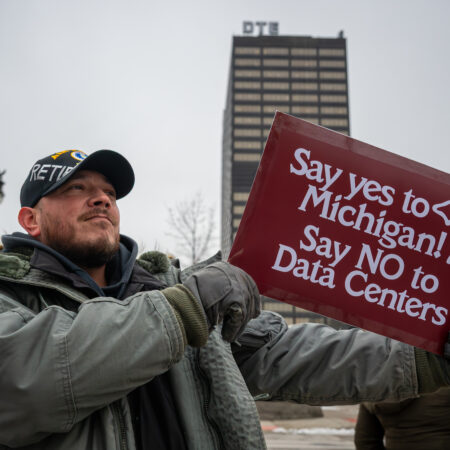
A small group of protesters gathered Wednesday afternoon across the street from DTE Energy’s Detroit headquarters. They were unhappy that DTE has tried to push plans for the data center through without public hearing.
Sarah Brabbs is from York Township, next to Saline. While she is not totally opposed to a data center, she said she’s not a fan of DTE trying to push the project through without allowing the public in on the process.
“Putting rate payers in a situation that you know we will be paying for, probably on multiple levels, is disingenuous, dysfunctional, and unacceptable,” Brabbs said.
Others at the protest said they’re concerned about the potential environmental impact, like how much water the facility could use and the amount of energy it would need to function.
“The access to the Great Lakes, they’re definitely taking advantage of whatever God-given resource in order to just implement whatever quantum, whatever new level of science and technology that they haven’t got consent from the people on if they even want it in the first place,” said Elijah Williams.
Michigan Public Service Commissioners Katherine Peretick, Daniel Scripps, and Shaquila Myers listen to public comments about a proposed data center near Saline, Michigan on Wednesday, December 3.
A virtual hearing Wednesday evening drew almost 90 participants. About 45 people spoke over the two and a half hours, with more in queue when the meeting ended at 9 p.m.
Appealing to Michigan’s workforce
A few speakers voiced support for the project. Most of the supporters represented trade unions or business associations who supported the project for creating jobs.
Randall Whitaker is the president of the Washtenaw County Skilled Building Trades Council. He said the project was an investment in Michigan’s workforce.
“A project like this is huge for workers,” he said.
Constructing the data center would create about 2,500 union jobs, according to DTE’s application. Other supporters argued that the facility would generate millions in tax revenue and attract talent to Michigan.
Burdening the electric grid?
DTE has said it expects the facility to increase its current peak electrical load by about 25%, but building out the capacity to accommodate that demand would not affect current ratepayers. DTE argues in its application that the data center won’t impact existing customers’ rates because of safeguards they’ve placed in the contracts with Oracle.
“The project strengthens Michigan’s long-term competitiveness in the fast-growing AI and advanced computing sectors, helping ensure our state remains a destination for innovation and talent,” Gov. Gretchen Whitmer said in a statement supporting the project.
But most participants opposed DTE’s request, citing the same concerns as the protesters – future electricity costs, how much water the facility would use, and whether the data center would actually benefit the local community.
A lack of transparency
Nichole Biber is a member of the Little Traverse Band of Odawa Indians, one of the 12 federally recognized tribes in Michigan. She said she doesn’t trust DTE or Oracle to do what’s best for residents.
“These ‘meaningful guardrails,’ from what I’ve heard so far, are all on the assurances of DTE and the multibillion dollar corporations that are pushing AI and data centers on us,” she said. “That does not reassure me.”
DTE’s application, which includes the contracts with Oracle, is partially redacted.
Maggie Kaercher, who runs a small fish farm in Dexter and also attended the hearing, said she wants the commission to deny DTE’s request and have the application available for a more thorough review.
“You can’t pretend that there’s transparency when there is so much redacted out of the papers that we’ve been able to see,” she said.
“What we are asking, and what many other people are asking for as well, is that the Commission give DTE’s proposal the proper scrutiny and ensure transparency,” said Katie Duckworth, an attorney with the Environmental Law and Policy Center. “Because this is the largest data center to be proposed in Michigan, and it’s one of the largest in the nation.”
Renewable energy or more fossil fuels?
Duckworth said the organization is concerned with how the data center’s power load will impact DTE’s ability to comply with Michigan’s climate change plans.
“It would also significantly increase the company’s renewable energy obligation under Michigan’s clean energy laws,” she said.
DTE is prepared for that challenge, the company said.
“Bringing on a data center of this size means more renewables, and more battery storage,” DTE said in a statement. The company also said the data center’s operators will finance the energy generation and storage needed to run the facility.
Duckworth said that solution would be “transformational” for DTE’s grid – if it happens.
“It raises a lot of questions including as to how those batteries would be charged and whether they will be charged by renewable energy, or whether it would involve prolonging the life of polluting fossil fuel plants or even building additional fossil fuel plants in the future,” she said.
Oracle expects the facility to open in December 2026. It won’t reach its maximum capacity of 1.4 gigawatts until December 2027, according to DTE’s application to the commission.
In October, DTE asked the commission to issue a decision by Friday, December 5. The commission is meeting at 1 p.m. that day.
At the virtual hearing, commissioners encouraged members of the public to attend a hearing on December 18 about the facility’s wetland impact permit, hosted by the state Department of Environment, Great Lakes, and Energy.
This story was initially published on Michigan Public Radio’s site and was produced in partnership with WDET.DTE is among WDET’s sponsors.
Trusted, accurate, up-to-date.
WDET strives to make our journalism accessible to everyone. As a public media institution, we maintain our journalistic integrity through independent support from readers like you. If you value WDET as your source of news, music and conversation, please make a gift today.
The head of Macomb County’s government says the economic uncertainty felt in some sections of Michigan has yet to truly impact his area.
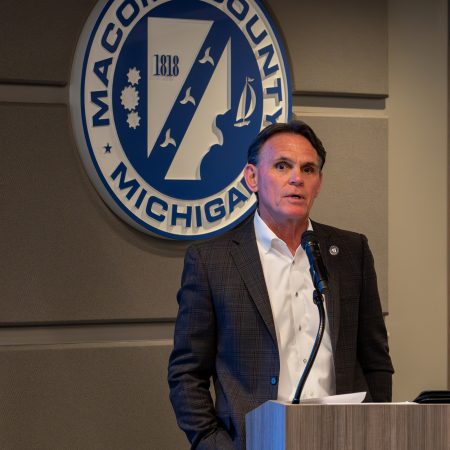
County Executive Mark Hackel summed up the situation in his annual State of Macomb County speech.
Hackel says the county is not just weathering the ebbs and flows of the overall U.S. economy but thriving in the midst of them.
Listen: Macomb executive says county thrives despite economic uncertainty
The following interview has been edited for length and clarity.
Mark Hackel: With our financial situation, our economic foundation, we’re in a great place. I know the things that you’re hearing across the country are challenging. But there’s so many things that kind of help lift us up. We’re pretty diverse too, though we rely heavily upon the automotive and defense industries and manufacturing. But the reality is Macomb is in a very sound place.
Quinn Klinefelter, WDET News: President Trump’s tariffs have impacted various segments of the U.S. economy, including the auto sector, which does have a pretty significant presence in Macomb County. Some of the prices for vehicles are starting to climb now. Do you have any concerns about how tariffs or the overall economic outlook are going to impact jobs or other parts of Macomb County’s economy?
MH: We’re always concerned about what happens at the federal and or state level that may have an impact on our economy. But look at what happened in 2010. There was a huge challenge with manufacturing, job losses, housing shortages that we faced back then. And we doubled down on manufacturing. By doing so, we’ve seen our economy continue to grow here.
Macomb County is a $54.2 billion economy. That’s bigger than the states of Vermont and Wyoming. We are right now at an all-time high. There’s never been a better time in Macomb County with our economy being as robust as it is right now. So whatever might happen with some of these tariffs or other economic concerns, we’re not seeing it directly have an impact right now. We’re in a good place with that.
QK: There is some financial stress in other parts of the country, other parts of Michigan, other parts of metro Detroit, for that matter. In your view, why is Macomb County doing well when some of these other places are having a bit of a struggle?
MH: We decided to double down on manufacturing. We retooled some of our manufacturing facilities. They’re different than they once were. We upgraded them. We really put a full-court press on making sure people understood that with our workforce, from concept to consumer, no one does it better than right here in southeast Michigan. And Macomb County is a major part of that. We are the defense capital of the Midwest. More contracts are awarded to Macomb County, as far as the actual number and the money associated with them, than anywhere else in the entire Midwest. So we keep promoting that, we keep pushing that.
And I think all the attention that we’ve been trying to drive has really helped us. We used a protecting growth strategy when we first got in and worked with the state on that. And we’ve done so well that we’re not really as worried about protecting anymore because we’re seeing that continuous growth. So we’re fortunate. Working with everybody has really had an impact on where we’re at today.
QK: In last year’s State of the County speech, you said that Macomb needed to focus on partnerships instead of partisanship. There was a line about not reaching across the aisle but getting in the aisle. How’s that bipartisan effort been going for you?
MH: Aside from a certain election here or there, for the most part, partisanship is not our conversation. None of that drives what we do here in Macomb County. People are willing to work with each other. You’ve heard that phrase, “Us versus everybody.” Some sports teams use it sometimes, municipalities or communities use it, as a sense of pride, a sense of esprit de corps. But when I look back on 15 years of how Macomb County has got to where it’s at and how we’ve evolved, we’ve kind of flipped the narrative on that. We look at it as, “Macomb with everybody.”
We’re trying to partner at the local, state and federal level. And never do we look at it as, “We can’t talk to them because they’re Democrats or Republicans. We can’t let their idea soak through or let them get successful because their party may get credit for it.” We don’t talk about that, don’t think about it. It’s a call for everybody who wants to come to be part of the solution. And if somebody looks more like they’re wanting to be part of the problem or be just a naysayer, we accept that. But the reality is we continue to forge ahead with people that want to provide solutions and help us get to where we need to go.
QK: When you talk about bipartisan cooperation, there are elections next year that could be pretty significant on a number of fronts. Michigan U.S. Rep. John James, for one, is running for governor and leaving a seat open that represents part of Macomb County. And there is a gubernatorial race underway. Whoever ultimately wins, what would you like to see from Lansing that you think could really affect Macomb County?
MH: That same willingness to partner and work with us rather than figure out how they could get credit by giving support to one particular area or segment of the state as opposed to somewhere else. Ensuring they are not ignoring any community within the state of Michigan. Specifically for Macomb County, whoever the governor is needs to realize they’re not the governor on behalf of the party, they’re the governor on behalf of the people. So govern on behalf of the people. That’s all I ask from whoever the next governor is. Work together on projects that matter, whether it’s in Macomb County, southeast Michigan or beyond.
QK: In terms of the partnerships that you’ve had, are there specific projects that you would like to see either the state or the federal government partner with Macomb on? Or projects that you’re pleased that they have partnered with you on to date?
MH: I’ll go with the ones I’m pleased that they have done to date. We got some support from the state because they realized the importance of our new jail project. It isn’t just about a jail. It’s about dealing with people that are going to be assessed for mental health or substance abuse when they’re brought in at the first point of contact. Every municipality now is partnered-in on this particular facility. We make a determination whether there’s any substance abuse, then decide what we need to do. The state partnered with us with some financial contributions because it impacts the state prison system too. When people are leaving our facility and sentenced on a felony, they’re going to the state facility. We look at what happened with Mound Road, a quarter of a billion dollar project. We got some state funding to help support that as well as federal and local. And then look what happened with Selfridge Air National Guard Base and us pushing the defense industry here in Macomb County. We are the defense capital of Midwest. And I do declare that at some point in time we’re going to be the defense capital of America.
There’s so much happening and we’re so excited about that. But there’s more to be done. We’re partnering on trying to figure out how we retool a facility or find a new use for the Romeo Ford engine plant. We’re looking at the Romeo airport. There’s a lot more that we need to do with our water quality. The support we get from Candice Miller and her team at Public Works. I’m telling you, there’s another trusted voice and a fierce advocate for cleaning our waterways and making sure we’re addressing underground issues. So, a lot has been happening. We’re going to continue those conversations and hopefully wherever the next governor is, they’re willing to address the issues that we’re talking about as opposed to politics.
The whole issue of where we’re headed as a region and even as a state is incredibly important. The biggest thing is that we all need to come together because we need to be competitive with other regions around the globe. And southeast Michigan is a major player. But our biggest challenge right now is our workforce, making sure that we’re attracting people to this area so they take on these jobs. That provides better opportunities for these manufacturers or companies that do the things that they do here in southeast Michigan. Us all coming together to promote the region as one.
Trusted, accurate, up-to-date.
WDET strives to make our journalism accessible to everyone. As a public media institution, we maintain our journalistic integrity through independent support from readers like you. If you value WDET as your source of news, music and conversation, please make a gift today.
The Michigan Department of Health and Human Services says there are now over 1,000 registered doulas in Michigan.
Dawn Shanafelt is the Director of the Division of Maternal & Infant Health for MDHHS. She says that’s twice the number of doulas the state department hoped to register by 2028.
“Numerous doula trainings were approved by MDHHS and the Doula Advisory Council, as well as the cost for taking those trainings and the time it takes to attend the trainings was also reimbursed through the Doula Initiative,” she says.
Doulas are non-medical trained birthing assistants.
Shanafelt says birth doulas provide benefits for expectant moms and babies, from reduced birth complications and medical interventions to postpartum care, especially if the care is provided early in the pregnancy.
“Improved mental health, reduced incidences of postpartum mood and anxiety disorder, and then really importantly, overall a satisfying birth experience in labor, birth and postpartum experience,” she says.
People can choose a birthing assistant doula based on county or specialty through the Doula Registry, which has 700 Medicaid-enrolled doulas.
MDHHS says the state also hopes to improve birthing outcomes for Black and Indigenous families, who have higher mortality and morbidity rates compared to other populations.
She says the state is hoping to increase the number of doulas in special populations that could benefit from a birthing assistant, including Black, Indigenous, and immigrant populations.
MDHHS says in fiscal year 2026, they will provide, “one Spanish-language training, one Arabic-language training and one Indigenous doula training,” and take on others upon request to The Doula Initiative team.
Beginning in December, MDHHS will also expand identity options to include Indigenous doulas.
“Culturally competent health care allows doulas to most effectively meet social, cultural and linguistic needs, and culturally congruent care improves health outcomes and helps reduce racial and ethnic health disparities,” says Shanafelt.
Currently, there are 60 Spanish-speaking doulas and 14 Arabic-speaking doulas listed on the registry.
Trusted, accurate, up-to-date.
WDET strives to make our journalism accessible to everyone. As a public media institution, we maintain our journalistic integrity through independent support from readers like you. If you value WDET as your source of news, music and conversation, please make a gift today.
WASHINGTON (AP) — The Trump administration has renamed the U.S. Institute of Peace after President Donald Trump and has planted the president’s name on the organization’s headquarters despite an ongoing fight over the institute’s control.
It’s the latest twist in a seesaw court battle over who controls the U.S. Institute of Peace, a nonprofit think tank that focuses on peace initiatives. It was an early target of the Department of Government Efficiency this year.
On Wednesday, the State Department said it renamed the organization to the Donald J. Trump Institute of Peace to “reflect the greatest dealmaker in our nation’s history.” The new name could be seen on its building, which is near the State Department.
The takeover of the Peace Institute was also anything but peaceful, with his administration seizing the independent entity and ousting its board before actually affixing his name to the building.
Anna Kelly, a White House spokesperson, said: “The United States Institute of Peace was once a bloated, useless entity that blew $50 million per year while delivering no peace. Now, the Donald J. Trump Institute of Peace, which is both beautifully and aptly named after a President who ended eight wars in less than a year, will stand as a powerful reminder of what strong leadership can accomplish for global stability.”
She added, “Congratulations, world!”
George Foote, a lawyer for the former Institute leadership and staff, said the renaming “adds insult to injury.”
“A federal judge has already ruled that the government’s armed takeover was illegal. That judgment is stayed while the government appeals, which is the only reason the government continues to control the building,” Foote said.
Since March, the headquarters has switched hands multiple times in court actions related to the DOGE takeover. A final decision on its fate is pending in federal appeals court.
USIP has maintained the organization is an independent creation of Congress and outside the president’s executive authority. The administration argues it is an executive branch organization.
After Trump fired the institute’s board in the the spring, the staff was fired as well and the building was turned over to the General Services Administration.
A federal district court overturned the action in May, putting the headquarters back into the hands of USIP leadership. But that action was reversed weeks later by a federal appeals court.
Employees at this juncture have been fired twice and the building is in GSA’s possession.
The building is expected to be the backdrop for the signing of a peace agreement Thursday between Congo’s President Felix Tshisekedi and Rwanda’s President Paul Kagame. High-ranking officials from the African Union, Angola, Burundi, Kenya, Togo, Qatar, Uganda and the United Arab Emirates are also expected to attend the signing, according to Yolande Makolo, a senior adviser to Kagame.
The USIP website remained unchanged Wednesday night, but its lead item was headlined, “President Donald J. Trump to Sign Historic Peace Agreement at USIP Headquarters,” followed by a write-up of the deal between Congo and Rwanda that Trump was overseeing at the institute on Thursday.
The Institute of Peace was created by Congress in the 1980s. President Ronald Reagan signed the bill into law in 1985. Described as an independent, nonprofit think tank funded by Congress, its mission has been to work to promote peace and prevent and end conflicts while working outside normal channels such as the State Department. It was operating in 26 conflict zones, including Pakistan, Afghanistan, Mali and Burkina Faso, when DOGE shut the operation down.
There is also broad speculation that Trump will be awarded a new peace prize from FIFA on the sidelines of the World Cup draw, happening in Washington on Friday.
Associated Press writers Aamer Madhani and Will Weissert contributed to this report.
President Donald Trump’s name is seen on the United State Institute of Peace building, Wednesday, Dec. 3, 2025 in Washington. (AP Photo/Matthew Lee)
WASHINGTON (AP) — Nvidia CEO Jensen Huang met separately with President Donald Trump and Republican senators Wednesday as tech executives work to secure favorable federal policies for the artificial intelligence industry, including the limited sale of Nvidia’s highly valued computer chips to U.S. rivals like China.
Huang’s closed-door meeting with Republicans on the Senate Banking Committee came at a moment of intensifying lobbying, soaring investments and audacious forecasts by major tech companies about AI’s potential transformative effects.
Huang is among the Silicon Valley executives who warn that any restrictions on the technology will halt its advancement despite mounting concerns among policymakers and the public about AI’s potential pitfalls or the ways foreign rivals like China may use American hardware.
“I’ve said repeatedly that we support export control, that we should ensure that American companies have the best and the most and first,” Huang told reporters before his meeting at the Capitol.
He added that he shared concerns about selling AI chips to China but believed that restrictions haven’t slowed Chinese advancement in the AI race.
“We need to be able to compete around the world. The one thing we can’t do is we can’t degrade the chips that we sell to China. They won’t accept that. There’s a reason why they wouldn’t accept that, and so we should offer the most competitive chips we can to the Chinese market,” Huang said.
Huang also said he’d met with Trump earlier Wednesday and discussed export controls for Nvidia’s chips. Huang added that he wished the president “a happy holidays.”
The Trump administration in May reversed Biden-era restrictions that had prevented Nvidia and other chipmakers from exporting their chips to a wide range of countries. The White House in August also announced an unusual deal that would allow Nvidia and another U.S. chipmaker, Advanced Micro Devices, to sell their chips in the Chinese market but would require the U.S. government to take a 15% cut of the sales.
The deal divided lawmakers on Capitol Hill, where there is broad support for controls on AI exports.
A growing battle in Congress
Members of Congress have generally considered the sale of high-end AI chips to China to be a national security risk. China is the main competitor to the U.S. in the race to develop artificial superintelligence. Lawmakers have also proposed a flurry of bills this year to regulate AI’s impact on dozens of industries, though none have become law.
Most Republican senators who attended the meeting with Huang declined to discuss their conversations. But a handful described the meeting as positive and productive.
“For me, this is a very healthy discussion to have,” said Sen. Mike Rounds, a South Dakota Republican. Rounds said lawmakers had a “general discussion” with Huang about the state of AI and said senators were still open to a wide range of policies.
Asked whether he believed Nvidia’s interests and goals were fully aligned with U.S. national security, Rounds replied: “They currently do not sell chips in China. And they understand that they’re an American company. They want to be able to compete around the rest of the world. They’d love to some time be able to compete in China again, but they recognize that export controls are important as well for our own national security.”
Other Republicans were more skeptical of Huang’s message.
Sen. John Kennedy, a Louisiana Republican who sits on the upper chamber’s Banking Committee, said he skipped the meeting entirely.
“I don’t consider him to be an objective, credible source about whether we should be selling chips to China,” Kennedy told reporters. “He’s got more money than the Father, the Son and the Holy Ghost, and he wants even more. I don’t blame you for that, but if I’m looking for someone to give me objective advice about whether we should make our technology available to China, he’s not it.”
Some Democrats, shut out from the meeting altogether, expressed frustration at Huang’s presence on Capitol Hill.
“Evidently, he wants to go lobby Republicans in secret rather than explain himself,” said Massachusetts Sen. Elizabeth Warren, the top Democrat on the Senate Banking Committee.
Warren added that she wanted Huang to testify in a public congressional hearing and answer “questions about why his company wants to favor Chinese manufacturers over American companies that need access to those high-quality chips.”
Nvidia CEO Jensen Huang listens as President Donald Trump speaks during the Saudi Investment Forum at the Kennedy Center, Wednesday, Nov. 19, 2025, in Washington. (AP Photo/Evan Vucci)
IRBIL, Iraq (AP) — The United States inaugurated a massive new consulate compound Wednesday in Irbil, the capital of northern Iraq’s semiautonomous Kurdish region.
The move highlighted Washington’s diplomatic and strategic engagement in the Kurdish region, particularly as the U.S. moves troops that had been stationed elsewhere in Iraq as part of a mission against the Islamic State group, under an agreement with the central government in Baghdad.
U.S. Deputy Secretary of State Michael Rigas joined Kurdish leaders for the inauguration of the sprawling complex — planned as the largest U.S. consulate in the world — built on a 206,000-square-meter (50-acre) site along the Irbil–Shaqlawa highway at a cost of $796 million.
“America’s investment in this new consulate provides a secure platform to advance the interests of the United States,” Rigas said. “It demonstrates the value that a sovereign, secure and prosperous Iraq, in mutually beneficial partnership with the United States can deliver for its own people and for America.”
The opening comes amid ongoing challenges in Iraq, including regional tensions and attacks on energy infrastructure. A drone strike last week on the Kormor natural gas field caused widespread power outages.
No group has claimed responsibility for the attack, but Rigas appeared to cast blame on Iraq’s politically powerful Iran-backed militias.
He urged both Baghdad and Irbil to “disempower and dismantle Iran-aligned militias that continue to engage in violent and destabilizing activities and only serve to harm Iraqi sovereignty.”
Kurdish regional President Nechirvan Barzani referred to the consulate as a “clear political message regarding the importance of Irbil and the Kurdistan region.”
He said the facility underscores the deep partnership between the U.S. and the Kurdish authorities and will serve as a hub for diplomatic, economic and security cooperation.
WASHINGTON (AP) — A dozen prior leaders of the U.S. Food and Drug Administration — appointed by Republicans and Democrats alike — issued a scathing denunciation of new FDA assertions casting doubt on vaccine safety.
The former officials say the agency’s plans to revamp how life-saving vaccines for flu, COVID-19 and other respiratory diseases are handled — outlined in an internal FDA memo last week — would “disadvantage the people the FDA exists to protect, including millions of Americans at high risk from serious infections.”
“The proposed new directives are not small adjustments or coherent policy updates. They represent a major shift in the FDA’s understanding of its job,” the officials, former FDA commissioners and acting commissioners, wrote Wednesday in the New England Journal of Medicine.
The internal memo by FDA vaccine chief Dr. Vinay Prasad hasn’t been publicly released but a source familiar with the document confirmed its authenticity. The document claimed — without providing evidence — that COVID-19 vaccines caused 10 children’s deaths. It went on to outline planned agency changes in handling those and certain other vaccines, and said that FDA staff who disagreed should resign.
FILE – In this undated photo provided by the U.S. Food and Drug Administration, Vinay Prasad smiles for a portrait. (U.S. FDA via AP)
Among Prasad’s plans were revising how yearly flu shot updates are handled and focusing more on “the benefits and harms of giving multiple vaccines at the same time.” A common message of vaccine skeptics is that too many shots may overwhelm kids’ immune systems or that ingredients may build up to cause harm — although scientists say repeated research into those claims has turned up no concerns.
On Wednesday, the former FDA leaders wrote that Prasad’s claim about child deaths related to COVID-19 vaccines had been reported to a surveillance system that doesn’t contain medical records or other information sufficient to prove a link — and that government scientists had carefully combed through those reports in previous years, reaching different conclusions. They also noted that “substantial evidence” shows COVID-19 vaccines reduce children’s risk of severe disease and hospitalization.
But the bigger picture, the former FDA leaders argued, is that the new proposals would reject long-standing science about how to evaluate vaccines being updated to better match virus strains, slow innovation to replace older vaccines with newer, potentially better ones, and make the process less transparent to the public.
An administration spokesman didn’t immediately comment.
Many doctors and public health experts also have expressed alarm about the memo.
“Vaccines save lives, period,” Dr. Ronald Nahass, president of the Infectious Diseases Society of America, said in a statement. “It is a sad day when FDA creates confusion and mistrust without supplying evidence, spreading propaganda that makes lifesaving vaccines harder to access and that creates additional confusion and mistrust for the public.”
The FDA’s planned vaccine changes come at a time when Health Secretary Robert F. Kennedy Jr. — who helped lead the anti-vaccine movement for years — is seeking to broadly remake federal policies on vaccines.
FILE – Health and Human Services Secretary Robert F. Kennedy Jr. speaks during a news conference at the Hubert Humphrey Building Auditorium in Washington, April 22, 2025. (AP Photo/Jose Luis Magana, file)
Kennedy already ousted a committee that advised the Centers for Disease Control and Prevention on vaccine recommendation and replaced it with handpicked members. And in August, he fired Susan Monarez 29 days into her tenure as CDC chief over vaccine policy disagreements. The CDC’s vaccine advisory committee will meet Thursday and Friday to discuss h epatitis B vaccinations in newborns and other vaccine topics.
Ungar reported from Louisville, Kentucky. Associated Press writer Ali Swenson contributed to this report.
The Associated Press Health and Science Department receives support from the Howard Hughes Medical Institute’s Department of Science Education and the Robert Wood Johnson Foundation. The AP is solely responsible for all content.
FILE – The Food and Drug Administration seal is seen at the Hubert Humphrey Building Auditorium in Washington, April 22, 2025. (AP Photo/Jose Luis Magana, File)
NEW YORK (AP) — One of Jeffrey Epstein and Ghislaine Maxwell ‘s most vocal accusers urged judges on Wednesday to grant the Justice Department’s request to unseal records from their federal sex trafficking cases, saying “only transparency is likely to lead to justice.”
Annie Farmer weighed in through her lawyer, Sigrid S. McCawley, after the judges asked for input from victims before ruling on whether the records should be made public under a new law requiring the government to open its files on the late financier and his longtime confidante, who sexually abused young women and girls for decades.
Farmer and other victims fought for the passage of the law, known as the Epstein Files Transparency Act. Signed last month by President Donald Trump, it compels the Justice Department, FBI and federal prosecutors to release by Dec. 19 the vast troves of material they’ve amassed during investigations into Epstein.
The Justice Department last week asked Manhattan federal Judges Richard M. Berman and Paul A. Engelmayer to lift secrecy orders on grand jury transcripts and other material from Epstein’s 2019 sex trafficking case and a wide range of records from Maxwell’s 2021 case, including search warrants, financial records and notes from interviews with victims.
“Nothing in these proceedings should stand in the way of their victory or provide a backdoor avenue to continue to cover up history’s most notorious sex-trafficking operation,” McCawley wrote in a letter to the judges.
The attorney was critical of the government for failing to prosecute anyone else in Epstein and Maxwell’s orbit.
She asked the judges to ensure that the orders they issue do not preclude the Justice Department from releasing other Epstein-related materials, adding that Farmer “is wary” that any denial could be used “as a pretext or excuse” to withhold information.
Epstein, a millionaire money manager known for socializing with celebrities, politicians, billionaires and the academic elite, killed himself in jail a month after his 2019 arrest.
Maxwell was convicted in 2021 by a federal jury of sex trafficking for helping recruit some of Epstein’s underage victims and participating in some of the abuse. She is serving a 20-year prison sentence.
In a court filing Wednesday, Maxwell’s lawyer again said that she is preparing a habeas petition in a bid to overturn her conviction. The lawyer, David Markus, first mentioned the habeas petition in court papers in August as she fought the Justice Department’s initial bid to have her case records unsealed. The Supreme Court in October declined to hear Maxwell’s appeal.
Markus said in Wednesday’s filing that while Maxwell now “does not take a position” in the wake of the transparency act’s passage, doing so “would create undue prejudice so severe that it would foreclose the possibility of a fair retrial” if her habeas petition succeeds.
The records, Markus said, “contain untested and unproven allegations.”
Engelmayer, who’s weighing whether to release records from Maxwell’s case, gave her and victims until Wednesday to respond to the Justice Department’s unsealing request. The government must respond to their filings by Dec. 10. The judge said he will rule “promptly thereafter.”
Berman, who presided over the Epstein case, ordered victims and Epstein’s estate to respond by Wednesday and gave the government until Dec. 8 to reply to those submissions. Berman said he would make his “best efforts to resolve this motion promptly.”
Lawyers for Epstein’s estate said in a letter to Berman on Wednesday that the estate takes no position on the Justice Department’s unsealing request. The lawyers noted that the government had committed to making appropriate redactions of personal identifying information for victims.
Last week, a lawyer for some victims complained that the House Oversight Committee had failed to redact, or black out, some of their names from tens of thousands pages of Epstein-related documents it has released in recent months.
Transparency “CANNOT come at the expense of the privacy, safety, and protection of sexual abuse and sex trafficking victims, especially these survivors who have already suffered repeatedly,” lawyer Brad Edwards wrote.
FILE – In this July 30, 2008, file photo, Jeffrey Epstein, center, appears in court in West Palm Beach, Fla. (Uma Sanghvi/The Palm Beach Post via AP, File)
The newly released material includes dozens of short videos and still photographs of the compound, including one showing a particularly bizarre room filled with an old-fashioned dental chair, Ikea-style metal cabinets and nearly a dozen caricature-like male face masks arranged irregularly on its walls.
An image released by House Democrats showing a bedroom at Jeffrey Epstein’s private Caribbean island estate. (Attorney General of the United States Virgin Islands)
Other images show a desktop computer displaying surveillance footage of the property; a bedroom in the compound; a shower room with several pillows; a room with a chalkboard with the words “power” and “deception” written on it; and a desk telephone with four names that appear to have been redacted.
An image released by House Democrats showing a bedroom at Jeffrey Epstein’s private Caribbean island estate. (Attorney General of the United States Virgin Islands)
Members of the Oversight Committee received the images in response to a Nov. 18 request to the U.S. Virgin Islands Department of Justice for information to aid the ongoing investigation into the disgraced financier, who died by suicide in his Manhattan jail cell in August 2019 while awaiting trial on federal sex trafficking charges.
“We are releasing these photos and videos to ensure public transparency in our investigation and to help piece together the full picture of Epstein’s horrific crimes,” said Rep. Robert Garcia, the top Democrat in the committee.
The images offer a “harrowing look behind Epstein’s closed doors,” Oversight Democrats said on social media, inviting the public to “see for yourself.”
An image released by House Democrats showing a bathroom at Jeffrey Epstein’s private Caribbean island estate. (Attorney General of the United States Virgin Islands)
The committee also received records from J.P. Morgan and Deutsche Bank, lawmakers said, adding that those files will be reviewed and should be made available to the public “in the days ahead.”
“We won’t stop fighting until we deliver justice for the survivors,” Garcia said. “It’s time for President Trump to release all the files, now.”
An image released by House Democrats showing words on a chalkboard, some redacted by the House Democrats, in a room apparently being used as a library at Jeffrey Epstein’s private Caribbean island estate. (Attorney General of the United States Virgin Islands)
Last month, in a stunning show of bipartisanship, Democrats and Republicans in both chambers voted overwhelmingly in favor of a bill to force the Justice Department to release all of its unclassified files on Jeffrey Epstein within 30 days.
Trump signed the bill on Nov. 19, but it remains unclear how much of the files will be released to the public, as the Justice Department can withhold or redact certain information under the law’s provisions.
An image released by House Democrats showing a dental suite, with masks of men’s faces on the walls, at Jeffrey Epstein’s private Caribbean island estate. (Attorney General of the United States Virgin Islands)
WASHINGTON (AP) — The Pentagon knew there were survivors after a September attack on an alleged drug boat in the Caribbean Sea and the U.S. military still carried out a follow-up strike, according to two people familiar with the matter.
The rationale for the second strike was that it was needed to sink the vessel, according to the people familiar with the matter who spoke on the condition of anonymity because they weren’t authorized to discuss it publicly. The Trump administration says all 11 people aboard were killed.
What remains unclear was who ordered the strikes and whether Defense Secretary Pete Hegseth was involved, one of the people said. That will be part of a classified congressional briefing Thursday with the commander that the Trump administration says ordered the second strike, Adm. Frank “Mitch” Bradley.
Hegseth has defended the second strike as emerging in the “fog of war,” saying he didn’t see any survivors but also “didn’t stick around” for the rest of the mission.
Hegseth is under growing scrutiny over the military strikes on alleged drug traffickers in the Caribbean and eastern Pacific. Legal experts and some lawmakers say a strike that killed survivors would have violated the laws of armed conflict.
Defense Secretary Pete Hegseth listens as President Donald Trump speaks during a Cabinet meeting at the White House, Tuesday, Dec. 2, 2025, in Washington. (AP Photo/Julia Demaree Nikhinson)
WASHINGTON (AP) — President Donald Trump’s decision to build a big ballroom where the East Wing once stood has significantly altered the visitor experience at the White House. Tourists enter through a different door now, and the tour is shorter because there are fewer historic rooms to see.
Tours resumed Tuesday after being suspended in September because of the ballroom construction, including October’s leveling of the East Wing.
“I’m glad they started it up again,” Kevin Heins, of Myrtle Beach, South Carolina, said about the tours. He and his wife visited the White House, and he said a highlight of the tour was the Red Room, which has been decorated with more than 10,000 blue butterflies.
A symbol of transformation, the butterflies celebrate young people the first lady tries to help through Fostering the Future, which is part of the Be Best child-centered initiative she launched during the first Trump administration.
Susan Bare, of Kannapolis, North Carolina, also liked the butterflies because they remind her of her late son, who planted a butterfly bush before a car accident took his life.
“My Christmas tree has butterflies on it,” Bare said.
Other visitors commented on how quickly they were able to finish the tour, which has been limited to just the State Floor, which includes the East Room; the Green, Blue and Red Rooms; the State Dining Room; the Cross Hall; and the Grand Foyer.
“The tour was significantly longer last year,” said Amiah Henry, a student at Sulphur High School in Sulphur, Louisiana. “It got cut down a lot.”
A woman holds a brochure following a White House tour, Wednesday, Dec. 3, 2025, in Washington, as tours resume for the first time since construction of a new ballroom began at the White House. (AP Photo/Julia Demaree Nikhinson)
People exit through a newly constructed covered walkway on the North Lawn following a White House tour, Wednesday, Dec. 3, 2025, in Washington, as tours resume for the first time since construction of a new ballroom began at the White House. (AP Photo/Julia Demaree Nikhinson)
People take a selfie as they wait in line for a White House tour, Wednesday, Dec. 3, 2025, in Washington, as tours resume for the first time since construction of a new ballroom began at the White House. (AP Photo/Julia Demaree Nikhinson)
1 of 3
A woman holds a brochure following a White House tour, Wednesday, Dec. 3, 2025, in Washington, as tours resume for the first time since construction of a new ballroom began at the White House. (AP Photo/Julia Demaree Nikhinson)
Rooms one level below on the ground floor, such as the China and Vermeil Rooms, are now off-limits to the public because of the construction. Additionally, some staff displaced by the loss of the East Wing are using some of those spaces as temporary offices.
“It’s definitely a big change. There was a lot of, like, beauty in the East Wing, and that was my favorite part of the tour,” said Henry, who spoke as noise from the construction could be heard in the distance. “I’m sad I didn’t get to see it today, but, you know, what can I do?”
Heins, who is retired after a career in law enforcement and the military, said the ballroom construction would ultimately add value to the White House.
“The tour was a little bit shorter, but I think in the long run, with the extension of the ballroom, I think it’s going to be a good thing because you won’t have to wait outside in tents for events and all that,” Heins said. “I just think that, with our country, we should have something nice to host events at the White House.”
People walk through a newly constructed covered walkway on the North Lawn while arriving for a White House tour, Tuesday, Dec. 2, 2025, in Washington, as tours resume for the first time since construction of a new ballroom began at the White House. (AP Photo/Julia Demaree Nikhinson)
Four Republican states have agreed to help the Trump administration gain access to state driver’s license data through a nationwide law enforcement computer network as part of the administration’s hunt for alleged noncitizen voters.
The Trump administration said as recently as October that federal officials wanted to obtain driver’s license records through the network.
The commitment from officials in Florida, Indiana, Iowa and Ohio comes as part of a settlement agreement filed on Friday in a federal lawsuit. The lawsuit was originally brought by the states last year alleging the Biden administration wasn’t doing enough to help states verify voter eligibility.
The settlement, between the states and the U.S. Department of Homeland Security, requires the federal department to continue its development of a powerful citizenship verification program known as SAVE. Earlier this year, federal officials repurposed SAVE into a program capable of scanning millions of state voter records for instances of noncitizen registered voters.
In return, the states have agreed to support Homeland Security’s efforts to access the National Law Enforcement Telecommunications System, an obscure computer network that typically allows law enforcement agencies to search driver’s license records across state lines. Nlets — as the system is known — lets police officers easily look up the driving records of out-of-state motorists.
The Trump administration and some Republican election officials have promoted the changes to SAVE as a useful tool to identify potential noncitizen voters, and Indiana had already agreed to provide voter records. Critics, including some Democrats, say the Trump administration is building a massive database of U.S. residents that President Donald Trump or a future president could use for spying or targeting political enemies.
Stateline reported last week, before the settlement agreement was filed in court, that Homeland Security publicly confirmed it wants to connect Nlets to SAVE.
A notice published Oct. 31 in the Federal Register said driver’s licenses are the most widely used form of identification, and that by working with states and national agencies, including Nlets, “SAVE will use driver’s license and state identification card numbers to check and confirm identity information.”
A federal official also previously told a virtual meeting of state election officials in May that Homeland Security was seeking “to avoid having to connect to 50 state databases” and wanted a “simpler solution,” such as Nlets, according to government records published by the transparency group American Oversight.
The new settlement lays out the timeline for how the Trump administration could acquire the four states’ records.
Within 90 days of the execution of the agreement, the four states may provide Homeland Security with 1,000 randomly selected driver’s license records from their state for verification as part of a quality improvement process for SAVE.
According to the agreement, the states that provide the records will “make best efforts to support and encourage DHS’s efforts to receive and have full use of state driver’s license records from the National Law Enforcement Telecommunications System” and state driver’s license agencies.
The language in the agreement is open-ended and doesn’t make clear whether the pledge to help Homeland Security obtain access to Nlets is limited to drivers from those four states or is intended to require the states to help the agency acquire the records of drivers nationwide.
An agreement to help
The agreement could pave the way for Republican officials in other states to provide access to license data.
Nlets is a nonprofit organization that facilitates data sharing among law enforcement agencies across state lines. States decide what information to make available through Nlets, and which agencies can access it. That means the four states could try to influence peers to share Nlets data with the Trump administration.
“They’re not just talking about driver’s license numbers, they’re talking about the driver’s records. What possible reason would DHS have in an election or voting context — or any context whatsoever — for obtaining the ‘full use of state driver’s license records,’” said David Becker, executive director of the nonpartisan Center for Election Innovation & Research.
Iowa Secretary of State Paul Pate, a Republican, said in a statement to Stateline that the settlement agreement provides another layer of election integrity and protection as officials seek to ensure only eligible voters are registered. He didn’t directly address questions about Nlets access.
“The SAVE program provides us with critical information, but we must also continue to utilize information from other state and federal partners to maintain clean and accurate lists,” Pate said in the statement.
Two weeks before the Nov. 5, 2024, election, Pate issued guidance to Iowa county auditors to challenge the ballots of 2,176 registered voters who were identified by the secretary of state’s office as potential noncitizens. The voters had reported to the state Department of Transportation or another government entity that they were not U.S. citizens in the past 12 years and went on to register to vote, according to the guidance.
In March, Pate said his office gained access to the SAVE database and found 277 of those people were confirmed to not have U.S. citizenship — just under 12% of the individuals identified as potential noncitizens.
Homeland Security and the U.S. Department of Justice didn’t immediately respond to requests for comment Monday.
Matthew Tragesser, a spokesperson for U.S. Citizenship and Immigration Services — the agency under Homeland Security that oversees SAVE — told Stateline last week that USCIS was committed to “eliminating barriers to securing the nation’s electoral process.”
“By allowing states to efficiently verify voter eligibility, we are reinforcing the principle that America’s elections are reserved exclusively for American citizens,” Tragesser said in a statement.
The SAVE program — Systematic Alien Verification for Entitlements — was originally intended to help state and local officials verify the immigration status of individual noncitizens seeking government benefits. In the past, SAVE could search only one name at a time. Now it can conduct bulk searches; federal officials in May also connected the program to Social Security data.
“It’s a potentially dangerous mix to put driver’s license and Social Security number and date of birth information out there … where we really don’t know yet how and when and where it’s going to be used,” Minnesota Democratic Secretary of State Steve Simon said in an interview on Monday.
Democratic states object
As the Trump administration has encouraged states to use SAVE, the Justice Department has also demanded states provide the department with unredacted copies of their voter rolls. The Trump administration has previously confirmed the Justice Department is sharing voter information with Homeland Security.
The Justice Department has sued six, mostly Democratic, states for refusing to turn over the data. Those lawsuits remain pending.
On Monday, 12 state secretaries of state submitted a 29-page public comment, in response to SAVE’s Federal Register notice, criticizing the overhaul. The secretaries wrote that while Homeland Security claims the changes make the program an effective tool for verifying voters, the modifications are “likely to degrade, not enhance” states’ efforts to ensure free, fair and secure elections.
“What the modified system will do … is allow the federal government to capture sensitive data on hundreds of millions of voters nationwide and distribute that information as it sees fit,” the secretaries wrote.
The secretaries of state of California, Connecticut, Massachusetts, Maine, Michigan, Minnesota, New Jersey, New Mexico, Oregon, Rhode Island, Vermont and Washington signed on to the comment.
The settlement agreement purports to make this year’s changes to SAVE legally binding.
The agreement asks that a federal court retain jurisdiction over the case for 20 years for the purposes of enforcing it — a move that in theory could make it harder for a future Democratic president to reverse the changes to SAVE.
But Becker, of the Center for Election Innovation & Research, said he doesn’t expect the settlement agreement would make it more difficult for a future administration to undo the overhaul.
“Should a different administration come in that disagrees with this approach,” Becker said, “I would expect that they would almost certainly completely change how the system operates and how the states can access it and what data the federal government procures.”
Iowa Capital Dispatch reporter Robin Opsahl contributed to this report.Stateline reporterJonathan Shormancan be reached atjshorman@stateline.org.
Stateline is part of States Newsroom, a national nonprofit news organization focused on state policy.
Delray Beach police officer, Matt Warne, informs a driver that the road to the beach is only open to residents as Hurricane Dorian continues to make its way toward the Florida coast on Sept. 2, 2019, in Delray Beach, Florida. (Joe Raedle/Getty Images/TNS)
WASHINGTON (AP) — The U.S. imposed sanctions Wednesday on alleged affiliates of the Tren de Aragua gang and increased the reward to as much as $5 million for information leading to the arrest or conviction of one of the leaders of the criminal group that the Trump administration has designated as a foreign terrorist organization.
The actions come as President Donald Trump’s administration has blamed the gang, which originated in a prison in Venezuela, for being at the root of violence and the illegal drug trade in many U.S. cities. Tren de Aragua also has become a key reference point in military attacks against vessels suspected of drug trafficking in the Caribbean Sea and eastern Pacific Ocean as well as Trump’s crackdown on immigration.
Treasury’s Office of Foreign Assets Control levied sanctions Wednesday on Venezuelan entertainer Jimena Romina Araya Navarro, who is known as “Rosita,” on accusations of providing material support to Tren de Aragua by helping the head of the gang, Hector Rusthenford Guerrero Flores, escape from Tocorón prison in Venezuela in 2012.
Navarro, known as Rosita for her character on a Venezuelan comedy show, has been linked to Guerrero for years. Local media previously reported that Araya, also a showgirl, frequently performed in a prison where Guerrero was once held and Tren de Aragua was established.
Tren de Aragua controlled the prison for several years during which a nightclub, swimming pools, a lavish suite and more amenities were added to the facility.
The State Department also increased the reward for Giovanni Vicente Mosquera Serrano, who is the first Tren de Aragua member to appear on the FBI’s Ten Most Wanted List, after he was charged in January with international cocaine trafficking conspiracy. The previous award was up to $3 million.
After the U.S. designated the gang as a foreign terrorist organization in February, Mosquera Serrano was indicted in April on charges of providing material support, according to the State Department.
“Under President Trump, barbaric terrorist cartels can no longer operate with impunity across our borders,” Treasury Secretary Scott Bessent said in a news release. “At the direction of President Trump, we will continue to use every tool to cut off these terrorists from the U.S. and global financial system and keep American citizens safe.
Jorge Rueda in Caracas, Venezuela contributed to this report.
Treasury Secretary Scott Bessent listens as President Donald Trump talks after meeting with New York City Mayor-elect Zohran Mamdani in the Oval Office of the White House, Friday, Nov. 21, 2025, in Washington. (AP Photo/Evan Vucci)

 Login
Login